
OPEN CALL – Global Africa & the CIHA Project – JUNIOR RESEARCHER’S INSTITUTE 27 OCT-2 NOV 2024, GHANA
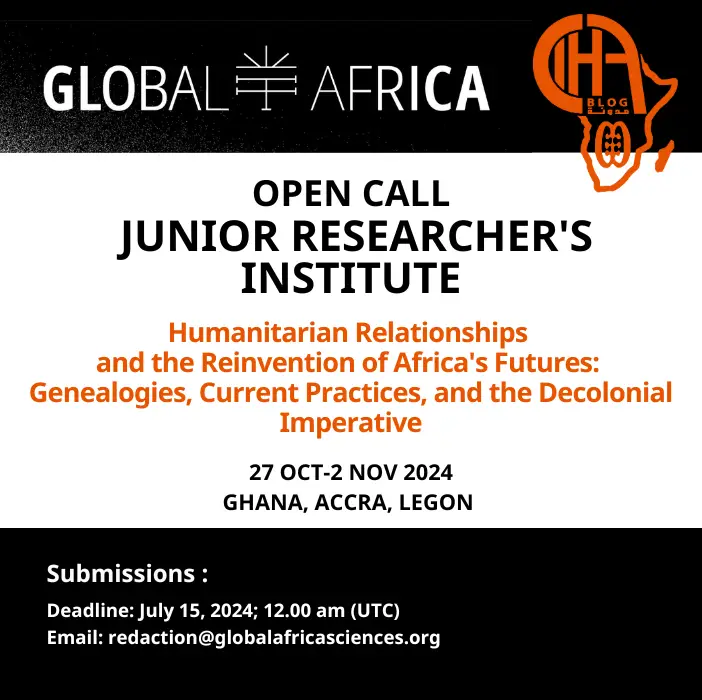
For more than a dozen years, Critical Investigations into Humanitarianism in Africa (CIHA) has produced a blog (www.cihablog.com), run workshops, and shared online courses. All these undertakings have been guided by our mission statement, which is: “to transform the phenomenon of aid to Africa into egalitarian and respectful relationships that challenge unequal power relations, paternalism and victimization. Their research and commentaries lean both on critical voices but also religious one so as to explore the connections that exist between issues of faith, governance, gender, and race in colonial and post-colonial contexts. Using critical thinking and open exchanges, we strive for equality, justice and, ultimately, respect for others’ desires, beliefs and practices” (CIHA Mission Statement). Their research and work with numerous African scholars and NGOs’ representatives, have reinforced our agreement with current calls across the African continent, Europe and beyond, to “decolonize” humanitarianism and aid in general. But what might “decolonization” mean? And how to ensure that decolonization does not reproduce the pitfalls of previous attempts to equalize relations between powerful external aid organizations and African states and societies? To explore these questions, the CIHA Project is holding their next workshop from October 27 to November 2, 2024, in Accra, Ghana, in partnership with the Global Africa program’s Junior Researchers’ Institute. The Global Africa Junior Researchers’ Institute integrates emerging African researchers into social scientific communities, enabling them to play an active part in shaping knowledge production about Africa and the world. In addition to the goals of mentoring and inclusion in scholarly communities, selected works derived from the JRI/CIHA Workshop are going to be eligible for publication in a special issue of Global Africa to be published in December 2025. We invite junior researchers to submit projects in line with the topic and concept note outlined below. Humanitarian Relationships and the Reinvention of Africa’s Futures: Genealogies, Current Practices, and the Decolonial Imperative GLOBAL AFRICA – ISSUE 12, DECEMBER 2025 Practical information: The October 2024 workshop will bring together participants from Africa and its diasporas. Priority will be given to advanced degree students, post-doctoral scholars, and artists/practitioners whose research involve in-depth empirical or conceptual work, and who have shown a capacity to engage critically with their research topics and the concepts highlighted in this Concept Note. The selection of applications will be based on the candidates’ ability to identify and justify their research theme in relation to the theme of this session of the Doctoral School, to explain their problematic and their questions, and to detail the methods they intend to use. In addition to the suggested Review Essays, a particular attention will be given to themes that require fieldwork [that is almost-finished or completed], and to dossiers describing how this fieldwork was or will be] carried out. The dossier must include: Schedule: Receipt of submissions: until July 15, 2024; 12.00 am (UTC) at redaction@globalafricasciences.org Responses to applicants: August 15, 2024 Mentoring : August 20-October 20 2024 Doctoral School : October 27 – November 2, 2024 (arrival in Accra on October 26)
About Global Africa
Global Africa | A scientific journal to revitalize African research. Global Africa is a scientific journal at the core of a capacity-building program for junior researchers, aiming to contribute to the expression, dissemination, and strengthening of research in the social sciences and humanities on the African continent. Program The Global Africa program operates in a context where the African continent represents 13% of the world’s population but contributes less than 3% to scientific publications. Today, while the African researchers elite publish in international journals, the majority still rely on national contexts characterized by local journals and often unappealing university presses. The crisis in higher education in Africa has left the academic community without a viable publishing means or the capacity to produce, promote, and disseminate the results of its researchers at the continental and international levels – an essential condition for amplifying African voices in global debates. In most countries, the allocation of resources between research, teaching, and consultancy activities is skewed against research. This results in multiple and cumulative failures: significant aspects of ongoing political, socio-economic, cultural, and environmental transformations remain unintelligible because they are not conceptualized from within the continent. Teaching practices remain stagnant due to the lack of research. Public policies do not sufficiently rely on reliable data, leading to the continent being primarily understood through external perspectives and, more broadly, its voices remaining largely unheard in international discussions. In addition to these challenges, research is often compartmentalized by discipline, predominantly produced in English or French, and heavily skewed towards male representation. These factors sharply raise questions about its social legitimacy and its integration into society – that is, its ability to identify and address the essential needs of societies and institutions. Partners The ambition of Global Africa is to have a broad impact across the entire African continent through a unifying organizational structure. The program has been co-created by four institutions: LASPAD at Gaston Berger University in Saint-Louis (Senegal), the Institut of Recherche and Development (France), the International University of Rabat (Morocco) and LASDEL in Niamey-Parakou (Niger-Benin). These institutions jointly steer the program as a consortium. In addition to the four core partner institutions, Global Africa has nine other collaborating organizations: Funding The program is funded with a budget of 2.65 million euros over four years. The main financial support (1.5 million euros) comes from the French Develpment Agency (56 %). Consortium members directly contribute to the program’s funding, accounting for 24%. The remaining funding is generated through revenue from online certification courses and a fundraising strategy. The program’s model has been designed to ensure its sustainability beyond the initial four years of operation. Please contact us for more information about program coordination, the journal, or partnership opportunities.
Call for Applications to the Global Africa Junior Researchers’ Institute in Niamey, 2022.
The Global Africa program is issuing a call for applications for its first Junior Researchers’ Institute (JRI), established to promote the integration of junior researchers into social science research communities and enable their active participation in the construction of knowledge being developed worldwide Context and justificationThe Global Africa program is issuing a call for applications for its first Junior Researchers’ Institute (JRI), established to promote the integration of junior researchers into social science research communities and enable their active participation in the construction of knowledge being developed worldwide The Junior Researchers’ Institute is an essential component of the Global Africa project. It is under the responsibility of the Laboratory for the Study and Research on Social Dynamics and Local Development (LASDEL), an independent laboratory with a sub-regional focus, based in Niamey with a branch in Parakou. LASDEL is responsible for the design and implementation of the school, in collaboration with other partners of Global Africa. Goals The Junior Researchers’ Institute was designed to enhance the capacity of young researchers in scientific writing and scientific publishing. It aims to achieve the following objectives: For its first session, the Junior Researchers’ Institute will be held in Niamey and will take place over the course of one week. It will be connected to issue number five of the Global Africa journal, which will focus on African public administrations (APA) under the title “Decolonizing African Administrative Futures’ (see below for the call). Such a topic undoubtedly generates interest among researchers concerned with understanding the dynamics of the state as they take shape and develop in Africa. It is a subject open to multidisciplinary approaches. It is stimulating because it is currently at the center of many discussions in the social sciences. Consequently, it will allow selected candidates to make valuable contributions to the renewal of knowledge on an ever-relevant subject, recognized for its high strategic importance in discussions on the state in Africa. Applications The Institute is open to junior researchers under the age of 35, holding a doctorate in social sciences or about to defend their thesis in 2022, and carrying a project for an article that fits within the thematic focus of the dedicated issue of Global Africa, whose call for papers is available in the following pages. The application package includes: Applications must be sent to the Junior Researchers’ lnstitute secretariat no later than October 30, 2022, to the following address: school@globalafricasciences.org. Download the call
OPEN CALL, DOCTORAL SCHOOL, DAKAR 2024
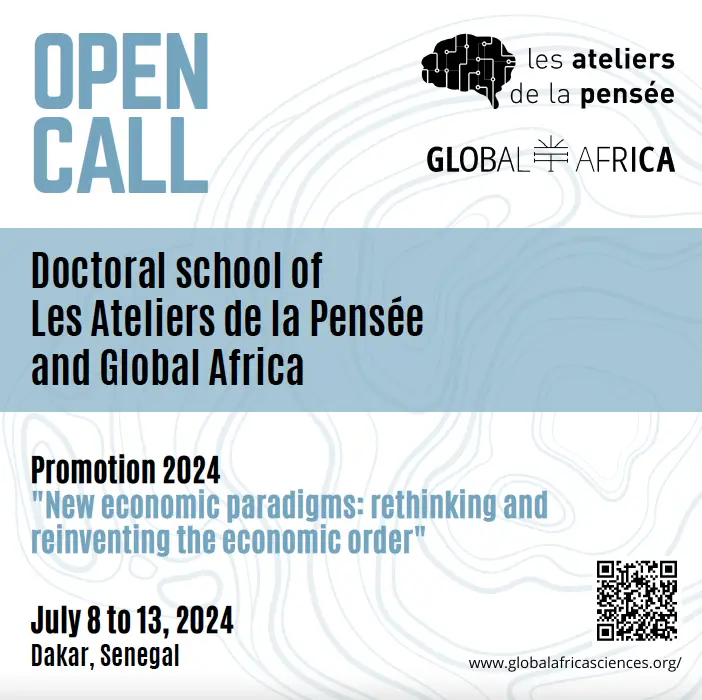
Les Ateliers de la Pensée & Global AfricaSince 2018. Les Ateliers de la Pensée de Dakar (ADLP) in association with the Consortium des Instituts pour les Humanités (CHCI) have set up a Doctoral School whose primary objective is to contribute to the empirical, methodological and theoretical imagination renewal in the study of Africa and, more generally, the dynamics of transformation in contexts of instability and uncertainty. This 2024 edition will be held in partnership with the Global Africa program, supported by Université Gaston Berger (Senegal), IRD, UR and LASDEL. Global Africa’s Junior Researchers’ Institute (JRI) has been set up to help young African researchers integrate into scientific communities in the social sciences, thereby enabling them to play an active role in shaping the world’s knowledge. The Junior Researchers’ Institute is an essential component of the Global Africa project. In particular, the School aims to introduce participants to contemporary transnational debates on new knowledge and global issues, from a continental and diasporic African perspective. The work resulting from the joint ADLP & Doctoral School will be the subject of a special issue to be published in March 2025. New economic paradigms: rethinking and reinventing the economic order The 2024 Session of the Doctoral School will take place in Dakar (Senegal) from July 8 to 13, 2024. All costs associated with the School will be fully covered by the ADLP and the JRI of GA. The working languages are French and English. Session 2024 will bring together participants from Africa and its diasporas. Priority will be given to those in the early stages of their thesis, as well as to more advanced doctoral students and post-docs. The selection of the 20 applications will be based on the candidates’ ability to identify and justify their research theme in relation to the theme of this session of the Doctoral School. to explain their problematic and their questions, and to detail the methods the intend to use. Particular attention will be paid to themes requiring fieldwork, and to dossiers describing how this fieldwork will be carried out. To find out more, scan the QR code or go to the Schools page on our website. Submission deadline: 12.00am (UTC), March 25, 2024 Applications by email: edadlpapply@gmail.com
The Junior Researchers’ Institute Has Begun!
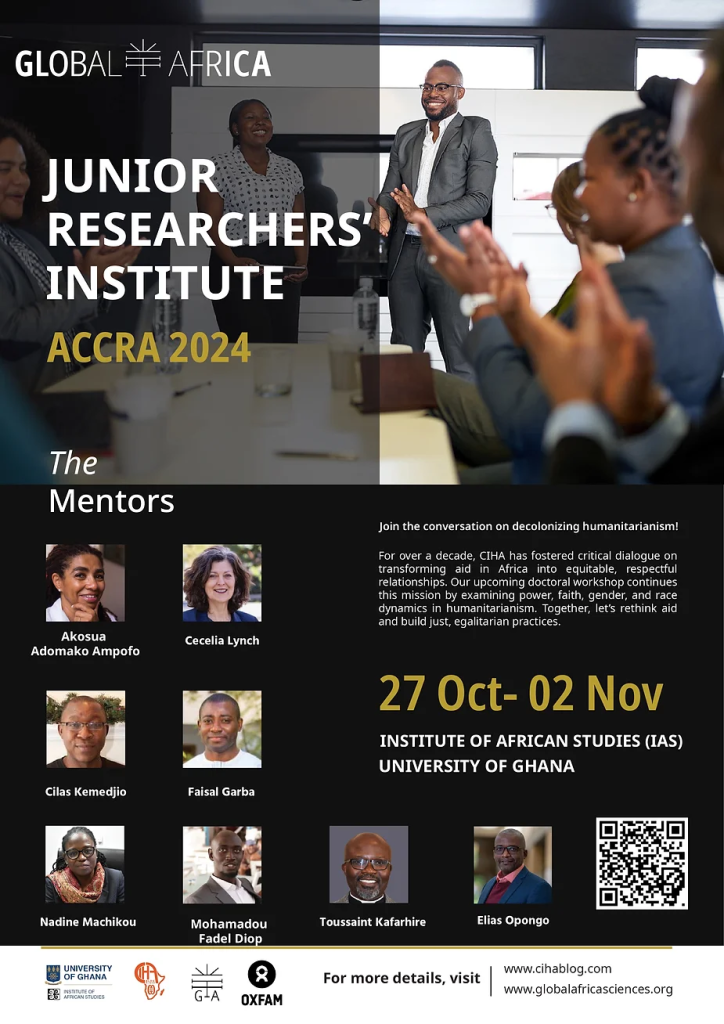
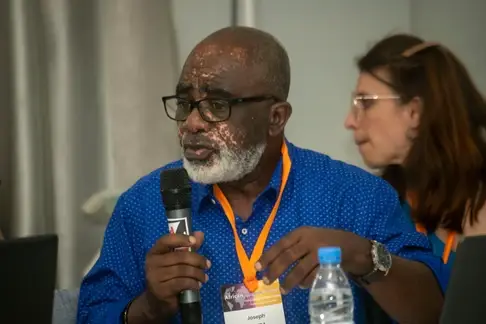
We are thrilled to announce the launch of the 2024 Young Researchers’ School, organized in partnership with CIHABlog and IAS. This event runs until November 2, bringing together emerging talents engaged in research on Africa and its global challenges. Follow Along to stay updated on the insights and achievements of the 2024 Young Researchers’ School!