

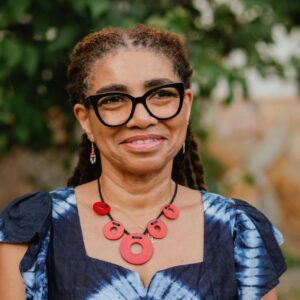
In this interview, Wangui wa Goro, is a feminist, translator, and academic who has both researched and worked in the world of “development”. She provides an innovative perspective on the translatability of concepts like “philanthropy” and “charity”. In this interview with Akosua Adomako Ampofo, she reflects on gendered, racialized, class-based, and other hierarchies in humanitarianism through tajuk chu/traducture which she defines as deep translation. Key to her perspective is the necessity of a deeper understanding of the lingering mechanisms established by former colonial powers who restructured practices in ways that did not, and still often do not make sense in African contexts. These practices were justified by discourses and terms that frequently do not exist in African societies where African concepts of “philanthropy” are not considered in those wider discourses. Her trenchant questions probe the tensions that become evident in Wangui’s experience of translation in both a wider and a narrower sense of the word.
Wangui wa Goro is an Honorary Professor of Translation Practice at the School of Oriental and African Studies (SOAS) and a Visiting Academic at King’s College London. She is the founder of SIDENSI, which promotes translation and traducture. She has worked relentlessly to encourage scholars and others to take translation seriously.
Akosua Adomako Ampofo
Let’s start from your own translation expertise and trajectory. As a feminist scholar, translator and public intellectual, what has been your experience translating both “conventional” and “neoliberal” forms of humanitarianism, or translating in so-called development work? For a long time, you have expressed your concern that words and actions do not easily translate from one language or culture to another and that care is requisite. You argue that words, perceptions, and the concepts behind them do not translate as well from one language to another, especially in contexts of historical inequalities. So how did you come up with this term or concept, Traducture/tajuk chu?
Wangui wa Goro
It is a privilege for me to have this timely conversation. I will use the terms tajuk chu and traducture interchangeably. Translation has been part of my life since I was young. Later, during my doctoral studies, I evolved this concept, “traducture,” which described gaps within the translation process and explored it further as deeper translation. I discovered what I considered conceptual and communication gaps, owing to historical relationships with the global world systems in relation to Africa. Later, I was involved in researching this concept further within international development and knowledge management contexts. The research was funded by the Dutch Government through the European Association of Development Organizations (EADI).
In development and humanitarian contexts, language does not merely describe reality; it produces it. Words shape policy priorities, justify intervention, and structure relationships between those who give and those who receive. A sudden geopolitical shift—a war, a coup, or the removal of a head of State—can radically transform the meaning of concepts such as sovereignty, rights, or nationhood. Translation is therefore never stable, and tajuk chu insists that this instability be acknowledged rather than concealed.
In formulating this interview, a colleague misheard my invented word, traducture, as “tajuk chu,” which I have adopted for this essay because it demonstrates how mishearing could cause a missed hearing or missed translation with different outcomes. Its purpose was to explore the unequal relationship in translation, including missed translations in the context of North/South relationships, particularly dealing with coloniality and postcoloniality in the development sector. Yet mistranslation happens every day in relationships and knowledge systems with minimal check. We live translated lives—bodily, emotionally, intellectually, ideologically, and politically—every day. We switch code, switching not only language but also through our entire being and living. Globalization has helped to narrow the gap, but ideological differences mean that there are wide gaps at other levels.
Akosua Adomako Ampofo
Can you explain this and give examples?
Wangui wa Goro
Both of us, like many Africans, and particularly people from former colonies, speak many languages and travel to different parts of the world. We experience translation bodily, through heritage, where we are compelled to negotiate across cultures, and within oneself as one moves across personal/family/local/geopolitical, familiar and unfamiliar contexts, probably consciously or unconsciously. This is whether you are dealing with members of your family, your community, when you go abroad, or are in your own city, etc. You are moving around emotionally, intellectually, linguistically, philosophically and psychologically without a dictionary. You learn to navigate values, expectations, and things you can or cannot say, because they do not fit in either community, but you know them, so you are always censoring, tailoring and adapting your meaning. Sometimes people lose their lives because of words. Educational exposure also affects how one deals with different communities, be they students or peers. This also means that there are concepts and ideas that one must navigate in order to share pertinent information.
At times, you are forced to censor yourself, perhaps because the concept does not exist in that language, or because of taboo, or because it may require more time, than a brief encounter, or that it may be inappropriate for the audience. Sometimes we think and express ourselves in an academic mode that we have learned, which differ from daily or common sociocultural or political discourses, for instance across cultures. There may be cultural nuances too, that one does not grasp in either of the language. The contours of this gap, especially in relation to power, are what interests me and have kept me busy for 40 years. Sometimes, we know what we are adapting or censoring, we know what we are withholding, sometimes it happens unconsciously. Sometimes, we know how to be careful with expressions when we use proverbs because of the different sizes, shapes, and in-between spaces of context. You navigate the affect that words carry, even silent negative words whose echo lingers silently because of its historical background. At other times, although certain words are not acceptable, social education or exposure and open-mindedness or tolerance can make a difference, when it is not the same with people who have not had similar experiences. Sometimes there may be a higher principle. If a racist or drunkard is dying and hurling insults at the doctor, they are obliged by their oath and duty of care to treat them.
Sometimes, translation and tajuk chu such as the birth of this new word can happen miraculously, but the converse is also true, that mistranslated words can have dire consequences. I realised this in academic and development spaces, where I became aware that this everyday labour of translation—so familiar to those of us who live in multilingual and multicultural contexts—was largely invisible in institutional thinking, including in Africa, where what are considered European languages remain the main medium of transactions. In further informal settings, translation was treated as something mechanical, neutral, and benign. Yet what I was witnessing was quite the opposite: Translation, while a powerful tool can serve distortion, benevolence and profound violence, just as it can produce their opposites. Furthermore, many people are monolingual and their experience of meaning is confined to that language or even a location, if they have never travelled linguistically.
Akosua Adomako Ampofo
How does this relate to the question of philanthropy?
Wangui wa Goro
It is relevant because the gap is glaring in both national and international development spaces because of their colonial and postcolonial configurations. Those who live multicultural lives, who move across numerous spaces of learning, policy, and practice may be aware of meaning and intent which even when not spoken produces affect. Lack of consciousness also exists, as people come with perceptions about situations. I remember once that a friend of mine and I were walking on one of Kenya’s hills and saw a very handsome Masai man grazing a large heard of cattle. We lamented loudly that it was a pity that he was uneducated and rural. We were nearly killed by a swarm of bees, but he saved our lives by diving and forcing us to lie flat on the ground where we were, which allowed the bees to pass above our bodies. Later, we learned that he was on vacation from his US university, and he told us that the grazing herd belonged to him and that if you counted each head, you would realize that he was a millionaire, let alone the family he hailed from. He taught us a valuable lesson not to make assumptions or judgements about people. We were very humbled and embarrassed as he had heard our careless talk. I hope that he will see this article and remember the fourteen-year-old girls whose lives he saved.
Akosua Adomako Ampofo
That is a good segue from assumptions, as I would like to turn now to the English word philanthropy, which sits at the heart of humanitarian and development discourse. You have suggested that this term is not as benign as it is often assumed to be. What concerns you about how philanthropy is understood and practiced? Much of the contemporary global vocabulary that governs development and humanitarianism emerged from specific European histories—feudalism, colonialism, Christianity, and capitalism.
Wangui wa Goro
Yes, that is an apt question, demonstrated by that little story and the kinds of assumptions that we were making, based on our “Western” perspective of the world. We “nativized” the young man and felt superior to him. Similarly, in local, global, and international arrangements, words and meanings of ordinary words, expressions, values, relationship and meaning are not articulated as intended or misread or misheard.
Therefore, values, perceptions, and assumptions, and their embodiment, form interpretation/translation, as in the example provided. So how much more so in wider contexts of international development or even national development, especially in multilingual communities. Another example is how nation-state or sovereignty and the rights of nation-states or people can suddenly change. We are witnessing, global, tried-and-tested compacts unravelling before our very eyes in a new world order. The meaning of sovereignty, for instance, can suddenly shift and affect humanity for years or millennia to come.
Akosua Adomako Ampofo
Would you say that translation is impacted by neoliberalism?
Wangui wa Goro
Translation is never clear-cut, let alone traducture/tajuk chu. And so, I would not just call these processes neoliberal because traducture/tajuk chu permeates through all values and people’s own thinking systems, and more formally through faith, the media, knowledge, education, and affiliation, etc. It is also present in all relationships across value systems, even in one language—the nuances and meanings of words, and of power, for instance, for individuals and in different relationships and locations. For example, the feminist Dale Spender demonstrated that there were male and female languages. She drew attention to their impact on everyday life. For example, we know that feminists tailor themselves to the context or audience when they share feminist ideas and thoughts because the rest of the world may not necessarily understand this language. In the eighties, we witnessed the great feminist debates on différence and difference, which I personally quietly noted as deference, and which arose from a translational failure. This failure demonstrated that even among feminists, such a language is not monolithic and is itself subject to power differences, and therefore contextual translatability/traducture/ tajuk chu sensibility or practice is important. It requires a method.
There are real stakes therefore, in general. Translation can fail irretrievably. We sometimes like to think of misunderstanding as something that can always be corrected, but that is not true, and it could take centuries or lifetimes—or it might never be corrected—as there are complex problems. Words can wound deeply. Policies can harm. Histories can be erased. The way that concepts travel, whether effortlessly or with difficulty, could produce different outcomes, where some are rendered invisible, “unintelligible,” or dismissed as “cultural” in a derogatory rather than celebratory way, in which they would be treated if circumstances, say of race or gender, were reversed.
Akosua Adomako Ampofo
As you were speaking about the translatability, or not, of words and concepts, I just thought of something that I felt is relevant to this conversation. From at least two of the Ghanaian languages that I speak, we have a word that is a kind of a preface that you use to sanitize what follows, if you like. You can say sɛbe, or you can say taflatsɛ, to preface what you are going to say, which could otherwise be construed as offensive, or could be interpreted by the hearer as a wrong or a disrespectful word. When you excuse yourself before speaking, it signals to the hearer, “Do not be angry or offended by what I am about to say,” especially in the current moment where there is all this cancel culture going on, and where the written word and the spoken word do not necessarily inhabit the same space because they are accompanied by other means of creating meaning, such as gestures or facial expressions, or other signs in language, showing approval or disapproval. I mean, the written word can be particularly problematic when you cannot see the person’s face, hear their verbal responses, which are not necessarily words, or read their emotions. So, I just love the concept of taflatsɛ and sɛbe, which allows you to even reprimand somebody, if you like, but the person really does not have the right to be angry or take offence, because the other hearers will be like, but she prefaced her speech, you know, taflatsɛ.
Do you have any thoughts on that, in terms of humanitarianism?
Wangui wa Goro
Yes, but there is a question about what can or should be sanitized and when, and what new words can be birthed and by whom, and when. The words traducture and more recently tajuk chu, which was born in the process of this interview, demonstrates that words have their own lives! Tajuk chu insists on ethics and depth in translation. In the international global context, for example, between Africa and the West (because that is what I know best), relationships have not been equal for centuries. The ways of resolving these seemingly intractable relationships are in process, but there exist push and pull factors. Where people are historically still judged as lesser by the color of their skin, or their gender, it makes it difficult to engage humanely. So, to move from language that perceives relationships and people as “it,” “these people,” or ‘‘slaves,” “them,” “us,” animalistic, etc. or lesser beings or “semi-human” has taken a while, say for Black/African people, and this colors contemporary and future relationships. Further, their own languages, by which they could consider themselves humanely, have been stifled, so the battleground of translation exists within their bodies and psyches, often unspoken in these translations. Languages are not only confined to words. Other non-linguistic mediums, such as art, cinema, music, and public behaviors such as discriminatory laws, accompany thought and words.
For example, as a translator, I have struggled with the word “inclusive” which I had always assumed was a positive term at face value. Deeper meaning in traducture requires you to ask what one is being included into. My assumption is that one’s humanity already gives them the full right to be. So, whoever is including must be able to do so from a higher hierarchical position to be able to include, presumably from a higher place. So, this relationship, in its real and linguistic expression becomes a matter for deeper reflection.
I can give you several examples, and one that comes to mind was a recent controversy in London in relation to the private member’s Garrick Club. It was founded in London in 1831 as a club for “actors and men of refinement to meet on equal terms.” Women could accompany men as guests, but they could not become members, although this has changed recently, even though the law on 2/3 gender representation and the 2010 Equalities law has existed for over two decades. Many have come to question why this is the case in the 21st century as discrimination has been prohibited for decades. Then further questions can be asked about what in such a context it means to be a woman, if you are Black or because of your sexuality.
In another example, in the French language, the term “ils,” (they) was/is conventionally used, apparently even if there was a male baby in a room full of women, referring to a masculine subject. Women could exceptionally be “included,” (ils) though the phrase “Mesdames et Messieurs” has become more common as more women continue to enter public places. At the Garrick and in many other places, the question of inclusion and equality is still being debated in this century! So, in practice, what would being “included” into a male club mean? Will the organization have to change to accommodate women? The answer to this exemplifies traducture and raises the question of what a new world would look like and how it would operate? There is a benign ‘‘paternalism” behind such words. Even when 2/3 gender rules are attained, there is always an echo of temporality around it, as I have argued above, that negative meanings and attitudes do linger, especially around power and privilege.
In essence, even sanitized language can do immense damage, precisely because it appears so reasonable. Once, when I challenged these terms by sharing scholarly findings on traducture as I am doing here, I was shut down, although I was the main invited guest speaker. We were just having a conversation, like the one I am having with you. And this was with feminists who are aware. There exists a whole industry around “inclusion,” and people earn their living off the concept and have spent years fighting for it. They may never have paused to ask this question, which translation and traducture force—as to what it means at the core. This is not an ideological position; it is factual and can be quantified. Data upon data exists for decades, especially in the UK, where the collection of data in inequalities is mandatory.
So, imagine what the world would look like if we flicked a switch and all people were equal before the law. To place this in context, it is estimated that it will take 134 years to reach global gender equality. Now imagine all the inequality issues put together without taking into account the possibility of reversals of gains. This is the depth of traducture, and I would say that a similar attitude exists around humanitarianism and development in general, particularly in relation to Africa and the global south.
It raises questions about systemic transformation and its terms. Often these issues have not been interrogated in humanitarianism and there is no legislation yet, though guidelines do exist, including universal moral guidelines, such as “do not harm”, but what does such a provision mean in law? So, if you suddenly discover the deeper meaning, it causes a stir and as the underlying nuanced implications have deep ramifications as illustrated above.
So, what I came to realize is that if the terminology that we use now in a concept such as “philanthropy” or ‘‘inclusion’’ is flawed, then we have a long way to go. And most surprisingly, such terms are still in use in places within the UN and other institutions because that notion of (ils) is so profound and significant in policy, as in diplomatic terms it stands for “the people.”
In humanitarian and development contexts, understanding this challenge is vital. Words such as aid, assistance, or capacitybuilding can sound harmless, even kind. But when you examine them closely, you often find assumptions of deficiency, hierarchy, and control. And I have worked in equalities and in philanthropy without questioning these notions.
Akosua Adomako Ampofo
I would like to hear your thoughts on the English word, philanthropy, and how you think that concept has been used or abused.
Wangui wa Goro
The English language still reflects a feudal society, but although it is a historical fact, saying it can cause offence. One definition of philanthropy is as follows:
Philanthropy is the voluntary promotion of human welfare through private initiatives, often involving donations of money, time, or skills to support the public good. Derived from the Greek word for “loving humanity,” it focuses on long-term, systemic solutions to social problems rather than immediate relief.
Philanthropy is loaded with this idea of needy people, and in the English language, the word needy leads to a charitable outcome because of the social structuring. The idea that “I have more” and thus “I should assist somebody” is inbuilt in that sense and this is not a bad thing on the face of it, like the concept of inclusion. But, the vessel that carries it, such as the private members’ club, already comes from a place of social hierarchies of feudalism, which evolved to the monarchic system and to global colonial and postcolonial systems, all of which require certain relationships of hierarchy, including extreme colonial and race dominance, and subservience such as slavery, class hierarchies based on gender and color and caste in some instances, and also double layers of slavery in colonized societies which practiced such.
These conversations are in long process because of what we can call the Garrick effect as it would raise other questions, such as the question of reparations and transforming the present and future, which is labor, including moral and emotional labor which is difficult ideologically and individually and you will hear mumblings, which in practice terms could lead to ongoing harm. This has not been resolved because some of these retrogressive ideas about who is human, remain. There seem to be classifications of humanity through inbuilt historical and humanitarian negating paradigms. The knowledge and resource flows viewed from a translation/traducture perspective—do not paint a good picture. I remember once at a very significant conference where an important philanthropist was offering aid and question of the terms, effectivity and effects of philanthropy was raised, he shouted angrily, “Do not be stupid, just take it,” and he stormed out of the meeting ending what could have been the beginning of a deep and important conversation, given his unquestionable good will, but where there was a seemingly intractable challenge of time, history and meaning for which he or the people in that room were not to blame directly. I hope that attempts at that conversation can be revisited, which is part of the work that I have been doing over the years, and how this term which depersonalizes the challenges can be explored scientifically.
Marginalized groups like black women and black scholars, for instance, generally consistently lament that no matter how many degrees or professorships they have, no matter how hard they have worked, they have basically just entered the door, and remain the bottom rung, waiting for this inclusion. And that is where you are, going nowhere in the decision-making, knowledge making and policymaking hierarchy for another 122 years for women. You are there, yet invisible despite receiving equal education with male peers and often doing better or on par with them. And the odd ones do break through what I call the ice ceiling, but at what cost? Mountains of research and legislation on “inclusion” and “equality” exists all over the world, yet it never seems to merit structural legal action or consequences. Therefore, words like “inclusion” or “philanthropy” or humanitarianism come cloaked in “goodness,” because of the historical vessels in which they come. And when ideas such as intersectionality arise, they cause such alarm as to be erased and books about them are banned, instead of embracing not only the law, but assisting society to understand this dilemma of the gap.
I believe that if we focused on the word “human” without qualification, it would change the paradigm of how we treat people. In truth, we can solve the problem by simply treating people with respect. There must be a basic humanity to which everybody is entitled and this is enshrined in the Universal Declaration of Human Rights of 1948, but that itself is a matter for deeper reflection as I have done in my forth coming books and begs the question of what human meant then and now which is pertinent to the concept “humanitarianism.”
Simply put, deeper meaning, traducture, invites deeper meaning like surgery, unravelling the ailment, or wound, and allows the careful unravelling of words, and suture or remedy) to heal. It is the gap therefore, between power, common sense and meaning is part of this concept of tajuk chu (traducture) but it goes beyond that. If it is truly humanitarian, people should not be coerced to do the right thing.
More disturbing in linguistic terms is how these seemingly innocuous words travel to other languages, where they may gain new meanings, such of dependency, so you will never find equivalents, even in different institutions or cities, north or south. Those dependencies, then create cyclical never ending cultures and behaviors, such as what is referred to as “white saviorism”. So, in such a process the deeper meaning, tajuk chu can get skewed or lost through this intended or unintended bias. More worrying is its presence in current global reality, including global and digital languages which are themselves based on power location and proficiency in traducture or/and translation. Whose word? Whose view?
Language too which is a collective tool needs to evolve to reflect humanitarianism in its true meaning which impacts not only policy and law but the every-day. We are still light years away, from being collectively human and we may yet be too late as the Machines are here as Gbadamosi (2007) alerted us: “The machines are coming” in I am Black/white/yellow: An introduction to the Black Body in Europe.
My own conclusion for now is that such terms as philanthropy are neither reparative, nor democratic looked at overall, within evolving contexts and awareness that movement is not always forward or progressive and the potential for retrogressive and negatively looking-back cultures exist.
Somebody went as far as saying that it was like a rapist being allowed to offer a vulnerable woman refuge from sexual violence which happens often in societies which do not have sufficient resources, including policy and knowledge tools for the community for even in wealthy societies owing to this gap, which sees this as the problem of the victim. In such an instance and for deeper meaning to occur, it seems there are other prior critical steps which must happen both in law and in social practice. In a case, of rape, reporting, background of the case, medical care, legal process, safety, treatment, counselling and healing and respite checks and life-long support may be the expectation if rape was accepted as a serious crime etc. For example, old UN data shows that globally 200 000 cases of reported rape were reported annually in 65 countries (gender violence data of up to 2013) so we have no idea of the real scale or the remedies for such at the present time and hence the importance of filling these translational gaps which would require deeper translation and legislation, such as mandatory reporting which is being broached currently in countries such as the UK in 2025/26. Such actions represent deeper translation which can be extended to “humanitarianism”.
In international development, there is an assumption that the external person is “good” and has superior knowledge of the local context and capability. And it leaves people in a position of begging and dependent on what some refer to as “white saviorism” and in African contexts it can be extended to “bourgeois saviorism”. People become spectators or recipient of others “benevolence” in unmediated relationships of power. I recently heard of the term patriarchal philanthropy which we may want to unpack in the context of tajuk chu, but it could also be gendered paternalistic philanthropy, but that must be a conversation for another day!
When I have tried to demonstrate is that when one hears the word humanitarianism, it sounds like a good word, like a healthy word, but what happens in translation when you dig deeper and from whose perspective and through which mechanisms of power and to what outcomes.
I think it was well-intended but a retrogressive model, which some refer to as neo-liberal, overall, and time and resources have been lost as a result in many instances. If it was framed differently, in terms of respect, collaboration and genuine engagement of engineers or doctors or communities, in real translation/traducture, it may be a different story. There is a critique that it is an industry, just like the inclusion machine, which thrives and is sustained by the never-ending situation of dependency on benevolence, rather than agency.
And I am not throwing the baby out with the bathwater, because of the skewed model. Even nations suffer from corruption and dependency syndrome which I think are equally related ills. This has made it harder for democracy and development to work, and the people in the sector are not necessarily always good-willed or knowledgeable about these nuances on the local and international differences in perception and meaning and become very defensive. Others choose to ignore the challenges because traducture requires moral work. Some genuinely fear for their survival, and some understand the perversion of the situation where others act willfully, and others are yet well-meaning though ignorant of the historical nuances. I researched that sector for six years, observing the unequal relations through translation, meaning and sense-making and noticed a major gap in translation.
Akosua Adomako Ampofo
Part of what we grapple with in this notion of humanity is the idea of humanitarianism. As you said earlier, if we treat each other as humans, then we are automatically looking after our brother or sister. And in many of our cultures, the stranger is somebody that we sometimes must give preferential treatment to because they do not have anybody else, while we have got family. You have contrasted this with African traditions of generosity and care. Could you speak to those differences more explicitly?
Wangui wa Goro
I think that the meaning changes with time, you can see now that you have had these more liberal spaces, if you can even call them that, within imperialism. And reversals can happen suddenly. And I do not always think it is innocent, where you have this “inclusive aid,” which is tied to peace and people not disturbing the big systems of extraction, and exclusion. It acts as a buffer that hinders people from claiming their rightful place as human beings in the global order.
My conclusions are that words alone, and associated actions are not always innocent and can even be dangerous if you unpack them. For instance, I was shut down when I said “Let us look at this term “inclusion” more closely’’ as I had been undertaking some research on it, in international development practice for over six years and have two forthcoming books on my findings. I expect the same pushback when I raise this question of inequality in international development, yet as I have said, this is not an ideological position, though it has become that, because it comes out of empirical work and data, even of the big organizations such as the UN and nations such as the UK which have advanced research, laws and policies.
What I would have to say is that many countries are signatories of the UN Universal Declaration of Human Rights (1948) although many countries were still under colonial rule at that time so many revisions, including new policies and declarations such as CEDAW and others have had to be created. Now I consider true implementation to be traducture/tajuk chu. A deeper meaning. The biggest test of transformative humanitarianism through traducture as we end this interview is how the world will act in relation to the signing on Slavery as the worst crime against humanity recently signed in 2026.
I will watch closely because in Kenya there has been a Bill of Rights from independence in the sixties (which is when I grew up feeling free,) that asserted that men and women are equal before the law. So, what happened along the way that now women are being “included” in 2026? and what are the ramifications of disregarding the law for so long? To “repair” this the Constitution of Kenya, now requires 2/3 representation in governance should reflect gender, (for me, a retrogressive move given the visionary 50/50 rule in the 1960s, long before CEDAW).
Over sixteen years since the Kenyan constitution was promulgated, this important constitutional needle has moved backwards, yet nobody has been held accountable. According to a report in 2023, only 21 percent of the representatives were women, 12 percent less than the retrogressive 2/3 constitutional requirement which is read to mean 1/3 requirement of women’s representatives if read through traducture. So, meaning matters. Traducture matters. These failures play out and cause real harm across generations and retrogression, in many arenas of “intrinsic value” such as faith ethnicity, gender, class, philanthropy, national and local development etc. including within every nation-state holding millions in oppressive captivity. They play out in social, political, economic and cultural and cross-cultural relationships and practices, at times to devastating and horrific effects for generations, for individuals and for society.
In this sense, I see philanthropy as one of those words which is a misused word. In the current form, I see it as a place-holder, either with an intent to improve, or like inclusion as an end, a kind of bad debt such as that missing 12 percent in the 2/3 gender rule, depending on whose calculator is used in the Kenyan or global requirement for equality (in my book, 39 percent is missing based on 50/50 parity). It is worse because it is a coerced debt, because women do not want that situation because this is not what humanity promises, nor national or international laws. Domestic slavery for women continues in much or the world despite the laws.
Akosua Adomako Ampofo
How can we think of notions of humanity or humanitarianism in relation to the (Xhosa/Zulu/Ndebele) concept of Ubuntu, “I am well because/if you are well”, probably popularized by Desmond Tutu during his work on the Truth and Reconciliation Commission in South Africa, but which can be found in many cultures—this notion of a shared humanity and that we are tied up in each other’s wellbeing? Indeed, Tutu explained that in dehumanizing others the perpetrators of apartheid were themselves dehumanized or robbed themselves of their humanity. How does this related to notions of “give and take”?
Wangui wa Goro
Ubuntu, “I am because you are” derives from a philosophical belief and expected conduct of Abantu (referred to as Bantu people) people’s culture, and many across the world have embraced it. Most societies have this notion of humanism. That philosophy which gives Abantu (pl) people their foundational value system. The word bantu (plural for muntu or mtu). It comes from the notion that we are the human. In Southern Africa it is referred to as “muntu” in Kiswahili “mutu” and in Gikuyu as “mudu” and I am sure there are other variations across the over million people who belong to this Abantu heritage. It emanates from a belief that everyone is equal and should be treated well and justly, whoever they are.
A muntu should be treated well and equally with others whether they are young, old, male or female or however they identify. The basic rule is to deal with them in a civil way as a human being which translates to respecting their human rights. If they need water, you give them water. If they are tired, you give them somewhere to rest.
Akosua Adomako Ampofo
I recall a trip that I had to make to the UK, when I was housed in the home of a white, British sister feminist. Eventually, the per diem that I was expecting was deducted by what in my view were random amounts. Obviously, by not staying in a hotel and paying for my own meals, I would spend less. But I thought she was extending me this offer so I could save money, and that any change in plans should have been discussed with me first. Perhaps, knowing how my per diem would be recalculated I might have preferred to stay in a hotel and decide what I would eat and when, right? She, on the other hand, felt that she was extending ties of kinship by inviting me into her home. Differing ideas of giving, lost in translation.
Wangui wa Goro
Yes, I get that. In many African cultures, if you came and found us eating, we would get an extra plate, and we would even scoop the food from the plate that we have not touched and give you an equal share. Those kinds of very small civilities and solidarities are what counted, and nobody would ask you to repay! Every time I go to Ghana, when I come to visit, you say to me, “oh, you must stay at my house,” I understand it and I am happy to do that and stay with no worry, but you can rarely do that in Europe. It is a very different culture. And you do not know what to do, whether they are asking you to contribute or pay.
This idea of charity or charging for hospitality does not exist historically in our language but the concept of reciprocal generosity exists as opposed to miserliness. There was a give and take but things have changed, partly because of colonialism, but also the society was emerging from a communal to a feudal society at the point of international contact, and we are still not yet really a fully-fledged hierarchical feudal though negative patriarchy is very powerful in many African societies emanating from coloniality.
Many societies had in place gendered practices, and some were strongly matriarchal. There was a communal and more egalitarian society based on division of labor, where certain tasks were designated for each gender or age set. For instance, in Gikuyu culture, everyone had to contribute to the solution, even a child’s view was considered. Tasks would then be determined, for instance by gender or age set or strength or height or speed for instance or skill. Strangers could be accommodated or adopted as you said earlier. Refuge or shelter would be provided for guests or travelers or refugees. They would be provided with shelter and food and integrated into the family and community. I remember we had a Zambian sister, who joined our family one holiday and remained with us, until she finished her education and returned to Zambia. The notion of extended “family” is familiar in much of Africa. Another example is that if you were a prisoner of war, you would be encouraged to marry ensuring that the waring communities were forced to engaged amicably to avoid hurting their kin. There is a song in Gikuyu where one community insults others because of their generosity, which shows that the humanitarian order began to give way to exploitative relationships
In earlier communal societies, there is no notion of beggars, Ahoy who begin to emerge with feudalism and become entrenched in colonialism. As noted, protective humanitarianism towards vulnerable people existed. The systems of bartering and trade included swapping goods and labor, say, five hours of my time, and you give me food.
Gikuyu women also practiced Itega, a collective, solidarity gifting and the system was not based on charity, and this is common across the world within the African and African diaspora communities through sororities or fraternities. If you were in need or vulnerable, women would bring you supplies through gifts of food, firewood etc., or celebrate your achievements on your important milestones. The provisions would last for the whole season. They came once, so as not to bother or demean you. They came prepared, they gathered, and made sure that you were okay for the season. You too are intrinsically part of the same system as you were expected to pay forward, then you are part of that group that goes to the rescue. You belong to your group for life through a ritual which creates a sorority or fraternity, while retaining your own autonomy, agency and integrity. In this sense, Gikuyu women like many African and African American communities had/have their own formal and informal ways of managing “philanthropy”. There was a saying in Gikuyu that “when a bean fell to the ground, we would all share it.” And the process was never intended to humiliate or demean, as sometimes the international practices do. It was a respectful and caring collective culture. It was not based in what in some instances has resulted in toxic culture of corruption, begging officials, a horror shows depicting pictures of suffering children with distended bellies with flies in their eyes. This is done often without the consent of the vulnerable people, often without their consent as they have no idea of the international fundraising cultures.
Akosua Adomako Ampofo
As you were speaking, I was thinking of some Akan concepts. The Akan philosophers, Wiredu, Gyekye, Abraham, for example, agree on certain core issues about the notion of personhood: that there is a distinction between an embodied, living person that moves, and somebody who is a (real) human being. Even trying to translate this into English becomes problematic for me. And so, we have a word, nipa, which in English is sometimes translated as person, but could also be translated as human being, where the latter implies a certain morality, So, based on someone’s behavior one could say, this or that person is [a] nipa, humane, or not. Or, they are so wicked, they are so cruel, that this [embodied] person is not really [a] nipa, human.
The morality that is built in that understanding is that you learn how to be [a] nipa by living with other people, by living in community. And so, Wangui, therefore, all the things that you said earlier, your neighbor, your sharing, and so on, you learn it by being embedded in community, and of course, people are also teaching you.
But at the same time, people could also believe deeply in accumulation and wealth. There is a phrase that goes as follow: “all the fingers are not equal.” Some people will be wealthier, because some men will have more wives and more children. Unfortunately, in terms of egalitarianism, the women could not accumulate more husbands. But the system of woman-to-woman marriage described so well by Amadiume allowed some women to become social males, marry women, and accumulate. Some people are also disabled, or mentally challenged, they become ill for a season, or they go through a catastrophe, and so on; all the fingers are not equal. But also, there is a phrase that times change. So today I might be the tallest finger and doing well, and tomorrow I might be the shortest. It means that these notions of living in community recognize that when you are the tallest or the biggest you should be careful not to be egotistical about it. You do not know what will happen tomorrow.
It means that you must be careful how you practice “charity”, for lack of a better word. It is more of a sharing with others when I have it and you do not have it. Of course, you also give because you are compassionate, you see somebody struggling, you give to them. But you need to be careful how you cloak it. How do African philanthropic practices contribute to this concept of sharing? And how do they differ from Western traditions of giving and receiving?
One of the things I often say to European people, or people who have grown up in a system defined by European concepts of giving and receiving, is that when somebody gives you a gift, and because you think that you are materially better off than them, a response of, “oh, you should not have” establishes a hierarchy of inequality. It is like, “I am the doctor, you are the poor woman from the village,” you should not have to give to me. Such a response implies that you are, and always will be, better off; that what the person has to offer you is of no value, and so on. So, whatever gift is given to you, you must receive it and receive it graciously. So could you share some thoughts on that, especially in relation to notions of solidarity.
Wangui wa Goro
Yes. I totally get that. What was expected was that you were required to pay forward as well. Women used to form these solidarity groups, which you would belong to by kinship, ritual or by being neighbors. It was understood and you were trained to know that you had a responsibility of looking out for others, especially those close to you. For example, when your baby is born, the women would come and help you and give you a “baby shower” in English parlance. These networks created these groups of philanthropic solidarity, “chama” in Kiswahili, associations or sororities. And those traditions continue including in the traditional and modern Diaspora. The women used to cultivate the land collectively especially if the rains came early so everyone could gain time. This was through contributing time, labor, solidarity and discipline.
There were many practical ways to this collective solidarity such division of labor, celebration, peer supporting etc., including determining economies, such as deciding who would plant which crop during the season. The harvest would then be shared. That way autonomous space worked well within the collective which included shared labor, talent, exchange of material goods, and emotional support, solidarity, education and presence.
British colonialism and settlement broke that whole system of solidarity through villagization and demarcating land parcels as private property, rather than communal property. Then, people were forced out of the communal culture and solidarity and breakdown. This has had serious ramifications, given the unresolved constraints that the colonial system imposed. Time was lost with forced labor, and taxation especially for women, (such as the hut tax) who were not allowed to join the formal economy, and sometimes, women were forced into both male and female roles within the communities as well as forced colonial labor.
However, to date people still reference the system spiritually, across distance, generations and cultures. And despite the major changes these traditions still thrive though diluted, but they have evolved into the contemporary era. Some people were completely evicted from their ancestral lands, and the reparations remain incomplete over generations. My mother was the first to cultivate the land on which I was born is what they call “virgin” as it looked as though nobody had ever cultivated it. She was a modern farmer without a collective and had paid workers, but the women would still come.
I also noted that were other deeper questions that go with disruptions, such as climatic and natural habitat disruption of organic life, and the loss of value and power. The extractive economies have different impacts on social and moral values which are at odds with the notions of philanthropy, given the colonial violence involved. It makes you wonder what it even means to be philanthropic in contexts of extreme violence such as racism, coloniality and slavery. And what does it mean to develop people? The encounter of an imperial, colonial, industrialized and forced labor encounter was a violent model, based on hierarchies of subjugation, slavery, forced and child labor, gendered and working-class labor and sexual violence. How do these things even translate to philanthropic relationships when the acknowledgement, such as that of slavery or coloniality has never been addressed? Similarly, the loss of sacred and cultural artefacts and their return is a big question today. Is their return an act of philanthropy or just the moral, right and reparatory thing to do? The questions of penalties and debt and what processes of return of people and assets are still under debate. These are deep questions that the recent decision on slavery as a crime against humanity will allow us to examine more objectively and how powerful nations/people respond to it, such as the gender rule, that discussed above in relation to Kenya. As noted, the deeper meaning of these matters which are linked are a delicate processes dependent on other factors, such as the world, national or local order.
Examples can be given such as breakdowns with Structural Adjustments and the economic crises that arise from them. We witnessed already vulnerable societies just crumbling. You could lose the ability to be hospitable, to be unneighborly which brought moral shame. Breakdowns of that welcome, “Teranga” in Senegal, “Akwaaba” in Ghana, “Karibu” in East Africa, “Barka da Zua” in Nigeria broke down. Generosity, solidarity and sharing were disrupted again. Solidarity networks were pushed to inventiveness or rupture.
I was struck by the moral devastation, by communities who have continued to suffer immeasurable loss, the trauma of which is carried across generations without repair. It is here, that I would begin to interrogate philanthropy. This breakdown of this ethic of empathy, generosity and solidarity as philanthropy, which struck me as a profound structural value which breaks down where people have fended for themselves for centuries if not millennia.
If we return to the language question, of course, nobody considers themselves a racist, or imperialist. Though these words exist. Yet people who are colonized use them to describe their perception of those who oppress them. The colonizers or former colonizers never think, “we are imperialists,” but colonized people think, “they are imperialists.” Or society thinks that certain people are racists or misogynists, but they probably do not see themselves as such. There are many words in African languages that refer to the brutal, colonialism, racism and supremacy which remain untranslated because the language and cultures are not ready yet to face the harm that was done and many people take it personally.
Against this backdrop, there is therefore a disconnect of meanings across philanthropists, leaders in the former colonies, and those colonized where the words and relationships in meaning remain contested. This is partly because of the absence of traducture, but also the historical reality the moral admission has remained a challenge because of its meaning in law, and the cost of reparation, beyond the reparational work which needs to be done.
There still seems no correlation with seeing the children with the flies in their eyes and how “developers” might be connected to how that came about (the deeper meaning). And there is no language in English yet, to even begin. There is no language yet to say, “We did harm to these people.” When people say, “Can you apologize?” yet in African culture saying sorry means so much as it does in international law. Yet some communities, including colonialists and slave traders were compensated. So, this idea of reparations in the ethics of translation and traducture are critical to peace and societal evolution from the imperial model, and more so, at this present time of world order upheavals and unknown AI capacity to replicate these unequal relations of power and their impact on humanitarianism within the emerging global order.
Akosua Adomako Ampofo
You talked about women’s groups and how they support each other. We are speaking a colonial language now. You and I both use the word feminist and feminism, and as you were talking about, “European culture” and how people deal with translation of concepts such as hospitality, do you have any comments on the feminist spaces solidarity that we share? Or feminist solidarity? Further, as African feminists, we often draw a line between African feminists and other feminists, maybe white feminists, or European feminists, etc. You alluded to it briefly when you talked about these collectives and how we help each other. Are there any other traditions that we had, just as women, as gendered beings who were women? How do you feel about, us, African feminists, how we interact as a collective these days?
Wangui wa Goro
What has been exciting is the wider women’s networks; and women’s movements are the largest community of solidarity on earth. These large, local, national global sororities, have demonstrated a glimpse of humane futures, inspired by feminism and the African feminist movement. And communities, either consciously or unconsciously continue to be work through solidarity and networks including across countries and across the globe, institutionally and cross-culturally. This happens within formal and informal arrangements depending on the contexts and those women’s sororities, philanthropy including through advocacy, litigation, policy, direct support to communities and individual women, political representation, and training among other interventions. As I mentioned, in traditional Gikuyu culture women were blood bound to those sororities such as through rites of passage, and your peers remain your network for life. With delegitimizing of circumcision through FGM and through colonial and global practices, some of these networks have broken down, yet some have found ways of reinvention excluding harmful practices, given their wider value. I believe that the Green Belt Movement thrived mainly through linking the power of those local, national and international networks with feminism. It understood and worked through them.
More research needs to be done around these gendered philanthropies which continue to flourish around the world. I have recently learned of powerful women in West Africa in another research I am involved in relating to African Women and economic thought and practice before 1970 and acknowledge my colleagues who have contributed to sharpen my insight into traducture.
In Africa, I found in my research between 2006–2012, that the North/South model of philanthropy remained unyielding even when there are knowledgeable southern feminists and progressive nation-states. There were other challenges within the feminist movement in agreeing on priorities partly emanating from location and the geopolitical issues of coloniality and imperialism and their effects on women in different locations. As argued before, the vessel in which the discourses are contained, impacts the hierarchy of international, national and local “benevolent” resources and power. The challenge lies in implementation and breaking the wider societal patriarchal imperial international and local norms which keep women down.
Yet, I have experienced global and African continuities of solidarity across the continent, in the Diaspora, such as in the USA and Europe, across Africa in what is called the African American tradition, and these have transnational impact on other communities. I remember the impact of the slogan “I am black and proud” as a young person, in a country emerging from a brutal colonial and settler rule. African and African women come in and out of the mainstream spaces, using their own norms, solidarities into the community. So, through this, what I have seen as intentional moral philanthropy in African feminism, doing amazing work, which has had an impact on global feminism within the wider global will, for women’s emancipation which can be progressive or retrogressive depending on the wider world order. I have witnessed it within local and Pan-African wide solidarity including across generations, such as women from the early sixties and seventies in Africa. Similarly, I have witnessed amazing solidarity in London from the late seventies and eighties, which continues to thrive and produce local and global impact.
What is important is that the echoes of the power of African and particularly women’s solidarity as philanthropy which reflect and are reflected in the community in the collective ways that people engage, whether in places of worship or in the community or family. There are also individuals who act as catalysts for this translated space, where women flourish and thrive and enjoy themselves. And women seek these spaces. Tajuk chu is translationally operational.
Akosua Adomako Ampofo
Given the times that we live in, we are not turning back the clock, clearly; history has happened; we are where we are today as a result of centuries of actions and inactions. “The poor we will always have with us”, as Jesus said, and we know we may never eliminate poverty this side of heaven. And yet Jesus also asked us to be our neighbors’ keepers and look out for the “least of them”. We have unequal global systems, unequal family systems, mounting inequalities. And there are well-intentioned “philanthropic” organizations trying to assist the poor, while for others, of course, the development aid industry needs to remain, so their jobs remain, right? In an ideal world, how should we practice care for our neighbor?
You know, we have what we have now. There are children who cannot go to school, there are children who are homeless, there are women who are battered. The list is endless. There are people in Palestine and Sudan who need to be taken care of, you know, meals, food, schools, housing. What kind of system should we build, if we could?
Wangui wa Goro
You asked this question at what I consider to be the worst and best time in history for me personally. The worst time because some people live in inhuman conditions and this is not necessary given that we live in an age of plenty. People generally seem to have forgotten the ordinary people who are dying in Palestine, Congo, Sudan, Iran or in many countries in Africa unnecessarily because it seems that their lives seem to count less. It is the difficult question to ask me in English and there, for me, is where the translation fails completely, where, leaning on the ubuntu spirit the horror when there is unnecessary human suffering, when life is extinguished and different lives seem to have different value and meanings. The selective silences, the disrespect of the UN system which is the only anchor we have for traducture of equivalence globally-shared values, of shared meanings and the potential of equitable global sharing and exchange. A life should equal another life.
We are at the most advanced stage for humanity in knowable times, in knowledge access and research. We are at the most advanced in scientific and technological knowledge at individual and collective levels, with technologies such as AI have ushering a quantum leap, as we speak.
Will this change the underlying meanings, relationships or discourses of philanthropy? In my view, this will only happen for the better if only if we engage with tajuk chu/deeper meaning without fear. Technology and specifically AI, for instance is not so different from the wider human reality of capitalism and imperialism despite efforts to build in ethics. If the ethical framework is not available through pure and ethical traducture equivalence, then the inherent danger to humanity is extreme.
Yet we see scientific possibility for such equivalence for humanity as we witnessed the greatest human solidarity of a lifetime during the COVID emergency. The emerging model demonstrated a large human global scale of philanthropy solidarity in action and spirit. This was through the collective collaboration of human knowledge, ingenuity, capability, science and technologies, generosity of spirit and an egalitarian humanitarian conduct as the ethical norm. This was evident across the world with incredible scientific and social outcomes that saved millions of lives and when the retrogressive version of history reared its head, there was a human outcry, when vaccines were being horded while people, such as in Africa were likely to be excluded. That solidarity and in the generosity of the nations who stepped forward and challenged this model of conduct led us to see the potential of a civilizational quantum leap, for a global humanitarianism. Whether the capability translates into a progressive or retrogressive force in this digital age of AI and even maybe beyond AI remains to be seen.
Who will train the machines, and who will control the self-coding machines? Are humans able to control them towards a new humanitarian/humanoidism through deeper meaning, traducture/tajuk chu excellence? Or will they lean towards the model that birthed them in the first place? My hope is that humanity grasps this window fast and instills in the machines the ethics of care for the human—I am because you are.
Turning to Africa, I believe that our continent has everything we need not only for Africa, but for the world as has been the case for many centuries. On top of the material wealth of the continent, as Jeffrey Sachs argues, Africa has the potential of human population growth and has the land/space to accommodate it. Other societies have shrinkages of population either naturally, aging or birth-control. He states that 35% of the population will be African by the year 2050 which is a very large number to think about, and we are at 15%, considering that Africa has vast land spaces, in relative terms. Harnessing this demographic for that humanitarian quantum leap could be the golden key for humanity. If nurtured carefully through a humanizing traducture/tajuk chu which views this humanitarian question from the perspective of “I am because you are,” which can be extended in the case of Africa, “you are because I am”. I do not know about Ghana, but most people in Kenya are very poor, generally with around 39.8% to 46.88% as of (2022,) of the population living below national or international poverty lines (approx. on $3.00 a day) where people live below human living standards, homeless, with no food or shelter, limited sanitation, water, and in some cases facing violence and exploitation.
Akosua Adomako Ampofo
Jeffrey Sachs is an interesting reference. His voice does carry weight. So, how should we take care of these people? Should we continue to collect money from Comic Relief, UNDP, philanthropic organizations, because people need food and housing and clothing and shelter tomorrow? Should we try and transform those organizations? Are they transformable? Ronald Reagan and Margaret Thatcher said we should transform Apartheid. We are like, yeah, well, maybe not. So, you know, how should or how can we take care of the people? I can be human to the people in my immediate environment, If I can send money to somebody in Gaza, if you like, but how, politically, should we begin? And it may not happen in our lifetimes, but we are alive now. We may have to begin to change the system for our children and our grandchildren. What should we organize? Should we keep working with organizations that are problematic? What are some of the low-hanging fruit, simplest things that we can do?
Wangui wa Goro
This is a very huge question in this moment in history, where even as we critique these efforts of the major organizations, and their outlook, including the UN.
In truth we are beyond that age, as AI will tell you. Individuals and collectively, humanity now has immense power. In Africa and in many parts of the world, there is abundance and technology, even at an individual level both technology and abundance are offering enormous potential that as Mo Gadwat tells us, that there should be abundance for everyone in very little time. In Africa alone, there are sufficient raw materials such as minerals, an abundance of rare minerals and natural resources, an educated youth bulge, food, and cash crops, such as cocoa, coffee, and tea, and so much more to feed millions. Science and robotic capacity can help humanity leapfrog the manual stage and bring abundance to everyone.
Human ingenuity, generosity and global collaboration and solidarity are the imperative ethic for the new frontier. I am because you are. Technology and labor can help to harness what we have through deep translation of human knowledges, as can our capacity to reimagine humanitarianism as a convivial space which can be nurtured through convivial creative collaboration, through science, technology and traducture.
Many exciting initiatives such as Book-bunk, the Ukombozi library in Nairobi; and the feminist library, 1949, in Youpugon, continue to demonstrate the power of collaborative co-working to transform local and global contexts through the power of translation/traducture. These are some are some of the many exciting examples where human ingenuity, and solidarity, and collaboration, courage and creativity are showing us what is possible. They are uplifting communities, through solidarity through collaborative reimagining with people by transforming space and life. These forms of philanthropic traducture (tajuk chu) which people from different communities/cultures come together to create magic should be normalized.
I think we have learned a lot from thousands of years about each other through translation. More recently we learned a great deal more about the philanthropic power of tajuk chu during Covid, though global collaboration across science, technology, and actions of humanity. Candid traducture ethics in philanthropy and a willingness to see that all benefit if we shared the existing resources in creative ways becomes the overriding ethic, because of our interdependence, and the disease was not discriminating. The threat is despite what we have witnessed; there are retrogressive forces which do not see traducture as a wealth for humanity.
However, I am certain that through genuine local and global solidarities and ethics and collective solidarity traducture will take us far, especially if the world is self-aware of the translation gap and strives to be fair, just and non-exploitative. There ought to be deeper understanding and collaborative relationships’ praxis based on human respect and real knowledge. That would move us away from this historical unequal humanitarianism at both local and global levels. We have no choice, and these shifts of technology and demographics are shifting these relationships, as can equalizing knowledge, including through fair mobility, sharing of skills and knowledge and genuine knowledge translational exchanges (tajuk chu). It all boils down to leadership and the actions of individuals, and what we tell the self-coding machines at all levels. So, everyone has a responsibility to engage with knowing what is happening in their localities and elsewhere and the inherent dangers and threats of not doing so, including to humanity.
I also think we can reimagine and learn about new models of philanthropy, such as what many feminists like Wangari Maathai, Jessica Horn and millions have advocated, and continue to carry the traditions of solidarities into the global digital present and future. The colonial individualistic model remains problematic, and the truth of our interdependency should bring it back to equilibrium if it is not too late.
Akosua Adomako Ampofo
What would you say are the most urgent actions that a “modern” humanitarianism can yield?
Wangui wa Goro
The urgent task is to multiply these models of collaboration witnessed in search of the COVID-19 vaccine and a philosophy of people before profits. This is the highest form of ethical traducture where we witnessed people across every spectrum protecting each other, respecting, shielding and humane social distancing, caring for each other and the vulnerable. We witnessed the ethical power of technology and science deployed through sophisticated modes including AI, to simple apps and texts, and drones, motorbikes and nurses and doctors, on foot or flying from A to B to save lives in timely ways. Data about humanity and the planet became instantaneously available and could be processed at lightning speed for a humanitarian end. And technological capability can be deployed at fractional cost to reach anywhere at any time. I did not know that there is an emergency alert system on the phones until I drove through a hurricane zone in the USA and the phone bleeped alerting me of danger.
We have seen the willingness and courage of movements such as the Green Belt Movement and contemporary movements of Gen Z and feminists marching against injustice across the world, or individuals willing to take a Global Sumad Flotilla in bringing humanitarian aid and solidarity to Gaza through collective engagement with genuine traducture/tajuk chu. Here scientific, technological, indigenous, local, international knowledges, cultures and generosity came together for a collective humanitarian cause.
Therefore, translational knowledge and ethics in the broad sense beyond translating languages is important. If we educate the present and coming generations to create real human and humane global democracies, care systems and exchange, I believe that a golden human age is within our grasp now. But it needs an ethical reimagining and daily enactment of utu solidarity: I am because you are, for safeguarding humanity and utu/being. This is the ethical call for every individual and institution and for knowledge and knowledge management and tools.
Akosua Adomako Ampofo
what are your final thoughts?
Wangui wa Goro
The window remains very limited, for the anticipated machines are here and we are yet unsure of their inclination or whether by their standards, a humane future is even relevant or necessary, given that they are self-coding. As humans, we therefore require an even deeper engagement with intent, meaning and purpose with urgency to ensuring deeper translational outcomes than the traditional philanthropy can be found. A human-centered humanitarianism, in a wider sense, that oversees knowledge and production at global scale is what is critical now. A philanthropy which is transparent including linguistically, and engaging humanity, and building the right institutions, instruments, knowledge, tools and transforming the perspectives of people from self-interested to collective outcomes.
I believe thattraducture can yield a new genuine global humanitarian age which will yield real wealth, enjoyment, conviviality and knowledge is within global collective reach. However, it is imperative for the survival of humanity, and of our world that we exercise this collective transformation urgently and consciously and it can only be achieved through sharing the best of what we have, beyond copyright. Many people have grasped the urgency of what is at stake, such as Mo Gadwat who has set up the one billion people happiness challenge. As a result of my research, and following in Wangari Mathai’s footsteps, and in the spirit of this interview, I have set up the challenge of onemillionsmallacts.com as part of my contribution through translation and traducture. For the challenge, I invite everyone to practice giving in the spirit by translating both in deeds and words the phrase: I am because you are and take one step, however small or large, in any area of the SDGs as daily practice to help us realize them, by 2030 or sooner!
I have seen evidence that creating and celebrating channels of action through solidarity can yield “convivial traducture/tajuk chu which must consciously continue to guide in our daily lives, where we live, in our collective spaces, in cities, across countries and around the world.
I really believe we can sustain such models and build infrastructures that allow humanity to use intercultural knowledge and surplus yields as currency to safeguard our collective home.
Tajuk chu offers both critique and hope. It insists that language is not decorative but infrastructural: words shape worlds. Without deep translation, and traducture as deep translation, humanitarianism risks reproducing the harms it seeks to address. A humane future demands more than gestures and posturing; it requires recognition, justice, and reciprocal care. Tajuk chu calls for an ethical reimagining of global relations—ones grounded in dignity, solidarity, and shared humanity.
We have seen the power of humane collaborations and technological ingenuity. I know for sure that, through tajuk chu, a humane solidarity will emerge through deeper understanding of meaning, intent and action. Arundhati Roy reminds us that: A better world is possible: she is on her way.
Akosua Adomako Ampofo
On behalf of Global Africa, thank you very much.