
Introduction[1]
Textiles have historically received insufficient attention in art history studies, often being regarded as mere decorative arts, “minor arts,” or “applied arts,” or else associated with domestic practices, the banality of fashion and clothing, and femininity. Similarly, little attention has been given to textile art within the field of African art studies—which, like Western art history, has privileged canonical productions such as traditional “sculptures” (Owoeye, 2017). Although this cannot be stated in the same way for textile production in the Japanese context, textiles there are nonetheless often considered secondary. Within the field of textile art, considerably more attention has been devoted to the weaving process, while dyeing is frequently relegated to a later and secondary stage in relation to spinning and the weaving of warp and weft threads (Postrel, 2020; St. Clair, 2019).
Regarding indigo traditions—the use of dye plants containing indican for dyeing processes involving reduction and oxidation, present in various regions of the world—there exists a body of general historical studies at a global scale, as well as descriptions of processes presented by Balfour-Paul (2006, 2011, 2012, 2020) and Legrand (2013), alongside archaeological and technical studies of natural dyes by Cardon (2007, 2014), complemented by socioeconomic and political analyses proposed by Taussig (2008).
With regard to indigo and the Yoruba adire textile tradition, existing studies emphasize the historical dimension (Akinwumi, 2015; Areo, 2013; Areo & Kalilu, 2013; Oloko, 2021; Owoeye, 2017; Oyelola, 2016; Picton & Mack, 2021; Wenger & Beier, 1957), technical processes (Kalilu & Areo, 2015; Oke, 2016), and especially the symbolic dimension of patterns (Akinwumi, 2015; Areo & Kalilu, 2013; Carr, 2001; Davies, 2014; Oyelola, 2016; Wenger & Beier, 1957).
Regarding the Japanese indigo dyeing tradition, aizome (藍染め), most of the available bibliography focuses on historical aspects (Nihon no Ai, 1994, 2002; Okinawa no Ai, 2021) as well as on the technical aspects of the process (Akiyama, 2021; Kawahito, 2015, 2020; Nihon no Ai, 1994; Okamura, 1965; Ooba, 1983; Yamazaki, 1989; Yoshihara, 2019).
In the present research, we propose a perspective grounded in Actor–Network Theory (Latour, 2007), re-evaluating the centrality of the human in art history and criticism, and deconstructing hierarchies that recognize only human agency. The aim is to acknowledge nonhuman actors—plants, spirits, bacteria, and materialities—in the production processes of indigo-dyed textiles.
During the research process, I was not aware of studies proposing such an approach within the field of textiles and indigo, which remain largely centered on human agencies or on the description of processes and pattern meanings, both in Yoruba and Japanese contexts. Likewise, research in art history and aesthetics explicitly adopting this perspective remains, in my view, still limited.
We observe that these are independent indigo dyeing traditions, yet their study in dialogue reveals resonances and a recognition of more-than-human agencies within non-Western epistemologies. In this regard, fieldwork conducted in Yorubaland was fundamental, as part of a research internship under the supervision of Professor Peju Layiwola at the University of Lagos (Nigeria), between April and June 2023; as were field studies conducted in various locations in Japan, as a visiting researcher at Waseda University under the supervision of Professor Pedro Erber, between October 2023 and January 2024.
Throughout the research, reading and engaging with so-called “more-than-human” studies, within which Latour and other authors are situated, was essential to the development of this perspective. The aim is to build bridges that connect and move beyond the divide between human and nature, culture and nature—characteristic of modern Western epistemology—as well as the separation between so-called human sciences and natural sciences (Franklin, 2023), which has produced further bifurcations, divisions, and categorizations structuring our modern understanding of the world.
Faced with the challenge of thinking and writing from multiple agencies, Tsing (2023) provides, in my view, fundamental contributions to this reflection. Should we give voice to diverse nonhuman or more-than-human entities, and if so, how? Would we not risk, to some extent, anthropomorphizing these other entities? Or reducing their agencies through scientific discourse and Western epistemological categories?
Tsing emphasizes the need to abandon the idea of a single world or single perspective, as well as the importance of making visible the contaminations between categories constructed through the interaction of multiple ontologies. The task is to think through plural cosmologies arising from practices, as well as from the relations and encounters between these different practices.
Multispecies anthropology is not only concerned with what humans do to nonhumans (and their world-making projects), but also with what nonhumans do to humans (and our world-making projects). Nonhuman responses do not require cognition or intention comparable to that of humans; indeed, despite the somewhat awkward category of “multispecies,” which might be better understood as “attending to many kinds of beings,” nonhumans do not need to be fully alive. The reciprocity of response constitutes the signature of the multispecies approach, distinguishing it from classical anthropology. But what is the best way to study these responses? If both nonhumans and humans make worlds, can their practices be analyzed as ontological frameworks? It seems to me that this is a necessary step toward bringing “multispecies” and “ontological” into a shared dialogue. (Tsing, 2023, p. 119)
The analysis of indigo risks being reduced to purely chemical processes, consisting of describing how the leaves of different plants containing the indican molecule, when placed in water, release indoxyl—an unstable organic compound—which, upon binding with oxygen, forms indigotin, the pigment responsible for the blue color of indigo. Different cultures and contexts, such as Yorubaland and Japan, have mobilized various techniques to obtain indigo dye, which can be explained both through molecular chemical reactions and through the action of fungi and bacteria in fermentation processes, typically involved in the chemical reduction occurring within dye vats.
However, beyond recognizing the agency of molecules and bacteria, it is also necessary to understand how other forms of understanding and agency intertwine, intersect, and produce complex assemblages that make it possible to perceive other histories and narratives of indigo. Thinking also about non-Western contexts at the center of this research, it is important not to reduce nor subordinate the Yoruba and Japanese contexts to one another, nor to Western scientific discourse. From a South–South perspective, the hierarchization of human and nonhuman agencies is not imposed, as I have observed in both realities.
As Tsing (2023) emphasizes:
Beyond this, many of these frameworks maintain connections with other places, even when they take local forms. Without the expectation of a single ontology of place-making and ethnicity, analysis can highlight cosmopolitical connections, that is, forms in which each ontological framework is emergent, mutable, and moves at an indeterminate scale. (p. 119)
In the present article, I propose initial attempts to articulate such perspectives and cosmopolitical connections, within which multiplicities, divergences, and convergences become apparent. Still according to Tsing (2023, p. 121), in the study of multiple agencies and actors, it is essential to consider “close attention to forms, encounters, and transformations,” as well as to seek understanding beyond spoken language, by thinking through other forms of knowledge arising from practice, transformation, and the sensible, beyond the textual and the visual.
It seems essential to take into account the multiplicity and entanglement of ways of life in order to grasp the current context of knowledge surrounding textile art and indigo dyeing in Yoruba and Japanese settings. The study of these traditions shows that they simultaneously mobilize forms of knowledge stemming from dynamic non-Western cosmologies and epistemologies, while also being embedded in a modernized world in which traditions are transformed. It is important to recognize and name Western modernity as one tradition among others. Looking through entanglement, without reducing these contexts to binary logics between modernity and tradition, constitutes, in my view, the real challenge of this research.
Far from being purely individual acts, these practices resemble material-semiotic enunciations (Law, 2015; Mol, 2002) or intra-actions (Barad, 2007), always involving associations between humans and nonhumans (Latour, 2005). Worlding may suggest an aura of totality, but it refers to practices that are always partial and incomplete in themselves. Conversely, worldings can be multipolar, generating the conditions of possibility for more than one world simultaneously. They are unstable in their forms and effects, open to critique, resignification, and transformation (Omura et al., 2019, p. 6).
In this attempt to trace convergent and divergent paths—sometimes entangled, sometimes discordant—I have chosen to focus on a few moments drawn from different fieldwork contexts conducted in highly distinct settings: Yorubaland and Japan. Without claiming to cover the diversity of cases and events—which are nevertheless extremely rich in possible encounters—my approach instead aims to raise questions and doubts, highlighting shortcomings rather than definitive answers. I therefore present these two experiences as a way of emphasizing the importance of experiential knowledge and the manner in which it contributes to the transmission of knowledge across different realities, as well as to the innovation of traditions twhich, though threatened, are being transformed and kept alive in both societies.
Another fundamental contribution of more-than-human studies, in articulation with the human, concerns translation and the “not only” (2019), or the “complex we” (2024a, 2024b), proposed by Marisol de la Cadena in her research on “earth-beings” in the Quechua Andean context. She highlights an insufficiency, or a translation that is never fully completed, between the categories used to name practices, as well as the negotiations that occur between names and languages. In the Quechua Andean context, mountains and stones “are, with people, producers and observers of the places where they are also located” (Cadena, 2019, p. 23), with humans potentially becoming stone. Drawing on Viveiros de Castro, de la Cadena proposes the idea of fields of equivocation, in which practices can be invested with distinct cosmologies and ontological spaces, while also frequently being translated into dominant and hegemonic names and practices.
Thus, the “not only,” which signals the plurality of things, becomes a way of highlighting the insufficiency and limits of translation and conversion. In interontological dialogues, names, categories, concepts, and practices may overlap, but, by not fully coinciding, they produce divergences and exceed that to which they refer. In this sense, it is a matter of thinking through partial connections, as proposed by Strathern (2004). The bringing into dialogue of the experience of indigo dyeing does not amount to a strictly comparative study, even though differences and similarities can be identified at various scales, without seeking to produce a coherent whole.
I also consider it important to situate my position within this research, as a Japanese-Brazilian researcher who has worked for nine years in the Recôncavo of Bahia, Brazil. I found it fascinating that different traditions of indigo textile dyeing developed independently from distinct plants and that they sometimes produce highly similar fabrics, as in the case of Yoruba adire using tying techniques comparable to Japanese shibori. Having worked over the past decade in the field of African art history from Brazil, and more specifically in Bahia, it seemed relevant to return to the Yoruba context, which has deeply influenced Afro-Brazilian religions, particularly Candomblé, as well as the broader cultural field, even though the Yoruba indigo tradition itself did not cross the Atlantic.
By contrast, the Japanese context appeared to me both close and distant, marked by a certain linguistic familiarity as well as a sense of relative belonging linked to a diasporic experience. Above all, I do not speak Yoruba or any African language. Since my first trip to the African continent, in Benin, I have experienced a persistent sense of something escaping me, as I do not master the main language of everyday exchanges. Even when relying on valuable collaborators to translate from one language to another, it was clear that something always remained elusive. I also grew up in a partially bilingual environment, with my mother speaking Portuguese and my father Japanese, which made conversations and translations constant. Yet one language never seems to be able to say exactly the same thing as another: there is no perfect equivalence. Perhaps this is why I found Marisol de la Cadena’s “not only” so compelling.
Moreover, although I am fluent in both French and English, speaking, listening, reading, and writing in these languages remains an experience of non-native language use, in which something continually slips away, through approximations of sounds, words, and meanings. Considering that we primarily—but not exclusively—mobilize speech and listening in interactions with human collaborators, it seems essential to begin with this experience of gaps and imperfect translations, which always leaves something missing behind. At the same time, these are both consonant and dissonant weavings, made of encounters and misalignments between tradition and modernity, frictions that produce insufficiencies—this “not only” that runs through the research at multiple moments.
Journey through Yoruba Adire
Yoruba is an intriguing, tonal, and complex language. I attended an introductory Yoruba course offered by the Federal University of Bahia (UFBA) during the pandemic: it was my first contact with the richness and complexity of this language, whose logic and syntax belong to a system different from those of Western languages of Latin or Germanic origin. The musicality of its sound, with open, closed, rising, and falling tones, seemed impossible to learn, to recognize, and ultimately to speak. I therefore relied on English to communicate with the various artists, artisans, connoisseurs, masters, and dyers encountered in different Nigerian cities.
Many of them did not speak English, and I benefited from the assistance of several individuals who agreed to translate from Yoruba into English and vice versa on different occasions. Some translators were highly engaged, seeking detailed translations; others adopted a more condensed approach, reducing long sentences and speeches into a short span of time. Some also spoke Pidgin—or Nigerian English—which I did not understand either and for which I also required translation.
It should also be noted that it was evident to everyone that I was a foreigner presenting myself as Brazilian, of Asian appearance—often perceived as Chinese—and speaking English. My presence was constantly interpreted, and I was called Oyinbo—a term used in Yoruba to refer to white people—or “Chinese” in English. It is therefore with all these limitations, and through many imperfect translations, that I arrive in Yorubaland from the Recôncavo of Bahia.
The art of dyeing and pattern-making is traditionally a domain mastered by Yoruba women. According to Akinwumi (2015, p. 18), they produced a lightweight handwoven cotton fabric called obo, which allowed for the creation of complex patterns. However, the production of this fabric was time-consuming and costly. The introduction of inexpensive, industrially produced British cotton enabled the expansion and popularization of adire. The use of indigo in Nigeria dates back to the fifteenth century, as evidenced by Portuguese travelers’ accounts from 1445 describing people wearing dark blue garments (Oke, 2016, p. 36). The main cities for adire production and dyeing were initially Ibadan and Abeokuta, then Oshogbo. Today, the center of adire has returned to Abeokuta.
Many patterns are created using various resist techniques. The tying and dyeing technique is used in adire onila: the fabric is folded and tied at regular intervals, producing striped or linear patterns after dyeing. Another common technique involves the use of raffia (iko, in Yoruba) for binding and stitching, creating seed- or stone-like motifs known as adire oniko. Some patterns are sewn with thread or raffia and referred to as adire alabere—abere meaning needle, and alabere referring to needlework. Numerous studies have been devoted to the names and meanings of adire patterns (Barbour, 2016; Oyelola, 2016; Picton & Mack, 2021; Wenger & Beier, 1957).
Among the techniques mentioned above, adire eleko, which uses cassava starch paste as a resist, is the most widely recognized. For Akinwumi (2015), a historian specializing in adire, fabrics using wax would no longer be considered “authentic” adire. He also clearly privileges indigo over synthetic dyes.
At this stage, I focus on the experience in Abeokuta in April 2023, a city known as a center of adire production, hosting not only an important textile production hub but also the country’s largest market, the Adire Mall. Through the artist and designer Ayo Olatunbosun, of Xpressionalé Afrodesignz, who creates garments and commissions adire fabrics as well as other Yoruba textiles, it was possible to discover and observe a significant part of contemporary adire production processes in the Itoku district.
Through his mediation, I was able to access the aladires, the alaras, and people in the market. At first, I was perceived as a foreign Chinese woman coming to copy, steal, or appropriate motifs in order to produce cheap versions and compete with the local market. Ayo Olatunbosun gave me a Yoruba name, Asake—which means “beloved, cherished,” and is also his daughter’s name—and introduced me to Yoruba greetings and hierarchies. It was through his translation and attentive guidance that I was able to move around Itoku and its surroundings for a week.
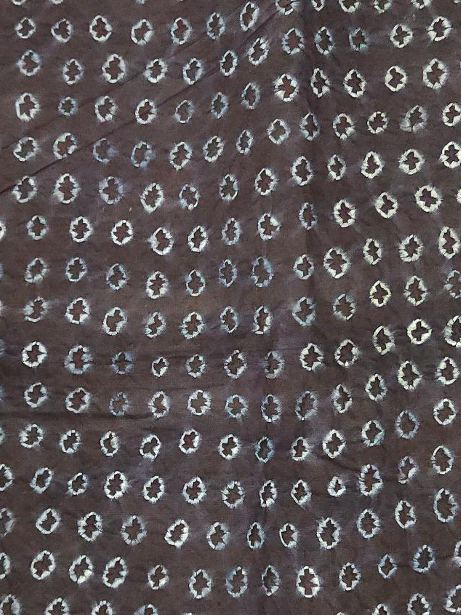
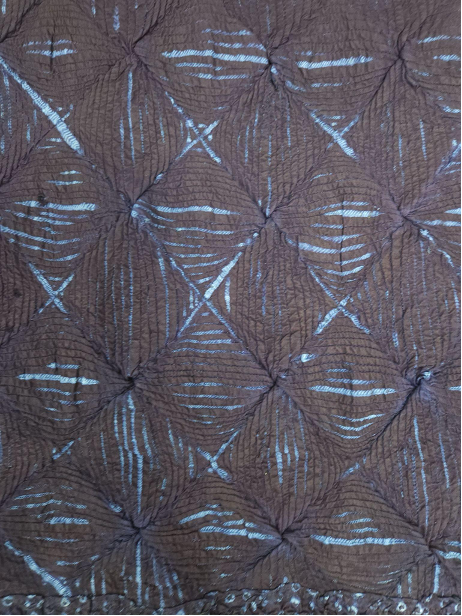
(Nike Okundaye collection) — photographs by the author
Traditionally, adire production has always been a collaborative process based on a division of labor. The aladires, artisans or artists, are responsible for creating the different patterns, whether hand-drawn (generally by women) or designed and cut using metal stencils (generally by men). This division of labor, which includes specialists in tying, stitching, folding, or the use of seeds and other materials to create patterns, highlights the shared responsibility and community-based ethos that structure adire production. The alaro, dyers—primarily those working with indigo—are women (Barbour, 2016; Picton & Mack, 2021; Wenger & Beier, 1957).
Adire market traders are also, for the most part, women, who occupy a central position in the Yoruba market economy. In the adire commercial center in Abeokuta, most traders are or have been linked to families of aladires/alaro, or have themselves previously practiced these activities. This underscores the decisive role of women in this artistic form, from the creation of complex patterns to the execution of elaborate techniques, and especially in the indigo dyeing process for adire production. Although tasks are no longer strictly divided along gender lines today, women remain the majority throughout the entire process. It is also worth noting the current prevalence of synthetic dyes. In Itoku, approximately 1,000 five-meter pieces of adire are produced daily.
The alaro, master dyer of indigo, has within her space a dedicated site for Iya Màpó—a figure of the first woman who transmitted to others various skills traditionally associated with femininity, such as pottery, the making of dudu soap (black, dark soap), and indigo dyeing—to whom prayers, sacrifices, and offerings are addressed before the dyeing process begins. This ritualized aspect of adire production highlights its deep cultural and spiritual significance within Yoruba tradition. According to Mason (2016, note 4), there is also a dyeing deity, Ajé Sàlúgà, associated with dyes derived from shells and mollusks. A connection with Ifá is also mentioned: a primordial bird is said to be the keeper of dyes. According to a Yoruba traditional song, the great blue turaco—Agbe in Yoruba, named for its beautiful blue plumage—would be the one who possesses the dark indigo dye (Campbell, 2016, para. 10).
There is also a link between indigo, adire, and the orisha Oshun, as well as with the city of Oshogbo. The city is known as ilu aro in Yoruba, “the home of dyeing,” and it is traversed by the Osun River, where the sacred grove of the deity is located. According to Yoruba mythology regarding the founding of Oshogbo, a group of hunters sought to settle on the banks of the Osun River. However, when they cut down trees that had fallen into the river, a deep voice emerged from its depths, protesting against the destruction of its indigo vats. It was the orisha Oshun, the first dyer in Yorubaland and the holder of indigo.
In Oshogbo, both traditional indigo dyeing and synthetic dyes are used in adire production, particularly in the workshop of the artist Mama Nike Okundaye and those of her disciples, such as Leken Adegun and others, as well as in a traditional alaro family whose grandson still continues the practice of indigo dyeing today. Currently, traditional indigo dyeing is mainly sought after by an expatriate clientele oriented toward export, by local patrons, or by textile enthusiasts.
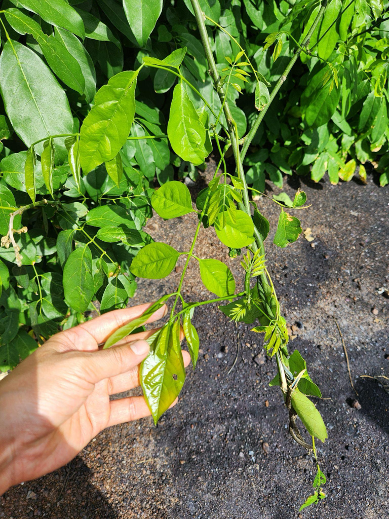
Mama Nike Okundaye in Oshogbo
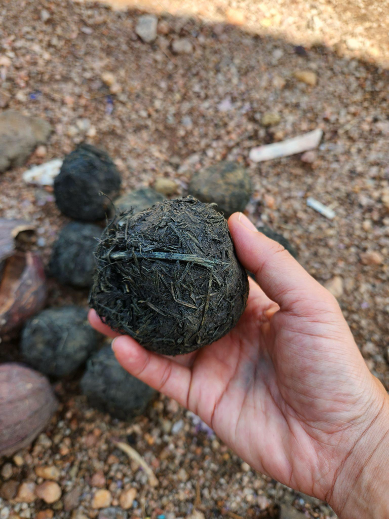
It is interesting to observe that the Yoruba indigo tradition did not cross the Atlantic. In the context of Afro-Brazilian religions, Oshun is associated with the colors yellow and gold, and indigo is not mentioned as a color of this deity, nor as part of a dyeing tradition in Brazil. The cults of the orishas have also been transformed in the diaspora and in Brazil, incorporating other deities of Fon and Kongo-Angola origin, and sometimes Indigenous entities as well as other spiritual presences.
It should be emphasized that plants occupy a central place in the worship of orishas, particularly for healing, spiritual protection, and enchantment, both in the Yoruba context (Verger, 2025) and in the Brazilian context:
Candomblé also preserves the idea that plants are sources of axé, the vital force without which there is no life or movement, and without which worship cannot be performed. The Yoruba maxim “kosi ewê, kosi orixá,” which can be translated as “without leaves, there is no orisha,” clearly defines the role of plants in rituals. (Prandi, 2005, p. 110)
Although there are traces of indigo use among Indigenous peoples in Brazil and the Americas, as well as colonial attempts to cultivate and exploit native indigo (Indigofera suffruticosa), and even the introduction of the Indian species (Indigofera tinctoria) by Portuguese governors in the seventeenth and eighteenth centuries, what is mainly observed is the mention of the labor of Indigenous peoples and enslaved Africans in the cultivation and processing of indigo (Chambouleyron & Cardoso, 2014; Dean, 1991). It can thus be said that, in the Brazilian context, attempts to cultivate and extract indigo were sporadic during the colonial period and remain largely little known, although they have recently gained greater visibility through various initiatives[2].
One of the West African plants containing indican is Lonchocarpus cyanescens, called elu in Yoruba[3]. Initially, the plant is harvested and ground in a type of mortar. Balls of elu of approximately 10 cm are then shaped and left to dry in the sun. The alaro—aro referring to the blue color of indigo—carries out the complex process of extracting indigo from these balls, which are then mixed with a solution originally obtained from the ashes of an alkaline wood (Anogeissus leiocarpus), called ayin in Yoruba (Oke, 2016, p. 37), and left to reduce through fermentation. The number of elu balls used varies according to the desired shade of blue; they are fermented in a filtered alkaline solution or aluba (in Yoruba), obtained from wood ashes or cocoa pod husks.
In the vicinity of Itoku, a few families continue to practice indigo dyeing, albeit with adaptations. According to Olatunbosun, it is important to note that for dyeing based solely on synthetic colorants, anyone can work, unlike indigo dyeing, which is reserved for certain families historically specialized in this practice. I accompanied the alaro Mama Ayedun Olaide Folawiyo for a few days in her family compound. She had learned the craft from her now-deceased grandmother. Known as Mama Zaineb, Folawiyo received fabrics already prepared with eleko patterns, dried or already stitched, and then dyed each five-yard piece in one of the three indigo vats located in the open space of the house.
Many children, aged 6 to 10, including her nephews, participated by helping to retrieve the dyed fabrics, laying them out on the ground to dry, and then immersing them again in the dye baths. According to her, she herself had learned the craft as a child, by observing and assisting her grandmother. Four different ceramic pots contained the indigo baths (ikoko aro, in Yoruba); she used one while the others rested. It is known that master dyers can “rest” an indigo vat and then reactivate it by properly adjusting ingredients, temperature, alkalinity, and other variables (Oke, 2016; Stanfield, 2016).
At one point, in preparing a vat, Mama Zaineb added elu balls, then caustic soda, and finally a black, shiny powder she called jellu—according to the alaro, it was a natural dye that darkened the fabric. At that moment, it did not seem exactly “natural” to me, although the boundaries between natural and artificial appear blurred here. Other limits, misunderstandings, and zones of opacity also permeated the exchange: Olatunbosun having been able to accompany me only on the first day, I went alone on the following days, without a Yoruba interpreter, while Mama Zaineb spoke little English.
Without a doubt, many gaps, uncomprehended elements, and multiple words traversed by the “not only” shaped this flow of experience. I tried to ask her about aluba (ash lye), about the ashes themselves; she replied that she did not know these processes and that she strictly followed the same recipe—caustic soda and jellu—as her grandmother. This struck me as surprising, since according to the literature (Hamilton, n.d.; Kalilu & Areo, 2015; Oke, 2016) and exchanges with Mama Nike Okundaye, at least ten dye baths would be required to obtain a dark blue, whereas Mama Zaineb achieved a dark blue in six baths, at most eight.
The transformation of leuco-indigo into indigotin pigment occurs through oxidation when the fabric is removed from the vat, and an increasingly darker blue is obtained through successive dye baths (Balfour, 2006; Cardon, 2014; Postrel, 2020). Here, caustic soda replaced the ash decoction (aluba), but my question concerned the nature of jellu. I purchased a small quantity in order to analyze its composition, which I have not yet been able to do[4]. However, subsequent research at the National Archives of Abeokuta—where a section was devoted to adire in the 1920s–1930s—leads me to think that jellu may be a synthetic form of indigo.
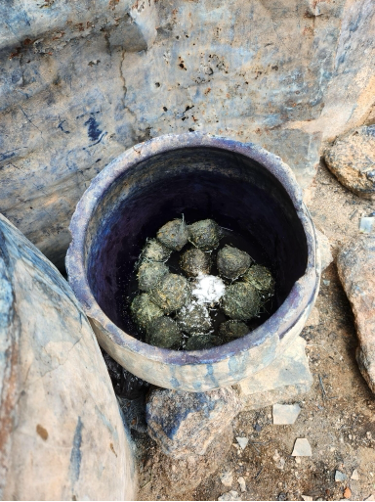
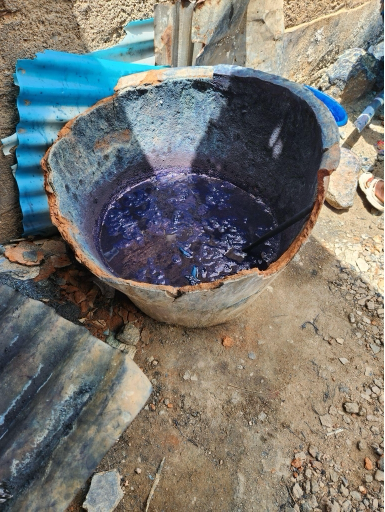
Since the beginning of the twentieth century, synthetic dyes were introduced during British colonial rule. It was once said that every house in the city of Oshogbo had a few elu trees in its courtyard, but today it is rare to find them, except for dried elu balls sold in the market, which come from the city of Ede.
However, it is essential to understand that the tradition remains alive. The introduction of synthetic dyes and caustic soda (which replaces ash decoctions) has made the dyeing process—once highly laborious—much faster. In the early 1920s, an issue related to the proportions of caustic soda had already been identified: excessive use could compromise fabric quality, as shown in documents from the period prohibiting the use of synthetic dyes and caustic soda by the Alaka of Abeokuta (Abeokuta Archives).
Once the appropriate proportion was established, the majority of indigo alaro in Abeokuta worked with elu balls (indigo) mixed with synthetic dyes and caustic soda, without the use of ashes. Moreover, the introduction of synthetic dyes, particularly BASF Indanthren in the 1960s, enabled a wide chromatic range in textiles. The colonial experience, although disruptive through the introduction of new materials such as caustic soda and synthetic dyes, runs through the dyeing tradition and ultimately becomes integrated into it.
After consulting the archives, I understood that the older technique using ash decoction had long been abandoned, and that a mixture of elu balls, caustic soda, and synthetic indigo now constitutes the contemporary form of indigo dyeing. The multidimensionality thus runs through Yoruba indigo, now composed of an assemblage of dried leaves and synthetic indigo. The intertwining of materials and practices, complexly entangled, shows that modernity does not fully impose itself but is negotiated and enters into friction with materials and meanings.
At first, I thought that “tradition” was no longer being practiced. Then, in discussions with Mama Nike, I learned that only her centers and a few rare alaro still use exclusively elu balls and ash decoctions, in a longer and more demanding process. In almost all production around Itoku today, indigo dyeing results from this friction with modernity, and synthetic dyes continue to be mixed with dried elu leaves.
Another element that drew my attention is that the alaro I accompanied, Mama Zaineb, at one point tasted the liquid in the vat to check whether anything needed to be added. It is indeed known that traditional dyers, in the absence of pH measurement instruments, assess the alkalinity of the solution through taste and the sensation of burning on the tongue. Here again, in this encounter between practices, techniques, and materials, a mode of knowledge grounded in the body and in the sensory experience of the dye solution persists, even though ashes are no longer used. Of course, caustic soda makes the process potentially dangerous in the long term. Yet this form of embodied, sensory knowledge appears to have been maintained despite the introduction and replacement of certain materials.
I also met another family of dyers, one of the few still engaged in a practice of indigo mixed with synthetic dyes in Abeokuta. This time, the encounter took place in the presence of Ayo Olatunbosun, who acted as mediator and translator. Mama Jolaoso and Mama Ajarat had also not heard of ash decoction (aluba) and likewise used caustic soda instead, as well as elu balls and jellu.
It is nonetheless possible to infer that the importance of preserving indigo leaves in the mixture, despite the use of synthetic products, is linked to the symbolic power and the sacred and therapeutic meaning of indigo. Only members of this family are allowed to touch the dyeing tools and the vat, as elu, the indigo leaf, is understood in its protective and spiritual dimensions. According to Olatunbosun, residues from the vat, as well as certain containers used for mixing and dried elu balls, are sold in the market for their spiritual properties and mystical power.
Adire production, particularly dyeing, cannot be carried out during the rainy season (June to October), as the fabric depends on sunlight to dry in the open air. When I accompanied Mama Zaineb, I asked whether this did not pose an economic problem, since no income would be generated during this period. She replied that they needed the rain to have enough water and that they had already organized themselves not to work during those months. The water cycle is thus respected as an integral part of the adire-making process. She was also one of the few people to mention Yemoja[5], another orisha associated with waters, which she in turn related to indigo. Moreover, even dyers working exclusively with synthetic dyes offer prayers and sacrifices to Iya Màpó to ensure the success of the dyeing process. More-than-human agency is thus present in adire production, in the water cycle, and in the intervention of deities.
In the Yoruba context, there does not appear to be a clear separation between nature and culture: these dimensions are deeply entangled. The water cycle is part of the adire production process, just as the elu plant and even jellu are, without a strict distinction between natural and synthetic products as opposing categories, nor any hierarchy between what would be “authentic” and what would not. While expatriate and foreign audiences often perceive this mixture as a form of loss of authenticity, Yoruba understandings instead maintain that this composition remains indigo, endowed with the same aesthetic and spiritual properties.
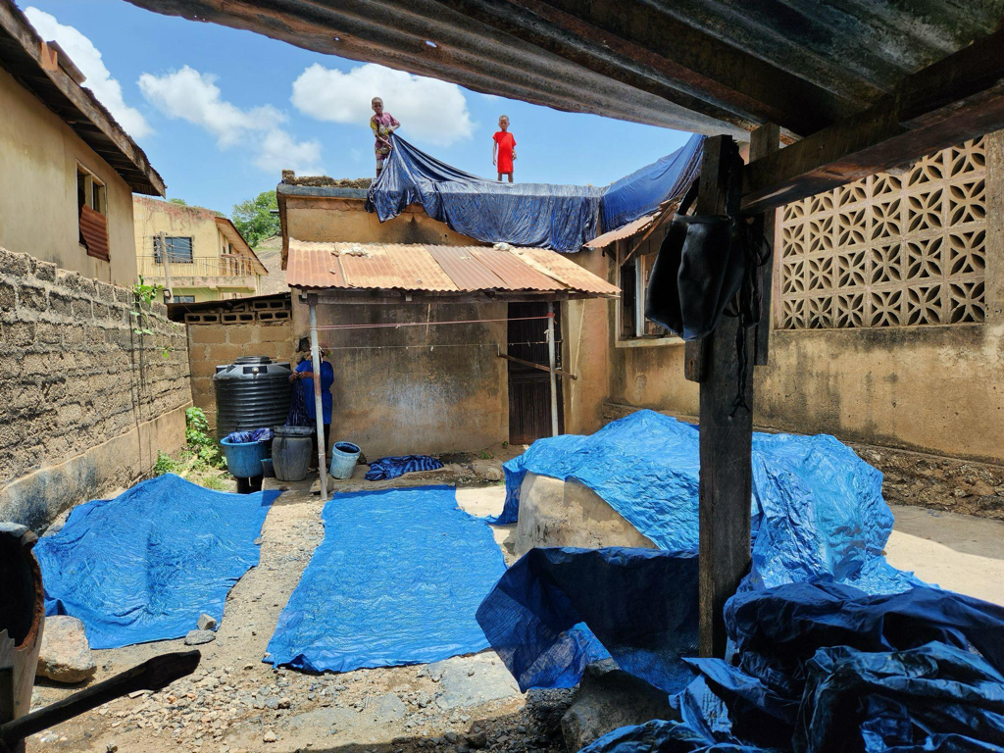
Although Akinwumi (2015) argues that adire refers exclusively to fabrics produced through dyeing, folding, stitching, and cassava starch resist techniques, and does not consider adire alabala (wax-resist) or batik as adire, the term is now also used to designate batik or Kampala. The majority of artists now produce textiles using cassava starch, wax, and synthetic dyes, including Mama Nike, artists trained under her supervision, as well as other artists such as Peju Layiwola.
Adire alabala or batik is a much faster process, as it dries immediately, enabling the rapid creation of a wide range of new patterns and designs. With wax-resist techniques, in addition to freehand drawing, foam stamps have been introduced. According to Akinwumi (2015), one of the factors contributing to the decline of adire in the 1970s and 1980s was the lack of new motifs and inventiveness, coupled with the widespread availability of cheap industrial textiles.
It is also important to emphasize that tradition has never been fixed; rather, it is in constant transformation, particularly in the Yoruba context. As Yai (1994) states:
In such a culture, the recurring art-historical question of tradition and creativity is less tragically posed, resolved, and experienced; to a large extent, the binary opposition between tradition and creativity is neutralized. Tradition in Yoruba is àsà. Innovation is implicit in the Yoruba idea of tradition. […] One cannot call àsà something that is not the result of a deliberate choice (sà) grounded in discernment and awareness of historical practices and processes (ìtàn) on the part of an individual or collective orí. And since choice presides over the birth of àsà (tradition), it is permanently open to metamorphosis. (pp. 113–114)
Adire has always told stories: its images and motifs are linked to proverbs and narratives. Mama Nike Okundaye has stated that it is a way for women to tell stories and express themselves, constantly integrating diverse responses to changing environments and contexts, as a living àsà (tradition).
The adire production process thus presents itself as a site of transformation, as a tradition in flux that incorporates the addition of new materials. Materials, motifs, images, fabrics, plants, water, deities, and humans all participate in the making of adire, within flows marked by frictions and contradictions, yet which nonetheless continue to converge in its dyeing processes and patterns.
Japan — Aizome
At the beginning of November, I conducted research in the city of Arimatsu, famous for the shibori (絞り) technique—literally “to twist, to bind”—historically produced using indigo, although in contemporary contexts most production now uses synthetic dyes. Since 1600, Arimatsu has been an important textile production center, known for highly elaborate patterns based on more than one hundred different designs.
At the Shibori Kaikan Center, it was possible to visit the museum, attend demonstrations of sewing and tying different patterns performed by local craftswomen—each specializing in a particular motif, such as tekumoshibori (手蜘蛛絞り, spiderweb pattern) or rasenshika (羅仙鹿, “fine silk of the hermit deer” pattern)—and to take part in hands-on experiences. The city of Arimatsu is thus considered part of Japan’s cultural heritage, and the tie-and-stitch dyeing technique known as Arimatsu Narumi Shibori (有松鳴海絞り) is recognized as an important national craft tradition.
It seemed interesting to me to relate the terms shibori (絞り) and adire (“to tie,” “to bind” in Yoruba), especially as many patterns produced through folding, stitching, and tying show striking similarities across both contexts. Fabrics, when sewn and folded in different ways, produce distinct patterns once dyed, depending on the areas exposed to color. As in the Yoruba context, there are also specific names for each type of motif in Japan.
It also seemed significant to observe that most dyeing in Arimatsu is now carried out using synthetic dyes, similarly to what I observed in Yorubaland. Although it is more common to encounter industrially dyed textiles, there remains a significant number of indigo dyeing practices based on traditional methods, relying on the composting of dried leaves and fermentation processes for vat preparation.
In this section, I focus on the indigo dyeing process based on my experience in a ten-day workshop entitled “Learning Indigo” (藍を学ぶ), organized by the Rotary Club of Tokushima and offered by Buaisou—an atelier that has been carrying out the entire Japanese indigo production process since 2015. This process includes the cultivation of tadeai (蓼藍, Persicaria tinctoria or Polygonum tinctorium), compost processing or the production of sukumo (蒅), as well as the dyeing of fabrics, yarns, and other materials using various techniques.
The Buaisou workshop was founded by Kakuo Kaji—a designer and master dyer—in Kamiita-chō, a small town in Tokushima Prefecture, considered the main indigo production center since the Edo period (17th–19th centuries). Traditionally, indigo production was divided into specialized roles: the plant cultivator, the aishi (藍師), an indigo specialist responsible for composting dried leaves to produce sukumo, the dyer (藍染屋, aizomeya), and the indigo merchant (藍商, aishō).
In recent decades, with the decline in indigo cultivation and the reduction in sukumo production—a composted form that yields a deeper, longer-lasting color and can be stored for several years—this specialized division of labor has become more difficult to maintain. Nevertheless, the main cultivation and composting area remains Tokushima, and the principal aishi, particularly the Satō and Nii families, are still based in the surrounding region.
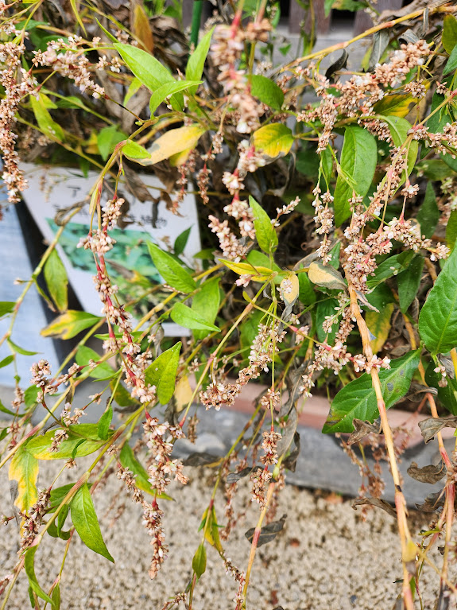
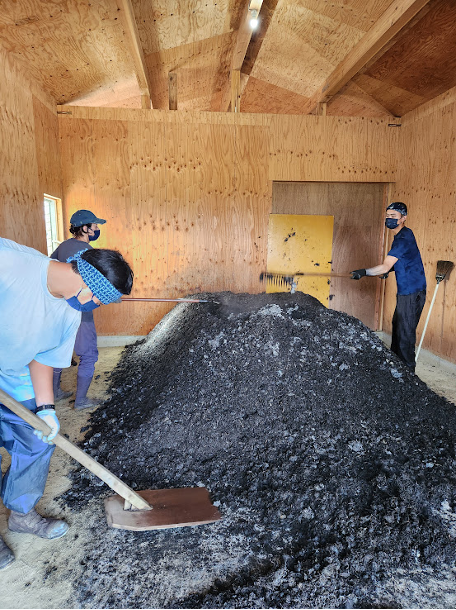
During the first ten days of the workshop at Buaisou, led by Kaji, I was able to learn part of the history of Japanese indigo as well as its various processes and techniques. Each year, the soil is prepared with fertilizers for the sowing of indigo (tadeai, 蓼藍), before the seedlings are transplanted into the fields. No pesticides are used, and weeds are removed by hand. An initial harvest takes place in mid-July, during which only certain parts of the leaves are collected, allowing the plant to continue growing, followed by a final harvest in August.
The leaves are then separated using a machine and left to dry in the sun during the summer. On the main island of Japan, sukumo (蒅) is produced—a material whose preparation requires approximately four months of fermentation and is used to obtain a more durable indigo color. In October 2023, the preparation of sukumo (蒅) began.
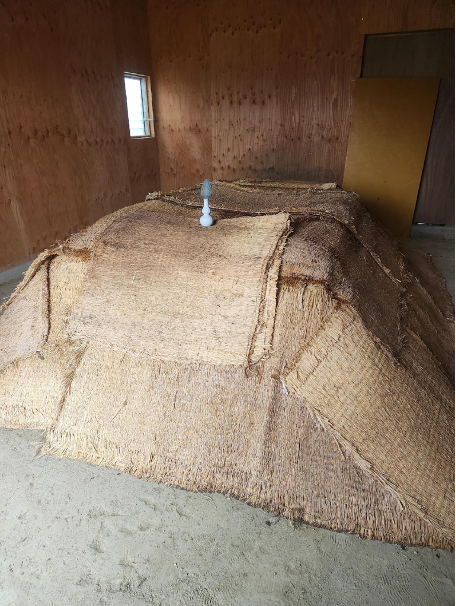
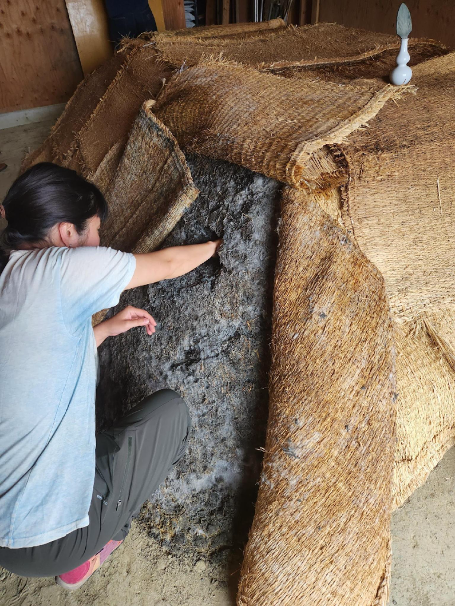
In this process, only dried leaves—generally at least one ton—mixed with water are placed in the resting chamber, the nedoko (寝床), an earthen-floor space that remains closed and where nesekomi (寝せ込み) takes place, a period during which the leaves “sleep” for four to five months in order to ferment. The leaves are covered with mats made of plant fibers. Each week, the leaves are turned and water is added, an operation known as kirikaeshi (切り返し).
At the moment the leaves are put to “sleep,” an amulet of the indigo deity Aizen-an (藍染庵) is placed above, and sake is offered. Just as in the case of Iya Màpó, to whom prayers are addressed in Yorubaland—sometimes accompanied by fruit—prayers and sake are also offered to the indigo deity in Japan. The sacred and the agency of deities, spirits, and ancestors are thus fully integrated into the process in both traditions.
During leaf fermentation, the temperature of the mixture reaches approximately 70°C. The finished sukumo (蒅) has an earthy appearance and is usually packed into fiber bags for sale to dyers.
As already mentioned, indigo—the generic term referring to the characteristic blue color—derives from a dyeing process originally based on plants containing the indican molecule. The dried leaves of plants such as Persicaria tinctoria (tadeai, 蓼藍), Strobilanthes cusia, or Ryūkyū ai (琉球藍), a plant used in Okinawa—an island in southern Japan—release, once placed in water, indican as well as an enzyme that reacts with it to produce an intermediate compound called indoxyl. Oxygen molecules quickly bind to indoxyl to form indigotin, the pigment responsible for the color.
However, since indigotin is insoluble in water, it cannot be used for painting without a binder. For dyeing textile fibers, it is necessary to raise the pH to make it alkaline and to reduce oxygen through fermentation, via the action of bacteria, which distinguishes indigo from most other plant dyes. According to Kawahito (2015), these are bacilli producing reductase enzymes that induce fermentation. Both the composting of sukumo and the indigo vat itself are considered living and active systems that must be maintained in this state; highly experienced master dyers can “put them to sleep” and later reactivate them.
Thus, sukumo is carefully maintained until the end of its fermentation process.
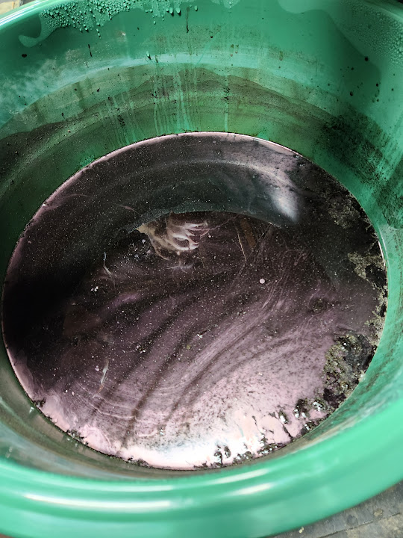
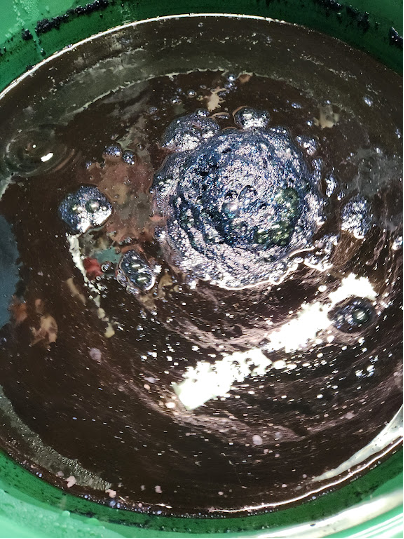
We prepared an indigo vat from sukumo (蒅) produced on site, in a large plastic container, which was then transferred to another space to continue the dyeing process. Recipes vary among dyers and workshops, both in terms of proportions and the agents used (Akiyama, 2021; Kawahito, 2015, 2020; Nihon no Ai, 1994; Okamura, 1965; Ooba, 1983; Yamazaki, 1989; Yoshihara, 2019).
In addition to sukumo, an alkaline decoction (decoada) at different concentrations is used, along with a porridge made from wheat bran (fusuma, 麬) and a powder made from crushed shells. According to Kaji, the use of the third decoction is essential, as it has a pH of around 10, which is relatively moderate: excessive alkalinity slows the growth of bacteria and delays the start of fermentation. The temperature and pH of the vat are measured daily, sometimes twice a day.
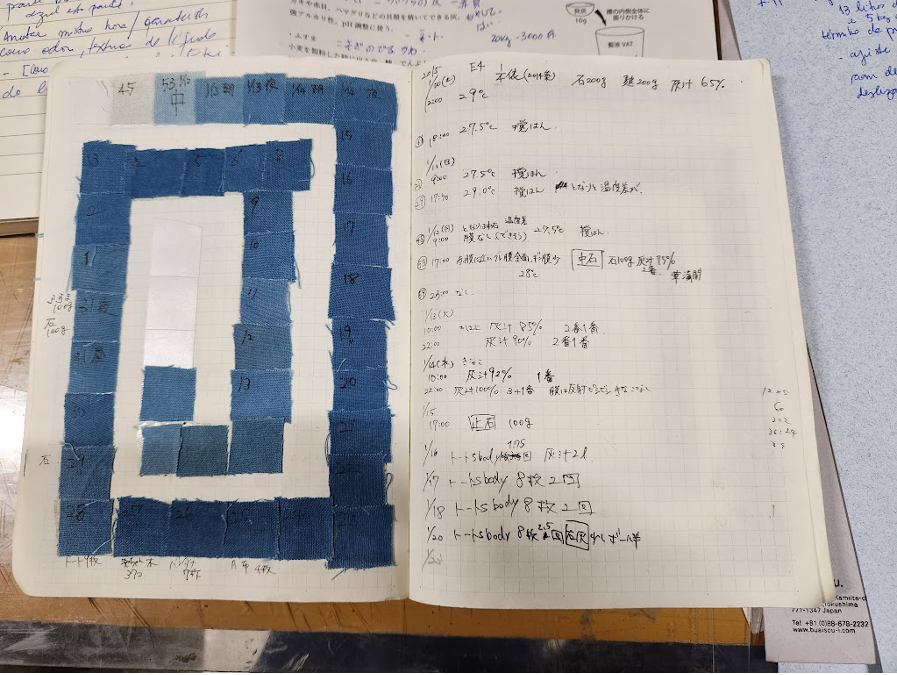
At Buaisou, temperature is measured, but Kaji is also able to assess pH through the texture of the liquid, the appearance of its surface, its color, and its smell. It is one of the few workshops in Japan that does not systematically rely on pH measurement. According to him, perceiving pH through the texture of the liquid requires rubbing the fingers in the solution: if the consistency is slightly slippery—in Japanese, richly onomatopoeic, this is called nurunuru (ヌルヌル)—it indicates a high pH; a lower pH is expressed by another term, kyukyu (きゅきゅ), which conveys a sensation of resistance and frictional sound.
All workshops maintain some form of vat journal, in which the temperature of the liquid is recorded, along with the color observed from a fabric sample immersed for about one minute, as well as the characteristics of the vat surface and its smell. A pH that is too low—associated with the kyukyu sensation and a ferruginous smell—can be dangerous, as the vat risks deteriorating. Conversely, when the pH is too alkaline, wheat bran, sake, or liquid brown sugar is added to promote oxygen reduction and restart fermentation. The contents must be stirred almost daily using precise gestures.
This reading of the vat and fermentation through the senses constitutes a form of knowledge that is difficult to translate into verbal language, but which reveals the entanglement of multiple assemblages: bacteria, plants, and human capacities to interpret the cues of the process.
Traditional indigo vats were made of ceramic and buried in the ground, with lateral openings allowing plant-fiber embers to be inserted in order to maintain a higher temperature in autumn and winter. At Buaisou and in some contemporary workshops, these large ceramic pots have been replaced by eight 150-liter stainless-steel vats, heated by an electric system. However, it is still possible to observe such traditional devices in several places, notably in the village of Kasama, located near the former imperial capital of Nara, which was an important indigo production center from the eighteenth to the twentieth century.
Many vats of the older type can also be found in Kurume, in Kyūshū Prefecture, which I visited at the end of November. This city is famous for its textile ikat, known in Japanese as kasuri (絣), which produces patterns by pre-reserving certain sections of the yarn before weaving. During a visit to a workshop, one of the main aishi (藍師), indigo sukumo (蒅) producers from Tokushima, Mr. Satō, mentioned that his grandfather had continued to cultivate tadeai (蓼藍, Japanese indigo) in secret during the Second World War, despite government prohibitions on non-food crops.
According to him, his grandfather’s justification was linked to Kurume: without tadeai cultivation and sukumo production, Kurume Kasuri (久留米絣) textile production would have disappeared. Originally, the yarn was dyed with indigo, and until the early twentieth century weaving was done on manual looms. These situations can be read as experiences of rupture or friction with coloniality, where the Japanese imperial state, during the Second World War, threatened the cultivation of dye plants and the transmission of dyeing knowledge—a transmission that nevertheless persisted clandestinely.
I visited the Sakata Orimono (坂田織物) workshop, which uses industrial machines and synthetic dyes, but continues to employ indigo and manual looms for certain productions in order to preserve tradition. I also visited the Ikeda workshop, which has been producing Kurume Kasuri (久留米絣) for one hundred years and is among the few workshops that use only indigo and manual looms. Mr. Ikeda also mentioned that, in the past, dyers would taste the vat liquid to check for a burning sensation on the tongue, expressed in Japanese by another onomatopoeia: piriri (ピリピリ), exactly as in Yorubaland.
In the past, in the absence of pH measurement, it was through the body and sensory perception—beyond vision—that the vat was “read,” and that one knew how to adjust conditions in order to balance the multiple agencies between plants, bacteria, and humans.
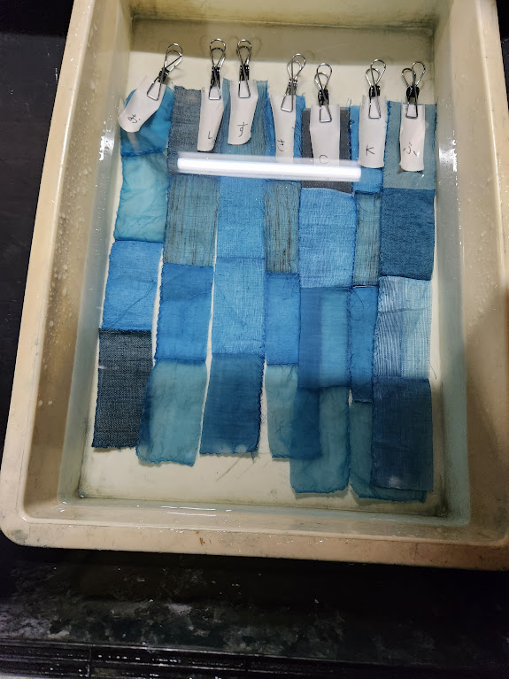
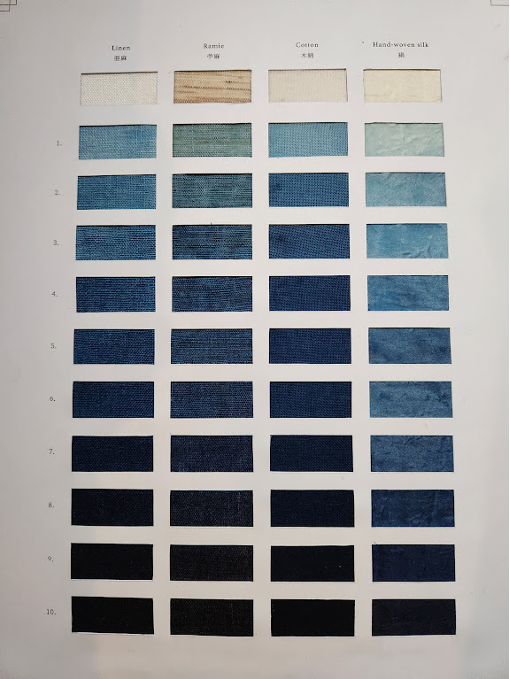
At Buaisou, by the third day, the vat had already changed: we could perceive a fermenting alcoholic smell, while the texture of the liquid was nurunuru (ヌルヌル), indicating strong alkalinity. Observation of the liquid surface also reveals transformation and the possibility that the color is already ready for dyeing. According to Kaji, a slightly shiny membrane (gin maku, 銀膜) or a sparkling effect (kirakira, キラキラ) would indicate a high pH. A reddish surface (aka maku, 赤膜), on the other hand, is a sign that blue color can emerge. Observation on the third day still revealed a light blue tone.
On the fifth day, a surface resembling a rainbow reflection appeared, but the layer was thin and fragile, which again indicated a pH that was too low or a “tired” vat. In other words, the process is in constant transformation: the vat constitutes a living assemblage of plants, ashes, sugars, bacteria, humans, and sometimes spirits and deities. Understanding the process therefore relies on multiple human senses—touch, smell, vision—without being reducible to any single one of them.
Tsing (2023) already emphasizes the need to integrate other forms of perception and additional senses beyond vision and verbal language in order to access more-than-human agencies. In this partial translation of the state of the living indigo vat, there is always a “not only,” something that escapes us. Each day, each hour, the vat is different, and it is up to humans to partially read the other agents and the states of transformation of the dye bath.
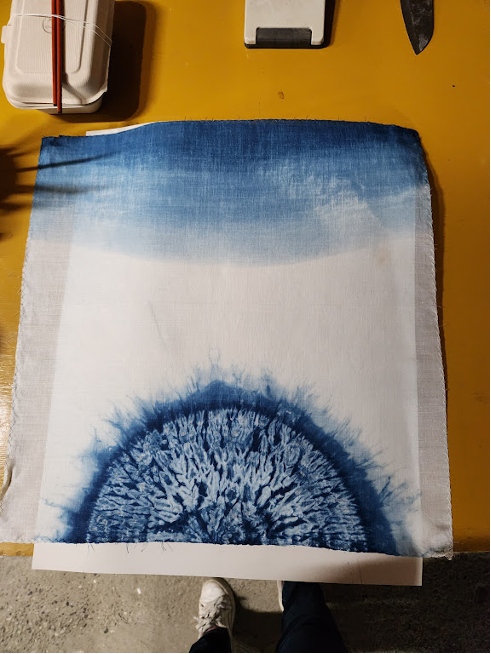
Finally, on the afternoon of the sixth day, the smell was fruity, indicating good fermentation. A firm purple flower formed at the center, and the color became more intense and stable. It became possible to begin dyeing various fabrics, and even paper. After each bath, according to Kaji, the vat must rest. Fatigue also leads to a decrease in alkalinity, making it necessary to add materials that raise the pH. Thus, the process continued until the tenth day, in a delicate balancing act, with careful observation of color, surface, touch, the texture of the liquid, and revealed smells—variables that indicate fermentation, bacterial activity, and indigo color.
For me and my colleagues, it was sometimes difficult to read these subtleties through the senses. For Kaji, it was knowledge already inscribed in the body: depending on the signs of the vat, alkaline decoctions, crushed shells, oxygen, or sugars were added.
This care given to the vat as a living being accompanies indigo dyers (藍染屋, aizomeya) in various forms. Other artisans working with Kaji have reported that, during their training at the indigo production and learning center supported by Tokushima Prefecture, Waza no Yakata (技の館, “House of Techniques”), his attention to the vat was such that he would send trainees to check the temperature, smell, and appearance of the bath even during the night.
A large 100-liter indigo vat, such as the one at Buaisou, can, if properly maintained, last about six months, alternating with other vats.
It is interesting to note that, while in the Yoruba context the art of dyeing is strongly associated with women, in Japan the vast majority of dyers are men. Many explain this by the physical strength required for repetitive work, where large fabrics or bundles of threads are immersed in vats, becoming heavy when wet, also requiring careful but firm wringing. Curiously, the same argument is not invoked in the Yoruba case.
At the end of December, I participated in a private workshop with another master dyer, Takayuki Ishii, in his Awonoyoh studio in Fujino. According to Ishii, sukumo (蒅) would be a feminine entity and therefore would have a preference for men. He cultivates tadeai himself, producing part of his own sukumo. In addition to indigo dyeing using various techniques, he develops contemporary patterns, especially for kimonos and obis, and gives workshops and courses in Japan and abroad.
For Ishii, the main interest of this practice lies in the challenge of the delicate balance of the fermentation process, as well as in the making and maintaining of the indigo vat as a living system. According to him, indigo is the only truly interesting dyeing process because of its living and fermentative character, absent from other dyes.
The only female dyer I met, Kayo Inoue, from the village of Kasama, continues dyeing in order to preserve the workshop and the legacy of her father-in-law’s family of dyers. She was the only one who referred to the indigo vat as a being that must be cared for like a child. During my visit to Kasama, on an extremely cold day, Ms. Inoue expressed regret at having lost four indigo vats during the summer, when they spoiled due to high temperatures.
It seems that the climate crisis and global warming are already affecting and altering the delicate balance of living indigo vats.
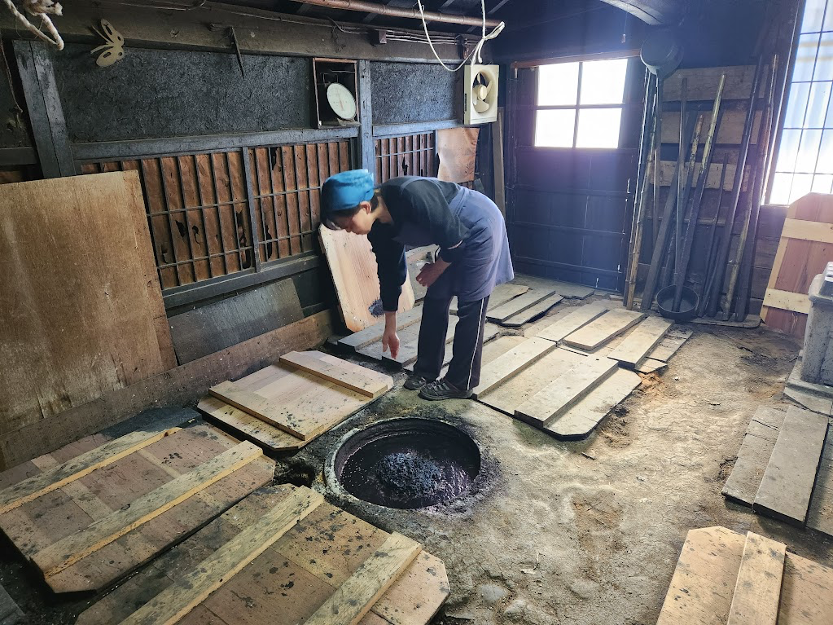
At the end of the workshop, after caring for the vat twice a day and dyeing with it, someone named it Ai-chan (藍ちゃん, “little indigo”), the suffix -chan being a Japanese diminutive, often used affectionately to refer to people, especially children. From then on, we too became attentive to the ferruginous smell, the fragile surface, the kyukyu (きゅきゅ) texture, and many other signs.
Many of the questions I asked different aishi and aizomeya dyers received laconic answers. Regarding the offering of sake to Aizen-an (藍染庵), all referred to a tradition: it was a way of thanking and soliciting the deity for a good sukumo (蒅). Concerning the New Year ritual, the answer was similar: it was important to thank the past year and to ask for a favorable year for dyeing. In general, great attention was given to technical details and to the dyeing process, but questions about reasons, symbolic dimensions, and associated narratives received brief and condensed responses.
One of the recurring observations was that the veneration of Aizen-an (藍染庵) fits within a ritual framework comparable to that through which Japanese people visit Buddhist and Shintō temples at New Year in order to give thanks and ask for good fortune.
There is also, in Japan, a cultural dimension in which many things are not explicitly stated. A common expression is “reading the atmosphere” (kuuki wo yomu, 空気を読む). As also observed by a designer friend who participated in the “Learning Indigo” workshop (藍を学ぶ) at Buaisou, Keiko Sugiyama, much of this knowledge is inscribed in the body.
Undoubtedly, in the very experience of caring for the vat and dyeing, as Kaji sought to show us, recognizing what the vat needs involves bodily perception engaging all the senses: sight, touch, and smell. Maintaining the indigo vat as a living system means going through the process with the body, perceiving sensations sometimes translated into onomatopoeic sounds, in order to nourish, together with bacteria and multiple other materials, the blue—by adding air, crushed shells, ash water, or glucose sources, perhaps even under the intervention of the indigo deity.
This fine, complex, and multiple synergy, both ritual and everyday, enables the dyeing of different fibers that acquire, with each bath and through contact with air, ever-renewed shades and depths, revealing and intensifying indigo blues.
Towards Other Horizons of Experiential Knowledge
Professor Liliana Morais, from Rikkyo University, with whom I was able to exchange ideas and participate in a seminar, also observed in Japan an overlap between habits and superstitions, or widely shared beliefs. It was she who shared with me a quotation from Ingold (2002), which seems to illuminate other ways of thinking about knowledge and stories. Drawing on the Ojibwa context—one of the Indigenous peoples of North America—it involves understanding forms of knowledge grounded in experience, not centered on mental representation or the accumulation of knowledge, but unfolding as movement through multiple senses, and thus difficult to formulate in propositional terms. This type of knowledge is close to that of the artisan, who does not separate elements but learns with and through matter:
In fact, this knowledge, very close to that possessed by a skilled artisan in relation to his raw material, is not easily articulable in propositional form and seems to be devalued by any attempt to do so, to detach it from its basis in the context of the knower’s personal engagement with what he knows. (Ingold, 2002, p. 99)
Here we find the idea of considering indigo knowledge, both in the Yoruba and Japanese contexts, through forms that do not necessarily lend themselves to translation into propositional statements. In a sense, this also runs through the Japanese context, particularly this sensory knowledge that unfolds in movement, such as that of the artisan, the indigo dyer, or the sukumo producer. This sensory dimension also appears in the functioning of indigo vats in Yorubaland.
It also seems to me that the exploration of other forms of knowledge is necessary precisely to grasp the dimension of the multiple human and non-human agencies involved in the indigo dyeing process—from plants to molecules, from bacteria to deities—whether in Japan or in Yorubaland.
The processes observed in both spaces were also experienced by myself, which made it possible to perceive both their dialogues and their divergences. The indigo vat is alive in both contexts, requiring, for dyeing to occur, processes, offerings, and conversations. The fragmentary nature of explanations regarding the importance of deities is perceptible in both spaces, although in different ways. And even when not explicitly articulated, their presence remains obligatory and continuous: it is a ritual of presence.
As Tsing (2023) indicates, regarding ways of following non-human practices, one must consider other forms and other languages, and above all learn to listen, read, and feel with human practitioners—such as Yoruba alaro and Japanese aizomeya—who know the indigo vat assemblage as a living being composed of deities, plants, bacteria, and ashes. Other senses beyond sight thus enable knowledge, even beyond temporality. The body is fully involved in the process in both contexts: it touches, feels, tastes indigo. It is a form of knowledge that requires bodily engagement, breaking with the separation that the Global North, or the West, imposes between body and knowledge.
The spaces of the Global South also appear as sites for the production of knowledge according to different modalities. Here, knowing through the senses involves displacing them: hearing with the eyes or hands, seeing with the ears or tongue, mobilizing the senses to understand the subtle alchemy of plants, deities, chemical elements, bacteria, and humans. And this, even though each context configures these knowledges and sensibilities differently. Added to this is the processual temporality of the vat, in continuous transformation, perceptible or readable through the senses and through experience with multiple materials and agents. Heterogeneous elements and agencies coexist and participate in the production of the different shades of indigo.
However, the aim here is not to propose, based on this field experience, a transcultural perspective reduced to a comparison between the Yoruba context and the Japanese context. Although similarities exist, there are also many differences, and above all gaps. We draw here on Strathern’s (2004) notion of “partial connections,” because, like a fractal pattern, the goal is not to produce a model or matrix, but genealogies without a center. Rather, the aim is to attempt to translate encounters and frictions, continuities and interruptions at different scales. Emphasizing the fragmentary nature of explanations in both Japanese and Yoruba contexts seems essential to me: knowledge there is not transmitted in propositional form, but through continuous experiences over time and through the body—differently in each context. As Strathern (2004) emphasizes:
Although the imprint of a tool on a skin is no less certain because of the infinitesimal scale between skin and wood that do not touch, knowledge produces the sensation of being there otherwise to explain. Certainty itself appears partial, intermittent information. A response is another question, a connection a gap […]. (p. xxiv)
Making room for the dimension of absence and fragmentation, for what never constitutes a totality, seems essential to me in rethinking the question of experience. The challenge is also to reposition process—making itself—as a site of knowledge, as proposed by Ingold (2022), rather than the final product, in order to think another history of art from a perspective that is not entirely Western.
In this sense, the research continues through experiments and gaps in knowledge in the Recôncavo of Bahia, within a research and outreach project. Together with students, we are gradually experimenting with the cultivation of different plants—so far without great success—and with the establishment of indigo vats (using either already transformed pigment or dried leaves), observing, listening, sensing, and collectively learning with the vat and its signs.
I also recall that before my departure for Yorubaland, I organized, in December 2022, a knowledge-sharing meeting[6] on textile practices[7] in the Recôncavo and the wider region. Among the invited practitioners, the mãe de santo Nilza of Oxum, leader of the terreiro Ilê Axé Yepandá, was already interested in vegetal dyeing and was conducting research on plants from the terreiro such as urucum, crajiru, and others. It is important here to recall the fundamental role of leafy plants in candomblé, as they are carriers of axé.
Mãe Nilza made clothing for terreiro festivities and also gave sewing classes to the local community. She expressed the desire to experiment with making garments dedicated to an orixá using a dye plant associated with that divinity. Without yet knowing that Oxum was the first indigo dyer in the Yoruba world, she asked me for indigo seeds; before my departure, I left her seeds of Japanese indigo and Native American indigo.
We hope that we will still be able to produce a garment for Oxum using indigo cultivated in the Recôncavo. The aim of this project is to cultivate entangled networks of human and more-than-human relations and to learn together, so that indigo may return—not through colonial extraction routes, but in dialogue with traditions—and continue, like the Yoruba àsà, in a constant state of movement.