
Introduction
Perceptions of China in Congo are contradictory. That is the message I received over three separate conversations with my interlocutor, Nathalie, a woman of nearly thirty and with whom I was sharing a house near the center of Brazzaville in mid 2023. Nathalie was interested in exploring opportunities for small business activities to make some extra money on the side of her regular job, working in telecommunications, as her salary was too low. She was curious to hear that I was in Congo to map Chinese activities and learn about China in Congo. In one of our first conversations, she told me that the Chinese in Congo are from what she termed “bad social backgrounds” and are probably ex-prisoners, a rumor about Chinese labor that has considerable traction elsewhere (Hairong & Sautman, 2012). My suggestions that that is not based on reality fell on deaf ears. From this, I concluded she had little positive to say about China in Brazzaville. Yet, in another conversation a few days later, she asked me if I had made any contact with Chinese entrepreneurs, as “the Chinese are very good at business,” and she was thinking of importing goods from China to sell in Congo. She seemed disappointed that I had met several Chinese people so far, although only superficially, as I am not involved in business nor a fluent Mandarin speaker. About a week after this second conversation, Nathalie invited me and some of her local friends on a weekend trip to a beauty spot for a picnic just outside the city. Driving back along a decaying road with frequent potholes and long delays, which, I was told, dated from French colonialism in Congo, Nathalie angrily slammed her hand on the steering wheel. She announced that had the Chinese built this road, it would have been so much better.
Nathalie’s remarks shed light on a more nuanced picture of China in Congo than the binary views on China expressed frequently in the global North. They also underline the importance of thinking about China as it is experienced on the ground in the global South, particularly in countries with recent experiences of colonialism. These questions are not unfamiliar to me. I have been interested in perceptions of China beyond Chinese borders for many years and was in Congo as an expansion of some of my previous work on this topic in Southeast Asia. The rising visibility of China, especially around Chinese investment in infrastructure in the global South and causing a possible debt trap for recipient countries, is hardly a new picture (Freymann, 2021; Pairault, 2014; Walsh, 2022). Congo is no exception to this (The People’s Map of Global China, 2022), and this article adds to that growing literature. Scholars have long grappled with local engagements with China in Congo and elsewhere in Africa, often engaging with questions of what Chinese actors are doing, and how this is perceived, as well as whether or not this can be regarded as neo-colonial (Bräutigam et al., 2019; Mohan & Lampert, 2013; Mohan & Tan Mullins, 2019). In this paper, I extend that question by focusing on what my interlocutors do as they build futures in urban Congo, in a landscape where the rise of China is evident and French influence remains high.
My key interlocutors here are urban Congolese, all of whom lived above subsistence level and had some sort of salaried employment. This group of interlocutors formed organically; I spent time with them daily. The longer this continued, the more aware I became of how their voices were enlightening because they were very aware of how much they could win and lose as the Chinese presence became more prominent around them. They are in a position to capitalize readily on new opportunities offered by rapid processes of change that involve China. Often well-educated in Congo and abroad, and with connections overseas, they were well-placed to learn Mandarin, access scholarships to study in China and work with Chinese entrepreneurs and local businesses. My interest in this article is when, how, and why they engaged with the newer influence of China and the extent to which this coexists with the continuing high influence of France. The existence of both these factors makes Congo a particularly interesting case study for how people make sense of geopolitical shifts.
In this paper, I shed light on how China and its growing influence in Congo feature in life plans and aspirations as my interlocutors take part in hedging. Frequently discussed in politics and international relations, hedging is a “strategy, undertaken by one state toward another, featuring a mix of cooperative and confrontational elements” (Ciorciari & Haacke, 2019, p. 367). Scholars have pointed out that all states do this as part of geopolitical positioning and the setting of foreign policies (Billé & Urbansky, 2019; Schmitz, 2014; Shinn & Eisenman, 2023). Hedging is receiving increased attention in the age of global China, most commonly regarding how smaller states manage China’s growing influence (Cabestan, 2016; Vu et al., 2021). What remains under-theorised is how this works at a more personal level or how to think with the arguments made by Adebanwi (2017) to consider hedging as part of “the political economy of everyday life” (p. 32).
As Hibou and Samuel (2011) point out, thinking from the ground up provides valuable insights into what macroeconomic questions really mean in everyday life. I am interested in thinking about these macro-geopolitical questions at the mundane and personal levels. From a grassroots analysis, the paper argues that hedging is also an everyday practice and examines how and why hedging happens as people perceive and negotiate the influences of China and France in their lives and how this informs their everyday decision-making. I also consider personal hedging strategies here in a plural context, namely, how people negotiate multiple external influences simultaneously. This is not a simple question of engagements with China but more of how Chinese influence in Congo is perceived to conflict with, displace or coexist alongside the influence of other places, most prominently of the former colonial power.[1]
Following a brief overview of my methodology, I begin with an overview of French influence in Congo and then consider China’s newer (but not entirely new) history in the country. I then situate myself in the literature on hedging practices, outlining how this research extends the literature on hedging through thinking through this at a micro-everyday level. In the following section, I demonstrate how aspiring urban Congolese encounter these overlapping and sometimes competing influences. I then show how they hedge these influences as they grapple with different versions of the future of Congo and connect this process with notions of modernity. They hedge at an everyday and interpersonal level, drawing on and cultivating personal connections. Overall, the paper demonstrates that hedging strategies on an everyday level mirror those at a more macro level and that thinking through everyday pragmatism sheds light on sense-making practices between Congolese and foreign influences.
Methodology
My interest in perceptions of China concerning Congo came from a longer-term project of researching global China elsewhere and wanting to think about this from a comparative perspective. During the COVID-19 pandemic in 2021, I began to follow the news online about Congo for personal reasons and was struck by a growing number of discussions about China in Congo. Accordingly, I gathered data online from six key interlocutors active in social media discussions about China in Congo, who directly communicated with me. All were students attending university. These interviews allowed me to gather some introductory data on general sentiments towards China in Congo. I then went to Brazzaville in July 2023 and remained for just over a month, renting a house with two women, one of whom was Nathalie with whom this article began.
I utilized participant observation to map Chinese activities in and around Brazzaville by walking between neighbourhoods looking for Chinese businesses, sometimes for hours. I undertook semi-structured interviews with around ten Congolese men and women (an even mix of both), mostly in French.[2] They mainly described themselves as natives of Brazzaville, under thirty-five, working in businesses and/or establishing their own. One interlocutor was in his late forties and had his own family already. Like most of my other interlocutors, he had family in France and often spent long periods there, completing his education and continuing to visit. I asked my interlocutors about their plans, and how they thought Congo would change, and focused my questions on what Chinese and French influences have to do with their imaginaries of the future. I then analyzed this data via a grounded theory approach.
While I generated considerable data from this ethnographic approach, I recognize that the period of in-person research remains rather brief. I also recognize I was an outsider in Brazzaville, and people responded to me as such. While this was limiting in the sense that I did not have a shared cultural background with my interlocutors, I also felt that my interest in their sentiments about China also functioned as a sort of safe space where people could share their feelings without judgement or repercussions. Here, I would argue that my methodology underlines why ethnography is an appropriate research method for a study that takes people’s perceptions of reality seriously. I utilized a constructivist methodology that is common in anthropology. I regard such a project, with perceptions at the center as only really being possible through a qualitative, grassroots approach even if that means that objectivity is impossible and how far my conclusions can be generalized, is limited.
Congo, “France-Afrique”, and Increasing Chinese Influence
Congo is a country of just over six and a half million people, with Brazzaville as its national capital and home to around a third of its population. A former colony of France until 1960, Congo retained French as its sole official language after independence. Despite, or arguably because of political upheaval and civil war between 1993 and 1999, French influence in Congo has been integral to Congolese political and social life since independence (Clark, 1997, 2008).[3] Continuing French influence is also apparent in France’s controversial role in managing Congo’s currency, the Central African Franc (CFA), which is pegged to the Euro. Congo is ranked by the UN as a low-middle income country primarily because of its oil wealth.[4] The influence of France in political, economic and cultural spheres is also apparent in the Congolese imagination, demonstrated through the queues outside the consular section of the French Embassy in the summer of 2023 spilling out into the road, not least with large numbers of students undertaking higher education in France facilitated through schemes such as Campus France.[5]
France remains Congo’s largest foreign direct investor, especially around natural resources. In 2025, French development aid to Congo was €489 million, mostly around existing projects in infrastructure, forestry and biodiversity, and includes specific funds for education and capacity building.[6] Congo is also a major importer of French products. According to the Observatory of Economic Complexity, France was the largest European source of imports to Congo in 2024, and these imports were worth $391 million.[7] Yet whatever else France and French actors may do in Congo, for many Congolese, especially middle-class educated Congolese such as my interlocutors, the feeling of exasperation at ongoing and often unwanted French influence with few tangible benefits for much of the Congolese population remains. When I asked my interlocutors what France built, many pointed me to a prominent tower on the Brazzaville skyline, the so-called Elf-Tower (figure 1), whose construction was financed by the French oil company Elf. Those same interlocutors told me about French influence coexisting with the rising influence of China. During 2023, I followed a discussion on an internet forum about rising Chinese influence across Francophone Africa, noting that one poster summed up their feelings by announcing:“I will wave the Chinese flag because [of] the majority of achievements… what did France build?”.[8]

Photo by the author—July 2023
Can it be said that China offers an image of a future that is not so intertwined with previous colonial histories? In official terms, Chinese foreign policy insists repeatedly that its actions are done with no interference in the political affairs of any other state (Alden, 2015; Bräutigam 2011a, 2011b). Chinese thinking on development put economics front and center for countries like Congo to eradicate poverty and raise living standards, a narrative that reflects the trajectory of China itself. Taylor (2007) notes how official Chinese policy insists that Chinese activities in Africa have nothing to do with resource extraction, even if critics have pointed out that such activities often appear concentrated in places with high levels of natural resources (Tan‐Mullins et al., 2010). Given its natural resources and authoritarian political system, one could argue that this is a significant reason Congo remains attractive to Chinese interests.
What is clear is that the speed at which China has become present and visible to much of the population in Congo, has come at a rapid pace in both breadth and depth, something replicated elsewhere in Africa (Alden, 2005; Bräutigam et al., 2019). This has been pronounced since China embarked on the Belt and Road Initiative (BRI) in 2013, which has led to an outward expression of Chinese power and an agenda of re-ordering the world along Chinese lines. This form of development aid is evident in infrastructure projects (Freymann, 2021). Such activities make for a much closer conflation between people of Chinese heritage in Congo and the contemporary state of the People’s Republic of China, a point my interlocutors quickly articulated. In official Congolese media, closer engagement with China is to be welcomed, even if critics raise concerns about it, which also increases Congo’s level of debt (Bokilo, 2012; Niambi 2023; Samba Zitou, 2017).[9] The question of debt matters because at the end of 2020, the Congolese Prime Minister confirmed that Congo’s debt to China stood at 98% of GDP, and following negotiations, an agreement for debt restructuring was made.[10] In 2024, the BTI transformation index confirmed Congo remains in debt distress and that inequality is growing.[11]
Niambi (2018a, 2018b) notes that China’s profile in Congo is increasingly intertwined with economics and infrastructure. These include the partial renovation of the country’s principal airport (Niambi, 2023; Pairault, 2018), the redevelopment of the corniche in Brazzaville and the upgrading of the road between Brazzaville and Pointe Noire, cutting journey times from several days to around twelve hours. Most prominently, Congo’s parliament building was renovated with funding from China. Pairault (2018) points out that these projects are not exclusively Chinese, and external parties may cooperate. However, I suggest that the generalization of “China in Congo” remains prominent even where this is the case. The Chinese Embassy, situated in downtown Brazzaville and just around the corner from one of Congo’s public universities, maintains a busy calendar of social and cultural activities which it makes strenuous attempts to publicize. Opportunities to learn Mandarin are increasing. The university hosts a Confucius Institute on its campus, and the number of students offered scholarships to study in China is increasing. In mid-2023, I was struck by a new Chinese school in downtown Brazzaville, which my associates informed me was fairly new. Walking past, the security staff were happy to give me information on the multiple levels of study possible there, from primary school level upwards. On the outside, the school displays some pictures of its activities, including its opening celebrations as a joint project between Congo and China. One of these is particularly poignant: Congolese children performing Chinese dances, and the photo in Figure 2 of Congolese children holding up signs with Chinese characters that a Mandarin-speaking friend told me are spelling out the words “China: Congo friendship”.
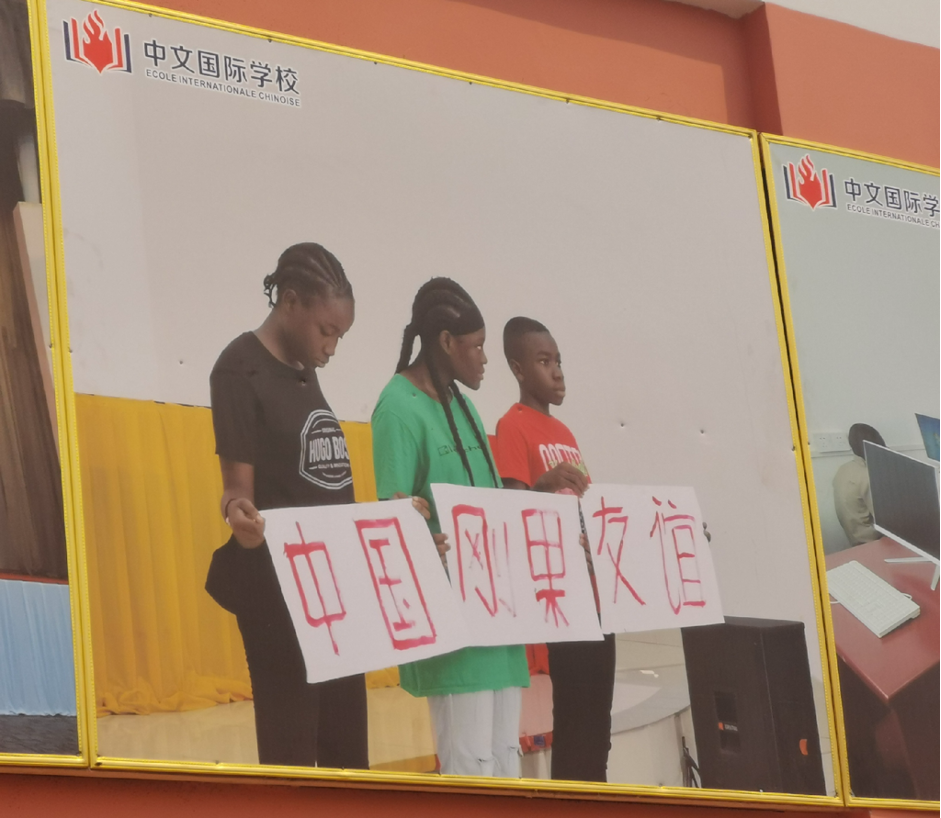
Caption: Students learning Mandarin in Brazzaville hold up signs spelling out “China: Congo friendship”
Photo by author—August 2023
Unequal Friends and Hedging from Below
Friendship sounds positive, but does not mean a relationship of equals, and thinking about the nature of encounters and friendships (or not) between Congolese and Chinese is enlightening for a discussion on hedging. Schmitz (2014) noted over a decade ago that China-Africa relations are multi-faceted and contradictory. This matters because, all too often, China in Africa is talked of and conceived as a homogenous entity when it is far more fruitful to think of China as multiple and, in thinking of China in any context as plural, realize that it can be contradictory. Schmitz (2021) has argued that personal connections matter, particularly in negotiating China’s rise in African lives and vice versa and thinking then at the local level of engagements with China. What choices do my interlocutors in Congo make to negotiate the rising presence of China that they see around them? I regard these local engagements as the everyday practice of hedging, which I consider to be a process through which one entity interacts with another and a process that includes calculations around power relations and likely gains and costs. Hedging at the level of international relations is a strategy of pragmatism that all states use towards each other (Shinn & Eisenman 2023; Tang, 2021). It is enlightening to think about how far this process of pragmatism is mirrored “from below” or on the everyday level and ask how people access pragmatism in their lives towards rising Chinese influence and the ongoing influence of France.
The concept of pragmatism emerges prominently in the literature on hedging at a macro level (Phan, 2024; Strating, 2020) and in the domain of local engagements towards China (Schmitz, 2014, 2021; Tang, 2021). While raising anxieties about China in Congo, in the main, my interlocutors did not reject Chinese presence outright, recognizing it as an option for future building and one with some previous history in Africa (Lovell, 2019; Yoon, 2021). But then the question remains of how the hedging process works in Congo, or what my interlocutors were prepared to be pragmatic about, and how, a point to which I demonstrate below. This matters because, as Ning (2024) argues, one must think beyond ethnicity and more towards the economic roles of different foreign actors in Congo. For Ning, it is insufficient to see the Chinese only in terms of their ethnicity but the economic positions that they occupy and offer to those who associate with them. This is an important point relevant to how my interlocutors discriminate between different Chinese people they encountered in Congo or aspired to meet. A similar argument can and should be made for the French; thinking about what these influences represent and how they are negotiated is vital for thinking about how people hedge daily. As Adebanwi (2017) argues, thinking about life as a political economy means asking questions about how people adapt and negotiate as required and what this means for perceptions of how life is lived, what is strived for, and what is rejected.
This also matters because the notion of China as a neo-colonizer still looms large in everyday sentiment about China in Congo and elsewhere in Africa (Robertson & Pinstrup-Anderson, 2010; Tan‐Mullins et al., 2010). While much scholarship has debunked or critiqued this notion (Lee, 2018; Mohan & Lampert, 2013), I recognize the potency of the trope of neo-colonialism in everyday speech. But even if that is the case, the more interesting question is to think through what agency people have and what they do with it on an uneven playing field. Chinese influence appears to be growing, and French influence remains prominent. Tang (2021) has taken up this challenge of thinking about how competing influences intersect and conflict in economics. Here, I suggest that we can and should also investigate this on the level of everyday perceptions to get to the heart of what the influences of China and France mean in everyday life. None of my interlocutors described their connections with the Chinese they met in terms of friendship at any point during my research on this topic. This suggests they needed to be more convinced by this narrative of a genuine friendship, regardless of what official policy in Congo would have them believe. That is not overly surprising, given how states utilize narratives of friendship, which may not reflect the nature of friendships between individuals Even so, if we understand hedging as a process of one individual, entity, or collective relating to another, connections can be significant and/or productive, but not necessarily warm and cosy.
Learning Chinese for The Future
Not far from the Chinese Embassy, I sat down with Patrice one day in mid 2023. Patrice is a man in his late forties working in education in Congo. He was keen to talk to me as a fellow teacher and was happy to share information about education in Congo and the future trajectories of students. I was keen to ask him about the take-up of the scholarships I had seen advertised by the Chinese Embassy and how many students are studying Mandarin language at either the new language school I had walked past or at the nearby Confucius Institute. Patrice explained to me that “China is significant in Congo”. He told me about Chinese influence in construction projects in Congo, most visible through the role of the Chinese in the construction of Brazzaville’s airport. Given the rising number of scholarships to study in China for Congolese students, he talked about how China features in the landscape of possible study destinations. He said, “China is very [1] present here [in Congo]”. Intrigued, I asked him what this meant for the presence of France. He told me that the French are in Congo too, even if not always so visibly or as something one can touch, as there are currently fewer white French people in Congo, and the number of people who are visibly Chinese is rising. But he was adamant that France remains present given the colonial history and ongoing ties between the two countries and that the arrival of China has not changed this, or in his opinion, at least not yet. Warming to this topic, he told me he was enthusiastic for his children to learn Chinese because this is an excellent investment for their future in a world where Chinese influence will become more prominent.
Being willing to try out opportunities can also be very material and again underscores Ning’s (2024) arguments about thinking about the Chinese in relation to their social positions rather than merely in terms of ethnicity. During my fieldwork in mid 2023, interlocutors told me they had visited several Chinese restaurants in Brazzaville out of interest. My housemates remarked on one that I frequented as a place to go for a decent meal, and sometimes we went together in order to, as one termed it, “try stuff out”. This attitude of being willing to try marked many of these encounters and perceptions of China in Congo. I suggest that pragmatism towards China and Chinese actors in Congo may explain why Congo has not yet seen the same anti-China sentiment seen elsewhere, most clearly demonstrated by rioting against Chinese and Chinese businesses in Kinshasa in 2015.[12]
This raises questions about the sort of interactions, how they occur and whether they are maintained between people who encounter each other in this urban environment or those who see each other but do not interact. When I asked around to meet someone learning Mandarin and ask about their motivations for doing so, this sense of the inevitability of rising China in Congo came through powerfully. One young person, Lucie, aged eighteen and just completing school in Brazzaville and the admission process for higher education in France, told me she is also studying Mandarin in Brazzaville because “Why not? Maybe it could be useful”. In early 2025, I asked Lucie if she was still learning Mandarin, and she said yes. I wondered if she had any plans to use it for work and study, and she said she did not have concrete plans yet, but it might still be helpful in the future because “there are always Chinese people here”. This demonstrates a sentiment that is felt personally and deeply pragmatic. Thinking about China in terms of personal advancement matters because, as Patrice explained, Congolese graduates from Chinese universities are still rare; it is relatively straightforward for them to find employment with Chinese companies upon returning to Congo, which also means a good salary. So then, as Adebanwi (2017) points out, everyday life is often about the financial and the immediate. One could also add the emotions and questions of security. Material advancement is all excellent, but as Lucie explained, going to China is entirely different. Few Congolese have been there, and anxieties about racism towards black people in China are expressed frequently.
But if these are the limits of hedging, a potent imaginary of China remains. This is crucial for thinking through what it represents in terms of hedging. Here, China can embody both opportunity and anxiety, but the extent of each depends on one’s perspective. Younger participants expressed a greater inclination to seize the opportunities associated with modernity. Patrice explained while I was present in Brazzaville in 2023 that I needed to understand what people mean by the term “modern” to fully appreciate how China can simultaneously signify different things in Congo to the same individuals. He noted that China serves as a provider of amenities and services that are accessible to most people. Thanks to Chinese products, an increasing number of individuals now possess material goods known for being relatively affordable and of better quality than many items exported in the past.
Furthermore, as illustrated by Nathalie at the beginning of this article, Chinese-backed infrastructure is appealing, especially when lamenting the state of the roads. Whether Chinese roads offer superior quality is another matter, but everyone agrees that infrastructures such as roads and communication systems require regular maintenance. In light of the lack of improvement in this area, if Chinese entities can renovate and create sound infrastructure, that is undoubtedly beneficial. Julienne, aged thirty, who recently returned to Congo from her annual summer visit to family in Paris and flew back through the new airport in summer 2023, remarked on its efficiency. For her, this infrastructure starkly contrasts with what was left behind by the French following independence, which has often fallen into disrepair. When I inquired whether my Congolese friends would use the new Chinese-financed transport infrastructure in Brazzaville despite understanding it contributes to high levels of national debt, they laughed and affirmed they would, asking if I had not yet travelled along many of the dilapidated roads. Around the same time, a taxi driver made this point to me, pondering why so many individuals remain impoverished decades after independence and why the quality of roads in Congo is still generally inadequate. Thinking through this in terms of hedging, I wondered what the price would be of better roads and if rising Chinese influence is acceptable to my interlocutors.
Congolese Imaginaries of China and France
One evening during my fieldwork in 2023, I watched TV with my housemates and around five visitors. In a break from one of the endless drama series that my housemates seemed so keen on, one of the visitors, Luc, an engineer in his thirties, told me he had heard that I was interested in China in Congo. He told me that, in his opinion, Chinese influence in Congo is visible and controversial. Hoping to dig into what was behind this, I asked what China—or Chinese people—are doing in Congo, what he and the others had seen of China here, and how they understood this. The others joined the discussion, and all agreed on one point: China in Congo is synonymous with debt levels from Congo to China. When I contacted Luc again while writing this paper in 2025 to follow up on this topic, he reconfirmed several times that “when we think about China [in Congo], we think about debts”.
The curiosity and openness demonstrated by some of my interlocutors and the observations about debt by others towards the Chinese in Brazzaville were undoubtedly matched by frustrations at the speed of what my associates in Brazzaville saw as encroachment by the Chinese in Congo, negative behaviors by and represented by the Chinese, and an abject lack of action on the part of their national authorities to mitigate against these problems. They are unconvinced by the notion that China does not meddle in the political affairs of other countries, even if it did not mean to, as what they see around them will change rapidly because of Chinese activities. This came out in some of my earlier interviews with urban Congolese students. Matthieu, aged twenty-two in 2021, wrote: “China is a technology leader and has the means of constructing infrastructures. Unfortunately, in my opinion, our government is naïve because the Chinese profit from the contracts, steal our primary resources, and exploit workers”. When I asked him if he still thought that in early 2025, he responded with: “Of course, because what has really changed?”
What indeed? I suggest that this is not merely a question of what happens when Chinese influence rises in Congo but also, as Patrice put it two years earlier, of thinking about how people live with multiple influences simultaneously and the inevitability of being influenced in numerous and possibly conflicting ways. But to think about this in terms of how China is hedged leads to another critical question. What then of France? If China represents a new form of modernity, or a fast track to it that can be conceived as attractive in certain respects, is France somehow not modern, or somehow different? Hedging is, after all, about living with and making decisions in landscapes of different influences, which conflict or coexist. Many Congolese are proud of their proficiency in French, aspire to study in France, or have family there. Julienne, recently returned from France during my fieldwork in Brazzaville explained: “People here want to go to France. They have family or they work or they have their lives there”. When people talked of imported food products, they often referred to those imported from France. I observed that when urban Congolese with sufficient spending power talked about going to “the supermarket,” they meant the Geant Casino supermarket in the city center, a branch of the French supermarket chain with the same name.[13] Other supermarkets now exist, although very few seemed interested in trying them out when Casino fulfilled their requirements, and they could park easily outside it. Casino sells products imported directly from France, and even when selling local products such as pre-packaged cassava, does so in a medium that replicates supermarkets in France itself.
But if this supermarket represents France, at least aesthetically, then somewhat ironically, it was in this very supermarket that I first really encountered Chinese people in Congo doing what everyone else was doing: waiting for fresh pizza and availing themselves of the ease of buying groceries at fixed prices and products unavailable in local markets.[14] Over several weeks during my time there in 2023, we began to recognize each other as people so obviously foreign and offered greetings and small talk in a mix of French and English. I would also meet them strolling along the waterfront in the early evenings, a popular spot for a walk. This area is also a manifestation of China in Congo, even if less obviously. The corniche in Brazzaville was redeveloped with financial assistance from China, which, as far as I could see, has yet to be noted publicly. One does not need to walk far to encounter a stunning bridge, which notes the date of Congo’s independence from France prominently (figure 3). This is an important symbol for Congo, and the date of independence is a reminder of the country being divorced from its colonial heritage and trajectory of independence. A sign marking the occasion of its opening does not refer to any external assistance in the area’s redevelopment. One can encounter France and China here with their influences carved into the Congolese urban national landscape, with the date of independence from France visible for all to see. However, any outward acknowledgement of Chinese capital for this structure is hidden. These structures are connected intrinsically to foreign influences, even if the only detail that makes that connection celebrates a separation. But the connection and the potency of the imaginary remains.
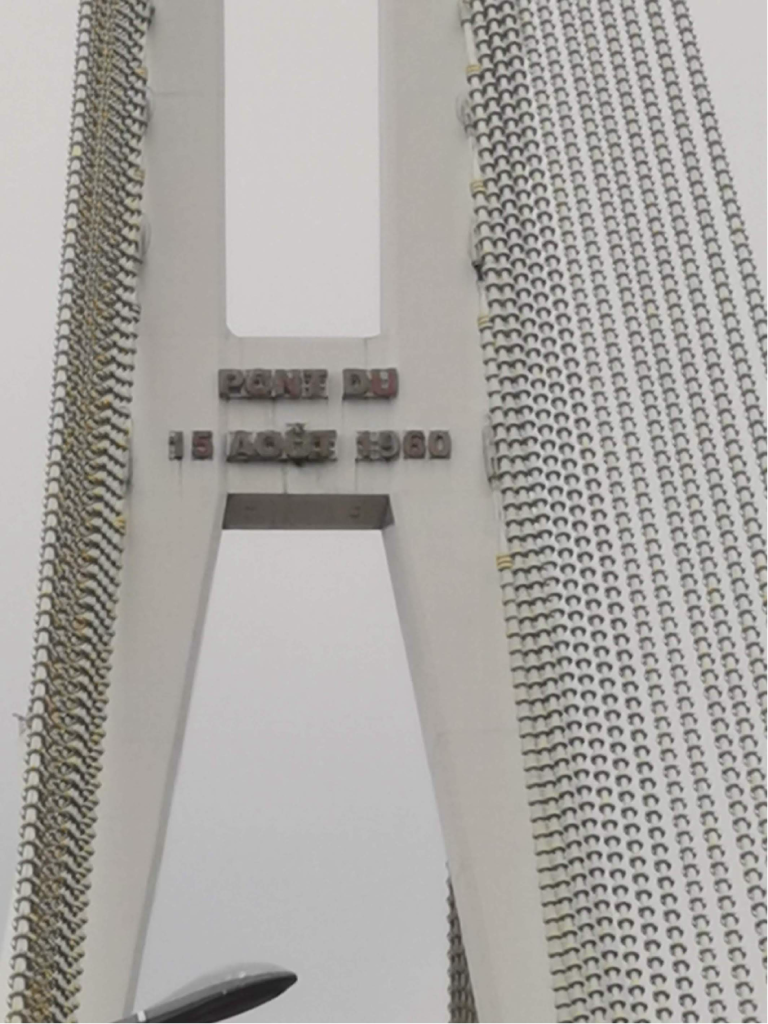
Caption: This bridge on the Corniche in Brazzaville forms a prominent landmark and notes the date of Congo’s independence from France.
Photo by author, August 2023.
Hedging: Cooperation and Criticism, with Pragmatism
All this adds up to a key question. How do people live with and aspire to these coexisting or competing influences, or to put it more simply, how do individuals hedge here? It is all very well to talk of hedging in macro terms, but even more important to focus on what this means in everyday life. Hedging options would explain why young people take a pragmatic approach to the opportunities available to learn Mandarin, to ask about Chinese contacts I had made, and to see positives in China-backed infrastructure in Congo. I never met anyone who had been in China while I was in Congo, but China is part of the physical and mental landscapes of many whom I met. When we think about France, its longer influence is not displaced by the arrival of China in Congo. People live between these different forces that influence their decision-making. This also brings out the contradictions China imagined as a neo-colonizer but also a modernizer in Congo, elements of which many Congolese identify as being attractive in their promises of quick development of the country’s transport infrastructure. China does not necessarily replace France, but connections with both are worth cultivating anyway.
All this goes to show that it is crucial to take agency very seriously. As MacGaffey and Bazenguissa-Ganga (2000) argued cogently in their work on trading between Congo and France, what people do, their negotiations and how these shift over time is crucial. My interlocutors do much the same in terms of living between Congo, France, and China in their imaginaries, and being open to doing so physically in the future. As Ning (2022) further shows, the personal is inherently political, a point well made out in early feminist scholarship. What matters then is what people do matters in the face of major geopolitical changes. Thinking at this everyday level provides a micro-level lens on macro processes of globalization.
This also matters because it sheds light on the question of what it means to be modern. Writing on this topic, Ferguson (1999) rightly points out the importance of taking local voices seriously, even if this causes a professional disconnect when, as anthropologists, we are trained to take our interlocutors as we find them and acknowledge multiple voices and understandings. As articulated by my interlocutors in this article, modernity is mainly conceived—but not exclusively—around infrastructure, amenities, and material goods. As Ferguson points out, while nobody has a monopoly on the term modernity, if interlocutors in Africa talk of modernity regarding social status or economic situation, we should listen carefully to what they are telling us. I take seriously what my interlocutors told me regarding how they see Congo changing along the lines of these foreign influences and, more importantly, their actions. This means thinking through what they do in this shifting landscape and how they perceive their options, what is attractive and what is not. For the urban voices in this article wondering what France built in Congo that was meaningful during the colonial period and what France is doing now that has any meaningful impact on them, China represents some of the trappings of what it is to be a modern person, even while they criticize Chinese influence in Congo at the same time. The same can and does apply to France.
In holding these seemingly contradictory viewpoints or facing both towards and away from France and China simultaneously, my interlocutors participate in the day-to-day practice of hedging. This is apparent when we consider what they do with their resources, both of money and of time. Their criticisms of China in Congo are far-reaching, as we see in the stereotypes of how Chinese laborers are portrayed as having bad social backgrounds and how these rumors are shared. But we also see the notion of “learning Mandarin, why not?” simultaneously, often concerning France and China. This is why it is crucial to think about what foreign influences represent to different people and not just in simple terms of who they are (Ning, 2024). This is an example of the resistance to foreign influences that Ciorciari and Haacke (2019) argue for, but also of pragmatic cooperation at an immediate, everyday level. Scholars of hedging as an international relations strategy note that hedging is often not done uniformly (Kuik, 2016) and can be contradictory (Strating, 2020) and that executing it is also very labour and resource-intensive (Shinn & Eisenman, 2023). Hedging is a process of finding a way forward, around tangible and intangible obstacles (MacGaffey & Bazenguissa-Ganga 2000; Ning, 2022). All these observations accurately describe the actions of my associates in Brazzaville and show clearly how macro-hedging strategies are mirrored in local, everyday actions.
Conclusion
There can be no doubt that China’s rising prominence in Congo (and elsewhere) is a major driver of change and that these changes impact people differently, and the question of how far this will intersect with, or displace the historically strong influence of the former colonizer is an emergent one. This is relevant at a macro level, but also regarding everyday, personal lives. I have argued here that the notion of hedging is enlightening for how people act in sometimes contradictory ways as they make sense and negotiate complimentary and competing influences in their lives. In so doing, my interlocutors show us they align wholly neither with China nor France. Instead, they engage with both and weigh up options, exercising agency within limits and navigating contradictions. This is the political economy of everyday life Adebanwi (2017) talks about, and keeping this economy going is pragmatic decision-making.
I have demonstrated here that Congo is an illuminating case study because the influence of France remains particularly prevalent, and the rise of China is not a simple matter of one foreign influence displacing another. This paper adds to the literature on hedging and aspiration by explicitly connecting these two concepts, recognizing that everyday hedging and pragmatism are identical. This is important when we consider the question of what people want to achieve, to what they aspire, and what do they imagine a desirable future to look like. I argued strongly here for thinking of hedging as something one does rather than something done to an individual or a group. In seeing how hedging works daily in Congo, we see Congolese people networking with the Chinese, learning Mandarin, and planning futures involving France and ongoing French influence in Congo at the same time. Then hallmarks of hedging—cooperation with resistance or confrontation—are visible in Congolese daily life and how this drives aspirations and future building. Future research could consider explicitly how these everyday sentiments also inform the hedging process at a policy level. It could also consider how far the dynamics observed here are replicated elsewhere, thus engaging with questions of how local engagements with geo-political changes differ (or not) between places and populations.
The question of ongoing French and other foreign influences, their displacements, and contestations, and what these drive in everyday actions could hardly be more topical. At the time of my fieldwork in Congo in 2023, Niger’s first democratically elected President was displaced in a military coup. Niger’s generals railed against poor management under the democratically elected administration, and citizens denounced the ongoing presence of France. Somewhat ironically, as in Congo, all criticism of France is conducted in French but clearly, French claims to a long history in Africa are not a guarantee of future influence there. This is not only the case in Niger. On 30 August 2023, following disputed elections, military personnel seized control in Gabon. This situation is somewhat different to Niger in that the coup followed an election, and the arrested President did not have the same democratic credentials. However, the justification given in Gabon for saving the population from an illegitimate and incompetent government backed by France was the same.[15] One could, therefore, argue that neither the Nigerien nor the Gabonese government was successful in hedging French influence sufficiently, and nor were the population convinced of this strategy at a personal or everyday level. Much as we see in Congo, what people aspire to really matters, as does what they do about it. In an age where Trump’s second presidency also provides new opportunities for China to further consolidate its influence in the global South, investigating who hedges, how, towards and against what, is a vital area for future research.
Acknowledgements
I thank all my interlocutors in Congo who generously shared their time and thoughts with me. I would also like to thank all at Global Africa and especially the anonymous reviewers for their helpful insights and suggestions.