
Science ouverte au Sud — 4ème édition | Rabat, 23–26 novembre 2026

Appel à communications ouvert jusqu’au 8 juin 2026 La quatrième édition de la conférence internationale « Science ouverte au Sud » se tiendra du 23 au 26 novembre 2026 à la Bibliothèque Nationale du Royaume du Maroc (BNRM), à Rabat. Organisée conjointement par l’IRD, la BNRM, le CNRST Maroc et le Bureau UNESCO du Maghreb, cette édition s’articule autour d’un thème central ambitieux : « Le renforcement de capacités au service de la visibilité et de l’impact scientifiques » Pourquoi cette édition compte Depuis sa première édition, la conférence « Science ouverte au Sud » est devenue un espace de référence pour les communautés scientifiques africaines et méditerranéennes engagées dans la transformation des pratiques de production, de diffusion et d’accès au savoir. En 2026, à Rabat, l’accent est mis sur une question décisive : comment les institutions du Sud peuvent-elles renforcer leurs capacités pour accroître la visibilité internationale et l’impact réel de leurs recherches ? Les enjeux abordés couvriront notamment : Soumettre une communication L’appel à communications est ouvert jusqu’au 8 juin 2026. Informations pratiques Dates 23 – 26 novembre 2026 Lieu BNRM – Bibliothèque Nationale du Royaume du Maroc, Rabat Organisateurs IRD · BNRM · CNRST Maroc · Bureau UNESCO Maghreb Site officiel opensciencesud4.sciencesconf.org Date limite soumission 8 juin 2026 Global Africa suit avec attention les initiatives qui placent les chercheurs africains et méditerranéens au cœur des débats sur la science ouverte. Nous encourageons nos lecteurs et partenaires à soumettre leurs travaux et à participer à cet espace d’échange scientifique de haut niveau.
Call for Paper: The Handbook of Postcolonial Sociology

Edited by Simone Maddanu – University of South Florida, USA Rachid Id Yassine – University Gaston Berger, Senegal Paola Rebughini – University of Milan, Italy We are currently accepting contributions for the Handbook project on Postcolonial Sociology, as part of the Routledge Handbooks program. Contributions can be either theoretical (including state-of-the-art and literature reviews) or based on empirical research, including on a regional/local basis. Other than classic postcolonial approaches in sociology, we are also welcoming original perspectives that include science, technology and medicine, policymaking (i.e. reviewing sedimented practices, also implemented by public health institutions), history and sociology of knowledge, gender, immigration, geography, intra-nation and interethnic relation. Considering current global events, old and ongoing imperialistic views, and wars, we are exploring a multi-geography of standpoints and institutions, with an emphasis on global south voices. We are particularly interested in critical perspectives about postcolonial realities in all their facets, internal and transnational, local and global, from all the continents and regions. Several sections of the volume will be dedicated to different – and sometimes opposite – aspects such as decolonization, postcolonial and hybridity, immigration and integration, activism and social movements, internal colonialism, race and ethnicity, postcoloniality and environmental issues, limits and criticalities of postcolonial studies. We aim to publish a cutting-edge sociology Handbook. As a rigorous authoritative volume that provides a view of the state of research in the field, we aim to publish an overview of the area and ‘signpost’ the field in all its aspects, moving beyond dichotomic and simplistic views about our current societies. As a decentralized reflection on coloniality, we are also expecting decentralized stances on subalternity and dependency that bring new lights on old or new geographies of power. Although not all contributors are required to situate themselves in a sociological field, we particularly welcome cross-disciplinary approaches that engage with sociology, and broadly with social sciences. Contributions may articulate original perspectives that encompass coloniality and the postcolonial from both historical and contemporary perspective, utopian as well as practical. All chapters should be newly written by scholars with research or teaching conditions, from a minimum of 5,500 words to 8,000 (notes and references included). Unfortunately, we cannot include graduate students. Deadline for submissions: Please consider sending an abstract of 250 words by March 31st, 2024. Final papers are expected by September 30, 2024. All queries and submissions shall be sent to: smaddanu@usf.edu, rachid.iy@ugb.edu.sn, and paola.rebughini@unimi.it
International Multidisciplinary Conference in Honor of Tiken Jah Fakoly
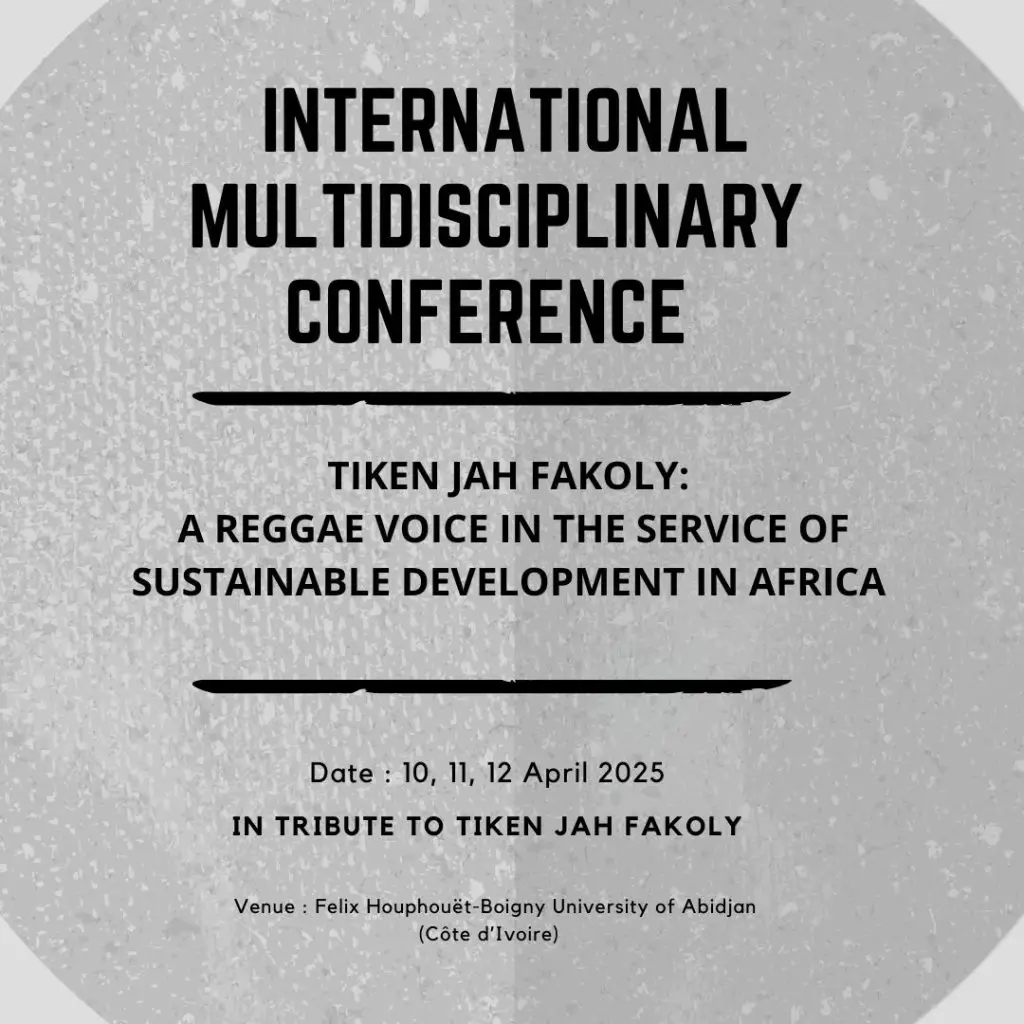
As part of the University Festival of Arts and Cultures of Africa and Beyond (FUACAA 2025), the Félix Houphouët-Boigny University of Abidjan, in partnership with the Laboratory of Communication, Arts, and Culture Sciences (LSCAC) and the Research and Action Group on Culture, Education, Health, and Society in Africa (GRACES), is organizing a unique conference around the theme: 🎶 “Tiken Jah Fakoly, a Voice of Reggae for Sustainable Development in Africa” 📅 Dates: April 10, 11, and 12, 2025 📍 Location: Félix Houphouët-Boigny University of Abidjan (Ivory Coast) This multidisciplinary conference will explore the artistic and activist contributions of Tiken Jah Fakoly to the promotion of sustainable development in Africa. 👉 Learn more and get involved