

Introduction
Climate change, with its disproportionate effects on countries in the South, is a global concern, particularly for countries in the Sahel, where extreme temperatures, rising sea levels, resource scarcity and food crises are real (IPCC, 2021). This vulnerability is accentuated by the low level of economic development of Sahelian countries (De Bandt et al., 2021). At the same time, in addition to its security implications, it pushes countries towards the “planetary limits”, threatening existence and quality of life, while wealth is increasingly financialized and polarized (Steffen et al., 2015; Carroué, 2015).
In order to analyze the consequences of global warming and security challenges, particularly human ones, through the lens of injustice, the Sahel region is chosen here as a case study because of its numerous economic and environmental challenges such as poverty, malnutrition, recurring droughts and floods (Oxfam, 2022), as well as evidence of sustainable development challenges exacerbated by this change according to the IPCC (2022). According to a World Bank Group report for five Sahel countries (Burkina Faso, Chad, Mali, Mauritania and Niger), up to 13.5 million people are at risk of falling into poverty due to climate shocks, requiring urgent adaptation measures. These challenges call for the implementation of resilience strategies, particularly in terms of human security in most countries in the region. In addition, global initiatives such as the Kyoto Protocol[1], the Paris Agreement – COP 21[2], and more recently COP 27 in Egypt and COP 28 in Dubai – now highlight the urgency of an international solidarity action to deal with the various effects of global warming, particularly in the countries of the South.
The main objective of this article is to demonstrate that disparities in economic development exacerbate climate injustice between countries and generate challenges, particularly security ones, highlighting the issue of human security in the Sahel region.
Methodology and Plan
The methodology adopted is based on a holistic approach starting with a review of the available scientific literature on climate change, climate injustice and security challenges, especially human, in the Sahel region. This review includes a careful analysis of available statistical data, relevant institutional reports issued by international and regional organizations, as well as previous studies carried out in the region. In addition, the methodology also includes an in-depth study of academic research published in specialized journals, allowing an in-depth understanding of the dynamics at play. This multidisciplinary approach aims to understand the different aspects and implications of climate injustice and security challenges in the Sahel region, taking into account the diverse perspectives and contributions of the scientific community.
The article begins by outlining the problem of climate injustice between the North and the South, as revealed by the disproportionate effects of global warming. It then shows how disparities in economic development exacerbate this injustice and generate security challenges, with a particular focus on human security in the Sahel region, before concluding by proposing avenues of reflection and action for resilience in the face of the consequences in the Sahel.
Climate change: a clear sign of injustice between North and South
The impacts of climate change in the Sahel can be understood through the lens of socio-economic injustices between countries, providing information on the challenges they present. Fossil fuels, the main emitters of greenhouse gas[3] (GHG) emissions such as carbon dioxide (CO2), methane (CH4), nitrous oxide (N2O) as well as fluorinated derivatives (HFC, PFC, SFC), have harmful repercussions on the atmosphere, leading to direct consequences on the climate. The combustion of fossil fuels, including coal, oil and gas, emits carbon dioxide, the main contributor to global warming (Nunez, 2023). The IPCC (2018) found that in 2018, 89% of global CO2 emissions came from fossil fuels and industry. In addition, energy use only contributes to climate change through the combustion of fossil fuels, accounting for around 80% of global GHG emissions. This combustion generates harmful emissions such as sulfur dioxide, nitrogen oxide and fine particles, all of this having deleterious consequences on the environment and the climate (Denchak, 2022).
CO2 emissions per capita in Africa, particularly in the Sahel region, are low compared to the rest of the world, representing around 3% of global emissions (Jeune Afrique, 2023). Despite economic and demographic growth which multiplied them eightfold between 1960 and 2020 reaching 1,326 million tons of CO2, in 2019, they were around 0.7 tons of carbon, three times more than in 1950. The World Bank (2023) highlights that these African emissions remain lower than those of China (7.6 tons per capita), Japan (8.5 tons per capita) and the United States (14.7 tons per capita).
Furthermore, due to the detrimental effects of GHG emissions on the atmosphere, the threat is becoming global, affecting not only the economy, the social and political aspects, but also security aspects. The Solana Madariaga report (2008) describes it as a catalyst for various threats, reinforcing the already existing trends, tensions and instabilities. Africa is identified in this report as “one of the continents most exposed to climate change due to multiple constraints and limited adaptation capacity”. Despite their low overall contribution to global emissions, African countries experience more pronounced effects. This is illustrated by the following examples from a number of Sahel countries, demonstrating the disproportionate impact of climate injustice.
The work of Keilar et al., (2023) around Lake Fitri in Chad, has revealed the consequences through spatio-temporal variations in rainfall, a decrease in the number of rainy days, an increase in temperatures and wind, causing a decrease in the water level as well as the degradation of plant cover and soils.
In Burkina Faso, there have been significant variations in rainfall since the drought episodes of the 1970s, with consequences for agricultural production and water availability in different areas of the country (Karambiri & Gansaonre, 2023). Similarly, in the south-west of the country, natural and anthropogenic factors, such as the temporal distribution of rainfall, are adversely affecting rice production. These challenges, in addition to other effects of climate change, require, according to Sanou and Hien (2022), the development of new rice varieties and adapted farming practices to improve agricultural production in the region.
Global warming also affects agricultural production in the Sudano-Sahelian area. In Mali, for example, the low yield of sorghum is attributed to this phenomenon and low soil fertility. Similarly, Togo et al., (2023), in their work, show that organo-mineral fertilization can improve sorghum yield in this region.
In addition, Map 1 establishes climate injustice on a global scale, showing that the main CO2 emitters in 2016 – and therefore the main contributors to disruption – are to be found in the developed countries of the Northern Hemisphere, Australia, New Zealand and the countries of the Persian Gulf.
Southern countries contribute little, as they are less industrially developed.
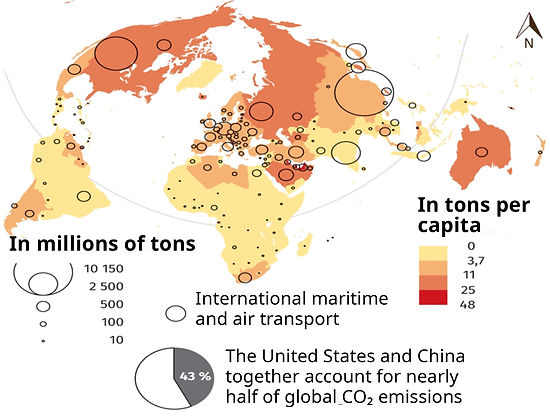
Map 1: CO2 emissions by country in 2016
Source : Global Carbon Project, Carbon Budget2017, www.globalcarbonproject.org, Cheikh Cissé’s rehabilitation.
This fact suggests that climate change should be seen as an injustice. The most vulnerable countries are those having contributed least to its origin. As a result, resilience initiatives are becoming an international imperative, particularly for poor and emerging countries, requiring support to adapt (Georgieva et al., 2022). Ongoing inaction could prove more costly than taking strong action, and economic damage could reach $1,700billion per year if the current rate of warming continues[4]. This observation is also confirmed by a study carried out by the Potsdam Institute for Climate Impact Research (2023) which concludes that “doing nothing about climate change would be more costly than taking action”. In the Sahelian countries, the lack of resources and the absence of immediate responses for essential services partly constitute obstacles to the implementation of strategies to consume less fossil fuels in an uncertain future.
On the other hand, it is important to note that these Sahelian countries, thanks to their vernacular, indigenous knowledge, can also position themselves as pioneers in terms of adaptation, agroecological and energy transition. Initiatives such as the International Agroecological Movement for Africa aim to revolutionize African agriculture on a sustainable basis and encourage the transition to environmentally friendly practices[5], favorable to climate resilience. In addition, research carried out on productive systems and the agroecological transition in family farming in West Africa highlights the essential role of local knowledge and agroecological practices (zaï[6], agroforestry[7], etc.) in the promotion of sustainable and more resilient agriculture facing the effects of global warming (AFSA, 2016). For example, in Mali, in the rural commune of Mafouné, the drop in precipitation and increase in temperatures have caused a drop in agricultural yields, loss of soil fertility, early drying up of surface water sources, the indebtedness of farmers and the intensification of the rural exodus. To cope with these harmful effects of climate change, farmers have implemented adaptation strategies such as the use of short-cycle varieties, the adoption of anti-erosion techniques, reforestation and diversification of activities (Ouattara et al., 2019). In a similar approach in Niger, the work of Abdou et al., (2021) examined the technical impacts of restoring degraded lands on plant survival and growth. The results demonstrated that these techniques improve soil water conditions and promote the survival and growth of plant species (Abdou et al., 2021). In the pastoral zone of the same country, Garba et al., (2023) sought to improve the estimation of forage biomass using the multiple linear regression method, thus highlighting the importance of such approaches for a better understanding of natural resources in the region.
Furthermore, climate justice is a principle integrated into various international agreements. The United Nations Framework Convention on Climate Change (UNFCCC) has set an annual target of $100 billion for funds from developed countries in the North to help countries in the South to adapt. The Paris Agreement (2015) promotes “common but differentiated responsibilities”, emphasizing the need for countries in the North to reduce their emissions and help countries in the South. This recommendation aligns with Rawls’ theory (1971) advocating “maximization of the fate of the most disadvantaged ones”. However, this North-South solidarity initiative in favor of climate justice remains ineffective. COP 27 in Sharm el-Sheikh revealed unmet demands, highlighting negotiating imbalances, particularly with regard to funding promised to poor countries. Some major polluters such as the United States and China, refuse to admit their significant impact, exacerbating climate injustice.
Most African countries lack the influence to impose decisions, and find themselves, as it were, having to pay back sums to solve a problem largely created by the lending developed countries. Faced with these economic, environmental and ethical challenges, climate activists and defenders in both the industrialized North and the South are increasingly resorting to the notion of “climate justice” to defend the rights of developing countries in international negotiations.
The impacts of climate change and security challenges in the Sahel
The complex interactions between the effects of warming and security challenges in the Sahel, although sometimes not directly correlated, require in-depth analysis focused on human security. The very conception of the term “security” varies from one context to the other. In the Sahel, it is part of a holistic approach encompassing the well-being of individuals and communities over and above major geopolitical threats. It involves protection against various threats, including food security, access to water, health, education, and resilience. The links between climate injustice and its consequences on human security are therefore major challenges in the Sahel region (Doumbia, 2013). The challenges faced by local communities, leading to direct repercussions on livelihoods, the economy and stability, often associated with conflicts of which climate change is the main trigger. The region has suffered significant consequences such as food shortages and water militarization, acting as aggravating factors to existing tensions (Werrell & Femia, 2018). The impacts of warming are often seen as additional stresses in areas of protracted conflict likely to generate new conflicts or intensify existing ones (Denton, 2016).
| Box: The Sahel, a region highly exposed to climate change |
The Sahel, stretching from the Senegalese Atlantic coast to the Eritrean-Djiboutian Red Sea, comprises ten countries: Burkina Faso, Cameroon, Gambia, Guinea, Mali, Mauritania, Niger, Nigeria, Senegal and Chad. These countries, located in areas under the influence of the Gulf of Guinea monsoon and harmattan winds from the Sahara, have specific physical and natural characteristics (Toupet, 1992; Raynaut, 1997). They are characterized by a sandy strip covering more than 7 million km2, with a significant demographic density, counting 135 million inhabitants in 2014 (Haub & Kaneda, 2014). Some larger countries, such as Mali and Niger, include a large part of desert and therefore have low population densities, generally below 20 people per km2.On the other hand, smaller ones, like Senegal with access to the sea, have higher population densities, often exceeding 50 people per km2. Landlocked Burkina Faso has a density of 65 people per km2, while Gambia exceeds 150 people per km2 (Haub & Kaneda, 2014).The region’s gross domestic product (GDP), calculated in purchasing power parity, remains relatively low, varying from around $900 to less than $3,000 per capita, with the main sources of income coming from natural resources such as oil and minerals (World-Bank, 2014). According to the World Bank’s 2015 “Doing Business” report, these countries are ranked among the least attractive for business, largely due to their history of political instability (World-Bank, 2015). In addition, the World Bank identifies half of the Sahel countries as “fragile states”[8], characterized by low income, recurring situations of insecurity and multiple climatic hazards.The terrible drought episodes of the 1970s and 1980s caused significant human and material losses, including unpredictable harvests in countries such as Mali, Mauritania, Niger, Senegal and Burkina Faso. These events led to the destruction of entire neighborhoods, demonstrating the extent of the damage suffered. The interest of climatologists in the Sahel is justified by the most severe periods of rainfall deficit ever recorded in the 20th century according to Hulme (2001), Jones and Hulme (1996), and Dai et al. (1998). This comes even though the region has always experienced alternating cycles of dry and wet seasons, as noted by Nicholson (2005, 2013, 2014). Map 2: The Sahel regionSource: Population Reference Bureau (PRB) :https://www.prb.org/resources/defis-demographiques-du-sahel/, Cheikh Cissé’s readaptation, 2024. Map 2: The Sahel regionSource: Population Reference Bureau (PRB) :https://www.prb.org/resources/defis-demographiques-du-sahel/, Cheikh Cissé’s readaptation, 2024. |
Highly vulnerable to global warming due to its precarious socio-economic balance, the Sahel has experienced an increase in heavy rainfall since 1990, leading to flooding and changes in the use of arable land (Heinrigs, 2010). For example, the variation in rainfall in the “Terres neuves” of eastern Senegal has had significant impacts on agricultural activities, in particular the cultivation of cereals such as millet, corn and peanuts. Since the 1970s, disturbances such as heavy rainfall, downpours, regular interruptions in rainfall, late start and early end of the rainy season have been observed, thereby affecting crop productivity (Faye et al. , 2018).
This is further exacerbated by exponential population growth and accelerated urbanization, with projections estimating a six-fold increase in the population of Sahel countries by 2100 (Heinrigs, 2010). Growing urbanization and the increase in low-income urban populations intensify heat stress, which is particularly harmful to young people, the elderly, and those with health problems. It also affects the water infiltration capacity of the soil. These conditions led to flooding, forcing many people to leave their homes and affecting more than 700,000 people from Niger to Chad in 2020 (UN-INFO, 2020).
Across the Sahel, around 70% of the active population is employed in the agricultural sector, and it contributes 30% to GDP. In Mali, agriculture employs 80% of the workforce and represents 40% of the GDP. Although mainly oriented towards food crops such as millet and sorghum, as in other Sahelian countries (Senegal and Niger), agriculture in the region also includes export activities, notably cotton and peanuts (French Senate, 2016). This dependence on agricultural activities without viable alternatives, increases its vulnerability to climate change with significant repercussions on food security and the risks of potential conflicts (Heinrigs, 2010). In addition, the region, facing environmental degradation, poverty, food insecurity, rapid population growth, gender inequality, political instability, and pre-existing conflicts (Alliance Sahel, 2019), is among the most vulnerable to the impacts of global warming. This could lead to increased levels of deprivation and collective conflict (Tesfaye, 2022).
Then, the Sahel countries are faced with episodes of extreme heat. Climatology experts predict an increase in the temperature of the Sahel of 3 to 5°C by 2050, and potentially up to 8°C by 2100 (Potts et al., 2013). Concretely, the increase in average temperatures between 1980-1999 and 2080-2099, confirmed by the IPCC (2007), is around + 3°C in coastal areas (Senegal), + 4°C in the continental part of the Sahel. (Niger, Mali, Burkina Faso), i.e. 1.5 times more than on a global scale. A temperature rise of 2°C could lead to a rise in sea levels of around 60 to 80 cm by 2080, with regional variations. In the 4°C warming scenario, this increase could reach 100 cm by the 2090s (Potsdam Institute for Climate Impact Research, 2013). This rise in sea level and coastal erosion could reach up to “one to two meters per year in Senegal…” (GEO, 2019). These climatic events have multiple consequences, such as the impoverishment of populations dependent on artisanal fishing, agriculture and pastoralism due to drought. Likewise, they affect the availability of water resources, pastures and arable land, intensifying tensions and rivalries between communities. These situations lead to massive displacements towards milder regions described by the term “environmental refugees” (El Hinnawi, 1985) introduced by UNEP as well as an increase in human security problems in each country in the region.
In short, climate change is creating a vicious circle that is undermining the resilience of communities to both environmental change and human security issues in the Sahel (UNHCR, 2022). Rising temperatures, extreme weather conditions, desertification, land degradation and flooding are disrupting livelihoods, food security and causing mass displacement, undermining the resilience of local populations. An in-depth analysis of the history of conflicts and displacements in the Sahel reveals the essential role of climate change impacts as a trigger for these human security phenomena (De Satgé, 2023), thus requiring efficient measures and actions for the resilience of the communities.
Some avenues for reflection and action
Climate change, through the prism of the unequal consequences suffered by the Sahelian countries to the detriment of the Northern countries as demonstrated in the previous points, is intrinsically linked to human security issues creating a complex context that requires a more detailed analysis. From this perspective, several avenues of reflection and action may emerge to address these multidimensional challenges.
First of all, the promotion of local adaptation through an approach that we describe as “glocal”. This approach insists on rooting responses to the consequences of climate change in the specific socio-cultural contexts of the Sahel region. By adopting local measures tailored to the realities and specificities of each Sahel country in terms of the effects they face, while also having global implications, such an approach could prove more effective than standardized international solutions.
At the same time, it is imperative to address the international political challenges that inevitably emerge. The economic, environmental and ethical implications of warming accentuate political difficulties on a global scale, particularly in terms of equitable distribution of negotiating and decision-making power at climate conferences. Equitable consideration of all countries’ concerns regarding resilience to climate change is necessary to address its multiple impacts, including human security concerns in the Sahel region.
In addition, in-depth reflection on human security is emerging as a fundamental component. The approach to security in the Sahel region should not be limited to its physical dimension, linked to the various forms of conflict, but should be considered more broadly. This includes access to water, food and other basic services. Understanding and managing security issues are essential prerequisites for their effective resolution in the Sahel region.
By highlighting the need for a holistic approach, these ideas underline the importance of considering the local, international and human dimensions of security in the face of the impacts of climate change in the Sahel region. Such an approach appears to be a strong incentive to face up to the complex and interconnected challenges arising from this ever-changing environmental dynamic.
Conclusion
In the final analysis, inequalities in economic development are closely aligned with the climate injustice suffered by countries in the South, particularly those in the Sahel. Although these countries emit fewer greenhouse gases than the North, they suffer disproportionately from the negative repercussions of global warming. This injustice generates a myriad of consequences, transforming the Sahel region into a theater of protean security challenges, including human security.
Faced with this reality, it appears appropriate for the Sahel countries to move away from the recommendations of international climate conferences which have so far only proved their inadequacy. It becomes imperative to seek solutions anchored in their specific socio-cultural contexts, adopting a “glocal” approach that combines locally adapted measures with global implications. This change in approach could offer more effective responses that are better adapted to the real challenges of the region, thus overcoming the barriers encountered to date in standardized international approaches. By adopting this global approach, Sahel countries can consider more viable resilience strategies in the face of the impacts of climate change, while taking into account their specific realities and contributing to a global approach to climate justice.