


Introduction
Wild vertebrate populations declined by 73% between 1970 and 2020[1], and one million animal and plant species are threatened with extinction (IPBES 2019). More than 35% of wetlands have disappeared since 1970, and the destruction of natural habitats continues to accelerate. In order to support international initiatives[2] for biodiversity restoration and, more broadly, nature protection, economic research seeks to identify the costs of land degradation and the benefits of ecological restoration, aiming both to demonstrate the positive value of large-scale ecological action and to organise its implementation (Nkonya et al., 2016; Giger et al., 2018; Mirzabaev & Wuepper 2023; Bodin et al., 2022). The assessment of the ecological and social benefits and costs of ecosystem restoration is intended to contribute to decision-making by cost-benefit analysis, cost-effectiveness analysis, and multi-criterion evaluation[3].
An increasing number of economic studies are producing spatialized analyses to inform an effective distribution of land dedicated to biodiversity protection (Figure 1 and Figure 2). These analyses compare the ecological and socio-economic characteristics of various geographical areas in order to target environmental actions for greater ecological gain and at a lower cost. In other words, so-called cost-effective prioritisation maximises ecological gains and/or socio-economic-ecological benefits and minimises the costs of project implementation; the results allow the publication of maps highlighting the areas where it would be most effective to restore or conserve natural environments. Therefore, this method assumes that ecological actions are substitutable – or at least comparable – across different geographical areas at national, regional, or global scales.
To give an example of regional analysis, Alisher Mirzabaev et al. published in 2022 an empirical article – Economic Efficiency and Targeting of the African Great Green Wall – identifying the most economically efficient areas for the restoration of the Great Green Wall ecosystems[4] (Figure 1). Other publications have used these methods globally (Figure 2). In 2020, Strassburg et al. published a world map of priority sites for ecological restoration by optimising three criteria – biodiversity gain, climate change mitigation and costs – across all terrestrial biomes and based on 1,200 scenarios (Box 1) (Figure 2 a). In 2024, economist Jonah Busch et al. published a cost-effectiveness prioritisation of two distinct ecological restoration techniques – natural regeneration and tree plantations – by integrating spatialized data on soil carbon storage on a global scale (Figure 2 b).
The findings of these spatialized analyses consistently indicate that biodiversity preservation is more cost-effective in southern countries or regions regarded as economically less developed. The available data and underlying assumptions (Box 1) mechanically frame cost-effective restoration of nature as the inverse of economic value creation. In other words, these analyses systematically suggest that the most economically rational strategy is to restore nature in areas where the economic returns from land use are the lowest.
This contribution questions the validity of such reasoning and the results it produces when used to inform international ecological action. We do not focus on the robustness of the data (Armsworth, 2014), a major limitation to the applicability of these methods, but rather on the more fundamental conceptual limitations that, in our view, underlie them. Beyond the issue of data availability, the complexity of both the drivers of biodiversity loss and the transformations required for an international economy that better integrates ecological imperatives calls for a different way of connecting economic knowledge production with the needs of public decision-making. Thus, our contribution examines the assumptions behind economic analyses of spatial prioritisation and their implications, organised into three main points, which are presented below and developed in detail throughout the article.
First, the recommendations for which areas to preserve tend to perpetuate existing economic inequalities. The cost data reflect differences in wages and in value-added production. Maximising ecological gains while minimising costs automatically leads to prioritising the ecological conservation of areas that are less integrated into the economic and trade system.
Second, the methodological framework and the data do not take into account the causes – including the economic drivers – of natural habitat destruction. The definition of costs and the localised, pixel-by-pixel approach fall far short of capturing the full scope of efforts needed to curb biodiversity loss. They emphasise the restoration of natural environments, but only partially address the deeper causes of degradation. The efforts, measured in accounting or economic costs, are not conceived as part of a broader transformation of economic systems and value chains.
Third, the alleged positivity of these methods rejects the geopolitical and ontological complexity necessary to understand the compromises to be implemented in order to preserve non-human life. The restoration or repurposing of natural ecosystems is inherently tied to territorial development, a sovereign prerogative, a stake in conflict, and a forum for shaping societal relationships with their environment in its diversity. While economic analysis is not immediately intended to directly integrate these considerations, the question of how it can be linked to other forms of knowledge to guide the spatial distribution of ecological action must be explicitly addressed. At first glance, the information produced may seem useful, even though it neglects institutional and social contexts. Yet we argue that notions of costs and gains cannot be dissociated from the contexts in which they are deployed. Beyond costs and gains, defining a path to prosperity compatible with the preservation of natural environments can only be done through an integrated and multi-scalar reflection on the future of territories and their insertion into the international economy.
Using the example of spatial prioritisation methods, this contribution opens an epistemological inquiry into the role and limitations of techno-economic and instrumental analysis in informing international ecological action. The systemic nature of the necessary transformations and the lack of straightforward causal relationships warrant the examination of different epistemic viewpoints, tools, and methods. Building on the three limitations identified, this contribution seeks to outline the contours of a new economic research agenda on international action to safeguard biodiversity.
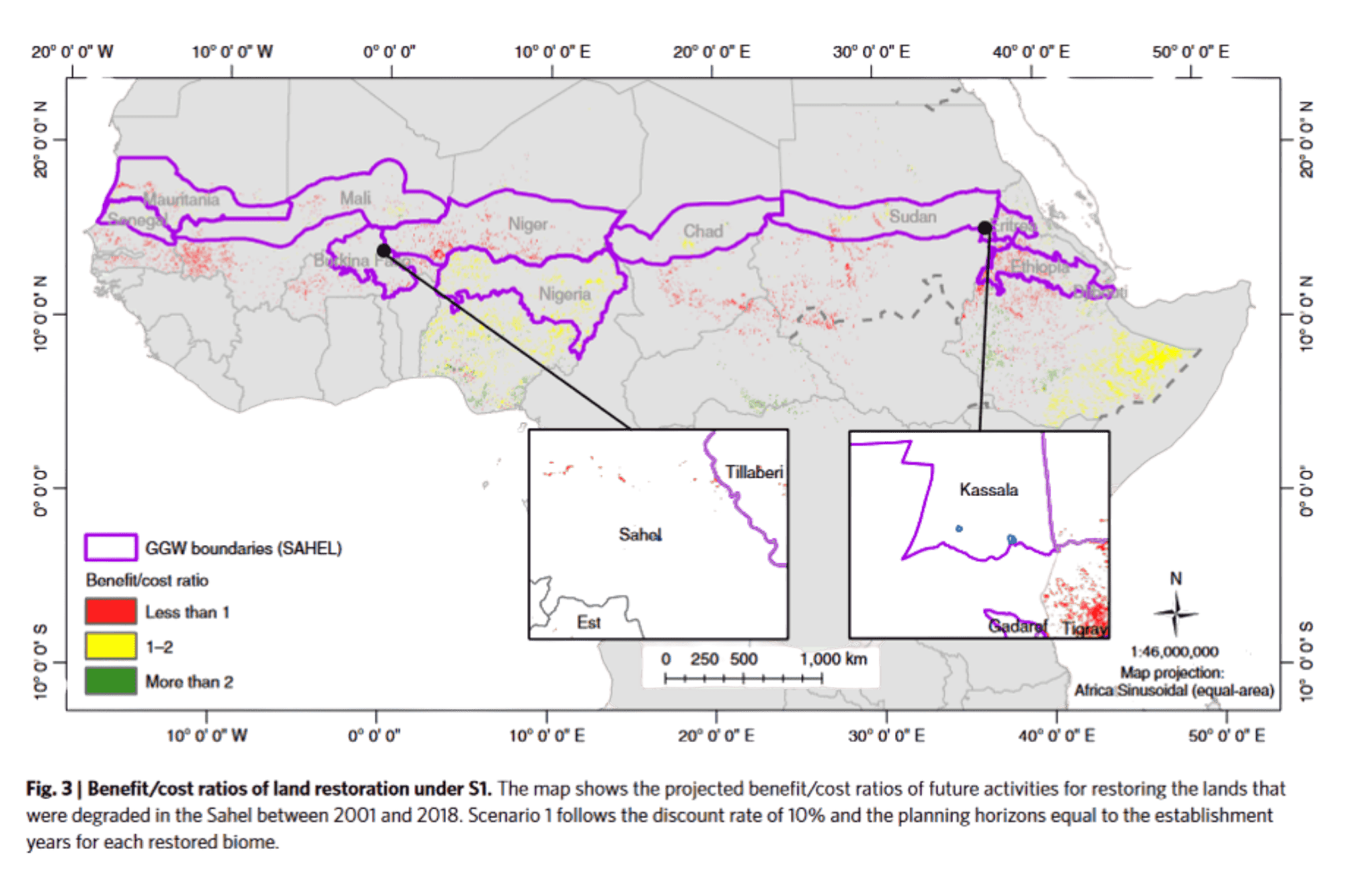
Reading note: The map presents the projected benefit/cost ratios of future degraded land restoration activities in the Sahel between 2001 and 2018. Scenario 1 is based on a 10% discount rate and a planning horizon corresponding to the year of establishment of each restored biome.
Source: Mirzabaev et al., 2022.
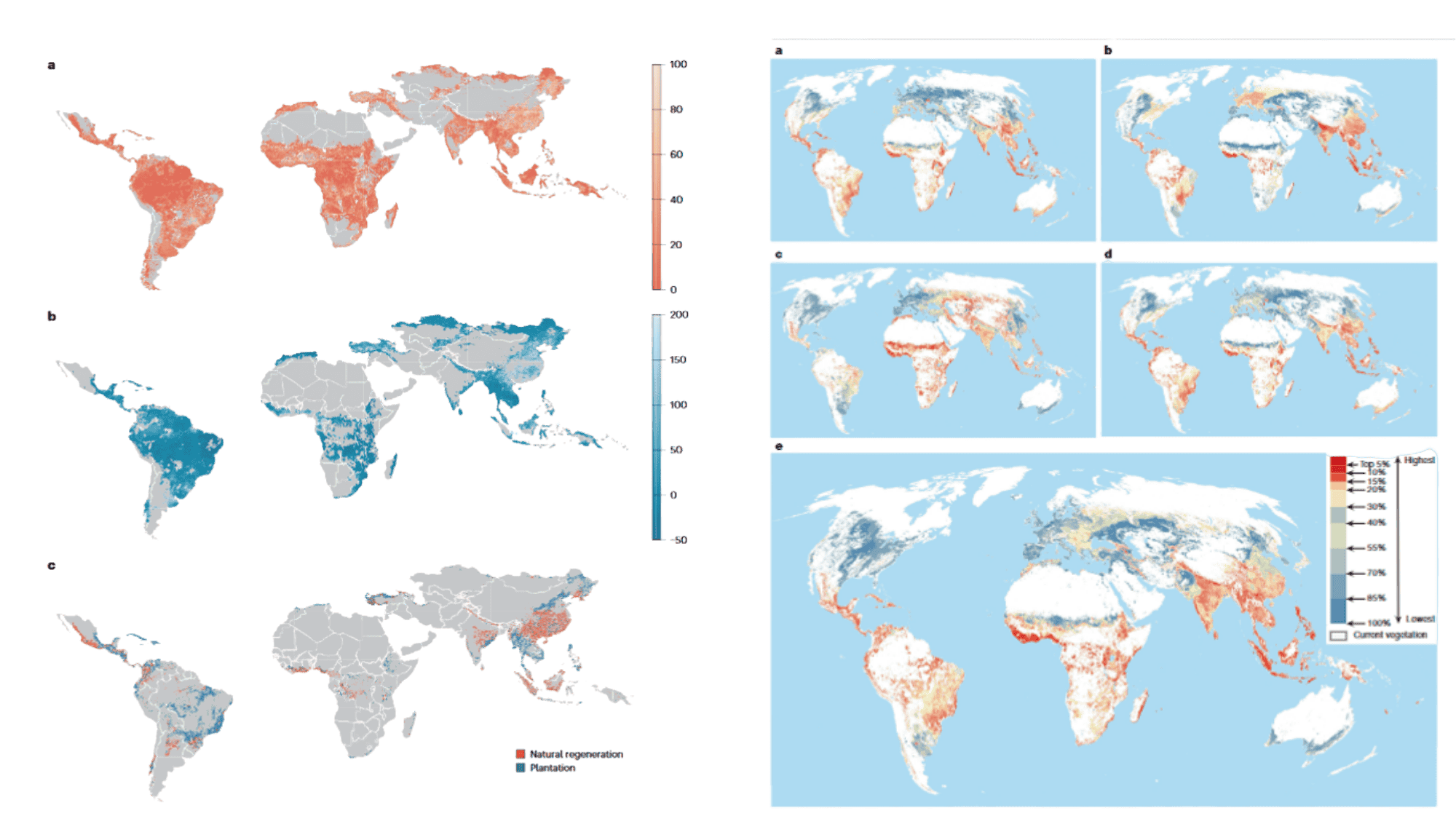
Source: Figure 2 a: Busch et al., 2024; Figure 2 b: Strassburg et al 2020.
Efficiency in Ecological Restoration: What World is protected?
The results of the spatialized cost-benefit and cost-effectiveness analyses systematically prioritize restoration and conservation policies in the so-called southern countries when conducted on a global scale (Figure 2), or in the poorest areas when applied at larger scales (Figure 1). Four factors mechanically produce these results.
First, accounting costs, the actual expenses incurred, are substantially lower in so-called developing countries than in developed countries (Bayraktarov, 2016). This is primarily due to the gap in labour costs, which constitute a major cost component of biodiversity projects (Giger et al., 2018; Su et al., 2021). In essence, these accounting costs are nothing more than the production costs of one unit of ecological restoration, with a significant wage gap between nations.
Second, opportunity costs mechanically follow economic value creation. They reflect the economic loss associated with implementing an ecological action (Box 1) and therefore increase with the profitability of the foregone activity. In other words, in the case of spatial prioritisation for ecological restoration, differences in opportunity cost reflect differences in income across land uses, and across land productivity when it comes to agricultural land (McAfee, 2012). At regional or global scales, estimated economic gains from land and labour are higher in countries considered more developed, resulting in proportionally higher opportunity costs. The notion of opportunity cost helps illustrate the fact that nature protection requires foregoing certain economic activities; however, the validity of comparing these costs across different geographical areas raises additional questions.
Third, when economists interpret ecological restoration as increasing nature’s contribution to people or ecosystem services (Box 1), the greater the local dependence on these services, the higher the estimated socio-economic benefits of restoration[5]. However, assessed dependence on ecosystem services is, on average, higher in areas considered less developed[6] (Whitehorn et al., 2019). This reflects limited infrastructure, the immediate role played by ecosystems in guaranteeing the conditions for survival, and the main types of employment – particularly agricultural or forestry – in these regions[7].
Finally, potential ecological gains tend to be higher, or at least more predictable, in ecosystems that are less degraded or integrated into ecological corridors critical for ecosystem functioning and resilience[8]. Yet, such ecosystems are mainly located in areas considered to be less economically developed. The approximation of ecological restoration by an ecosystem change (Box 1) and its valuation through spatialized ecosystem services or carbon storage capacity structurally favour restoration in forested areas. In contrast, agricultural or urban areas, although generating pressures, entail higher costs for more uncertain ecological gains.
In other words, as it stands, cost-effective nature restoration is defined as the inverse of economic value creation, in particular through the lens of opportunity cost. Mechanistically, it is less costly and more effective to safeguard areas that have not already been degraded and altered by human activity by maintaining or intensifying the use of already economically productive areas. This also reflects the difficulty that economics researchers face in grasping the reality of integrated and multifunctional land use.
The recommendations derived from these spatialized analyses are in line with those of the conservationist approach to biodiversity – also known as the half-earth (Kok, 2022) or spared land (Kremen, 2015), “separate lands” – in the promotion of the strict separation of land uses[9]. Cost minimisation leads to prioritisation of the intensification of productive areas and the conservation of areas currently used for small-scale agriculture (McAfee, 2012). These results have been translated into policy recommendations in some economists’ publications (Bateman & Balmford, 2023). This alleged economically efficient distribution reproduces, or rather is constructed as a mirror of, the spatial organisation of value-added production. Its own logic reinforces financial accumulation and ratifies existing economic inequalities between regions or nations. Implementation and opportunity costs are derived from market prices of land, labour, and commodities—particularly export commodities—and, even before considering restoration protocol effectiveness, these costs reflect disparities in purchasing power, wages, and living standards.
Implementing this efficient or optimal distribution encourages a reward by economically richer areas via compensation markets, guarantees, or payments for ecosystem services. The logic of separating productive and conserved spaces, when implemented, tends to make the “remaining” natural areas dependent on the payment of Rent against development (Karsenty, 2004). Carbon or biodiversity can then be considered as commodities, virtually exported[10] to compensate for – i.e. to enable and maintain – a production process in industrialised regions[11]. The lower production costs of a restored unit of biodiversity give rise to a form of ecological surplus value captured in low-wage countries. In the case of an offset market, it is transferred through international exchange to more industrialised countries. More broadly, preventing further destruction of biotopes leads to freezing the status quo, that is, a hierarchical structure of economic development in exchange for guarantees, allowing us to make the analogy with the rationality of non-proliferation[12]. This model of global distribution of ecological action raises questions, as Guillaume Blanc (2020) puts it, “what world is protected?” by these recommendations.
The Hidden Economic Drivers of Biodiversity decline
The under-representation of factors driving biodiversity loss – such as pollution, fragmentation of natural habitats, overexploitation, or invasive species – in spatial prioritisation analyses is an obstacle to their ability to inform ecological policy. Economic interests implicated in biodiversity loss are only marginally reflected by the cost estimates, and not at all by the environmental indicators used by these analyses (Spangenberg, 2007). Opportunity cost – defined by the cessation of an economic activity on a given plot (Box 1) – is insufficient to account for the transformative changes required to halt the loss of biodiversity, for two reasons detailed in this section: (1) the concentration of analyses and data at a highly local scale, and (2) the lack of connection between the need for ecological restoration and broader production systems.
The calculation of opportunity costs is micro-economic, conveying the idea that degradation occurs “at the plot” level and results from a trade-off between exploitation and protection of the land according to the perceived benefit (Giger et al., 2018). Spatialized analyses, by treating[13] each pixel virtually independently – describing it by ecosystem type, management practices, a predefined associated cost (Box 1) – cannot provide a systematic or transformative view. The resulting map layers cannot take into account the structure of the agricultural system, its resilience, and its ability to meet domestic needs and/or export demands. What are the structures of jobs? What dietary changes are expected? Will a reduction in subsistence agriculture lead to inflationary pressures? Opportunity costs are a static indication, detached from development trajectory, national priorities, or the socio-economic vulnerabilities of the regions under consideration.
However, several studies have demonstrated the complexity of the socio-economic drivers of land use (Lambin et al., 2001; Lambin & Meyfroidt, 2010)and biodiversity loss (Spangenberg, 2007). For instance, empirical analyses highlight the links between the ecosystems destruction and global value chains and exports[14] (Arto et al., 2022; Mittempergher et al., 2023; Hoang & Kanemoto, 2021; Moran & Kanemoto, 2017; Pendrill et al., 2019), and distinguish between “net exporters” or “net importers” of biodiversity – i.e. countries that degrade their natural environments primarily for the export of commodities, or those whose domestic demand is met by the exploitation of natural environments outside their borders (Lenzen et al., 2012). Specifically, the connection between the success of conservation programs and the modalities of integration into international trade has been studied, for instance, in Costa Rica (Jadin et al., 2016). In open economies with strong balance of payment constraints, international market trends shape the production of commodities – and, by extension, land use and biodiversity (Shandra et al., 2010; Althouse & Svartzman, 2022). Analogous to the low-carbon transition, halting nature loss requires a profound transformation of value chains, production and consumption models (Kok, 2022), and the political, economic, and financial institutions that structure them (Olk, 2024). The depth of these socio-economic and institutional transformations, along with the associated conflicts, cannot be reduced to a cost metric, even within an extended economic cost framework focused on well-being. This limitation echoes the conservationist assumptions that are underlying spatial prioritisation analyses – the separate earth or half earth mentioned earlier – which, in theory, do not require transformation of production systems[15].
Responsibility for Ecological Action: Ontological and Geopolitical Complexities
Coordinating international action for biodiversity on a global scale involves “supra-economic” considerations, including ontological and geopolitical ones. Economic analyses on the effective prioritization of conservation areas assume that these considerations are second-order. Effectiveness is an objective criterion that determines the best spatial distribution, which is then adjusted and revised due to political compromises. We argue that an alternative articulation of economic reasoning with a normative and ethical framework for the protection of living species is necessary to guide decision-making in these complex governance contexts.
The very definition of costs and gains is contingent upon the socio-economic context. Their estimation requires a detailed understanding of the relationships between societies and their environment, followed by an integrated, dynamic and multi-scalar reflection on the future of spaces. When more closely embedded in context (Olivier de Sardan, 2021), at the crossroads between institutionalist analysis and the development of planning tools, at the scale of circumscribed territories, cost-effectiveness analyses can be tools to support decision-making (Claron et al., 2022). However, a techno-economic determination of costs and gains deprived of political, social and institutional content and abstracted from context cannot inform ecological action, even less at the international level.
The global distribution of ecological action and the trade-offs it entails engages the diverse ways of inhabiting the Earth, the plurality of relationships between human societies and their territories, and the interactions among these modes of existence, far beyond questions of economic and ecological efficiency. Implementing, making happen, effective biodiversity preservation on a global scale requires consideration of the plurality of ways of life, social organisation and relations with the living world (IPBES, 2019). “The Earth cannot be reduced to a single global oikos” (Ferdinand, 2022), and thus its management cannot be confined to a single oikonomia, a single regime of rules, or a single conception of efficiency. Once again, this example highlights the challenge for economic knowledge to address the plurality of contexts[16] (Alves & Dutt, 2024).
The distribution of responsibility for ecological action among states or political entities is a geopolitical issue. Nature protection is closely linked to land use planning, an attribute of political sovereignty[17] that is overlooked by concerns for globalized ecological-economic efficiency. The geopolitics of nature protection involves questions that are intrinsically economic, such as distributional issues related to access to development, prosperity and natural resources (Charbonnier, 2024). In practical terms, foregoing a form of economic development to establish ecological conservation or restoration within a territory can result in immediate and future losses of independence and bargaining power in international trade. In a fragmented international order, relying on the willingness of Western powers to pay for environmental protection seems precarious. This geographical distribution of responsibility for ecological action exemplifies what Amartya Sen describes as “an ethical problem with mechanical aspects and involving economic relations” (Sen, 2012, p. 83).
At the same time, these questions suggest another role for economics, in support of defining multilateral governance frameworks. Given the scale and complexity of the systemic transformations required, the absence of simple causality, other positions, tools, and methods must be explored. Economics can contribute to this international agenda—but only if it moves beyond optimizing a global ecological budget to inform the distributive dimensions of ecological policies[18] (Myrdal, 1973). From a stewardship perspective, economics is then assigned a technical role, exploring the knowledge and know-how related to the allocation of resources and the production of economic goods (Sarr, 2016).
International Economics for Sustainability in a Plural and Fragmented World
Another economic research agenda to inform international action for biodiversity could be defined as follows: accept as a starting point the link between integration into global value chains, human needs, and nature loss. It would focus on mapping economic interests, conceive the geopolitical and geoeconomic consequences and tensions that rise from the transformations of production and consumption systems in order to anticipate them, and to propose instruments or regulations to cushion and distribute them[19]. In other words, economists can work on a different integration into the world economy of the different economic spaces, an integration that allows and engages ecological action adapted to their context, their socio-ecosystems, and the socio-economic vulnerabilities they face. This research agenda is based on the observation of the close link between economic dependencies and the conditions of ecological action: the bargaining power in international trade is a prerequisite, necessary, although not sufficient, for the ability to take care of one’s own soil and territory.
As an example of existing work that can be connected to this research agenda, a strand of literature seeks to inform a sustainable integration into the world economy by examining the transformation of the international financial architecture so as to enhance green investment (Gallagher et al., 2023; 2024), mitigate macro-financial vulnerabilities associated with the green transition (Althouse et al., 2025) and improve solvency conditions (Volz et al., 2020; Zucker-Marques et al., 2025). Other strands of work focus on interdependencies and value chains through multi-region input-output analyses (Oppon et al., 2018), or even multi-scale and multi-region (Bachmann et al., 2015) to provide a more systemic mapping of ecological-economic relations. From a more normative perspective, this agenda also resonates with the literature on the economics of global reparations (Sylla et al., 2024).
This research agenda does not primarily depend on making the dynamics of non-human life visible or integrating them directly, as is generally proposed in efforts to ontological recast economics in response to biodiversity loss. Rather, its horizon remains oriented toward the classic objects of economic inquiry—namely, the distribution of value and access to development—while integrating the constraints imposed by natural resource use and environmental impacts, rather than towards the establishment of a bioeconomic science (Jean & Mouysset, 2022). It is therefore not a matter of inverting the ethical and economic order by asking economics, as a discipline, to interpret the needs of non-human entities, even if the underlying ethical frameworks acknowledge them. This does not imply, however, that the epistemological transformations required to rearticulate the production of economic knowledge within an ecological, ethical, and normative framework are any less ambitious.
| Box 1: Measuring the Economic Effectiveness of Ecosystem Restoration The calculation of a differentiated economic efficiency of ecosystem restoration across geographical areas follows three steps: (1) the measurement of the costs of restoration, (2) the definition of efficiency criteria and the estimation of benefits, and (3) the net present value of restoration. This box details these steps, without claiming to exhaustively cover the methods present in the literature. In the case of the spatialized analyses we focus on, each pixel is generally associated with a type of ecosystem that these steps successively allow to characterize it by a cost, an ecological potential and/or a benefit. Step 1: Estimating Restoration Costs Depending on the studies, restoration costs can include some or all of the following costs: acquisition, establishment, maintenance, transaction costs and opportunity costs (Iftekhar et al., 2017; Mirzabaev & Wuepper, 2023). These costs cover both accounting and economic or socio-economic costs. The accounting cost corresponds to the actual expenses incurred (wages, equipment, etc.). The economic cost includes accounting costs but adds opportunity costs and implicit costs, up to and including the loss of welfare. The economic cost reflects a forward-looking vision aimed at optimal management. The scope of the relevant costs reflects different realities and varies across publications. Accounting costs include acquisition, establishment and maintenance costs. Acquisition costs are the expenses incurred to acquire land for conservation or restoration. Establishment costs are those required to implement ecological restoration practices and technologies (site preparation, seeding, or planting). Maintenance costs refer to the recurring expenses incurred afterwards to maintain these plantations. Between accounting costs and economic costs, there are transaction costs, which, depending on the theoretical approach, may or may not be accounted for (Coggan et al., 2010; Falconer & Saunders, 2002; McCann, 2013; Gonon et al., 2025). In accounting terms, transaction costs include expenses associated with identifying suitable sites for restoration, planning, negotiation, and program organization. In economic terms, following the work of Ronald Coase, transaction costs refer to the risks inherent in the transaction, hindering or slowing down exchanges on a market. Opportunity costs are the loss of economic benefits from the previous use of the restored land. For example, if a reforestation program is implemented on agricultural land, the foregone farm income should be accounted for as opportunity costs in the economic analysis. In some cases, opportunity costs can account for up to 87% of total costs in these analyses (Strassburg et al., 2020). The costs considered for ecological restoration vary across publications. Some analyses include only opportunity costs (Jakovac et al., 2020), while others exclude them (Bayraktarov et al., 2016). Some vary the costs according to ecosystems or biomes (Mirzabaev et al., 2022), others depending on the restoration method (passive regeneration, planting) regardless of the biome or ecosystem concerned (Brancalion et al., 2016). The costs associated with work, salaried employment or equivalent, are a significant part of the costs of establishment and maintenance, as highlighted in several meta-analyses (Su et al., 2021; van Kooten et al., 2004). The spatialization of these costs requires the construction of cartographic layers from data on productivity and ecological characteristics. For instance, Strassburg et al. (2020) (Figure 2) mention in the appendices of their study, “We used each net present value [farm profit] to convert the maps of each crop’s current productivity in each grid cell, from the quantity produced per area to the value of production per area. […] We added the resulting maps to get the opportunity cost layer for agriculture.[20]“. Step 2: Defining and Quantifying Benefits or Effectiveness The benefits and costs of degradation[21] are estimated by the sum of the changes in the Total Economic Value (VET), which represents the sum of the ecosystem services taken into account in the analysis, over a time interval such as |


Acknowledgements
The author thanks Felwine Sarr and the Global Africa team, Pierre Charbonnier, Hugo Mosneron Dupin, Harold Levrel, Yann Kervinio, and Antoine Godin for their comments. The manuscript is the responsibility of the author.