Introduction
The fight against corruption is promoted by all governments in developing countries as a priority economic policy objective. For African countries, this commitment sometimes conditions the support and financial backing of development partners. However, despite the efforts made, the level of corruption remains very high and heterogeneous in African countries. The World Bank’s governance indicators indicate that corruption control is still at low levels, averaging -0.670 in 2020 on the continent.
Corrupt practices are universally perceived as negative (Gorsira et al., 2020). They are seen as a factor inhibiting domestic and foreign investment (Beekman et al., 2014; Brada et al., 2019; Méon & Sekkat, 2005), depressing economic growth (Aidt et al., 2008; Méon & Sekkat, 2005), aggravating inequality and poverty, and reducing trust in the state (Apergis et al., 2010; Çera et al., 2019; Glaeser & Saks, 2006). They discourage taxpayers from paying their taxes (Osipov et al., 2018) and have negative effects on social welfare and public services, as they lead to budget cuts and disrupt equitable access to public services (Mazzanti et al., 2020). In extreme cases, corruption can lead to the non-recognition of state legitimacy, causing political and economic instability (Grayson, 2020).
The modernization of public administration and services resulting from the integration of information and communication technologies is essential (Mansel, 2012) and should become an ongoing concern for African governments. Digitalization is an engine (Russell, 2020) that contributes significantly to the modernization of societies and the transformation of state institutions (Bennett & Segerberg, 2012). Since the late 1990s e-government development has been considered as a potential tool for increasing transparency and citizen’s engagement in the provision of public sector services (Jaeger & Bertot, 2010); decreasing opportunistic behaviour in public sector service delivery (Saxena, 2005) and inducing managerial innovations (Aldieri et al., 2020; Panori et al., 2021). Today, digitalization is perceived as an essential factor to perform good governance. E-government presents one of the utmost opportunities and challenges for development and offers solutions to tackle corruption.
Number of studies have quantified the effect of e-government on corruption (Androniceanu et al., 2022; Garcia-Murillo, 2013; Kleven et al., 2011; Li et al., 2021; Mistry & Jalal, 2012; Neupane et al., 2014; Ndung’u, 2017; Ouedraogo & Sy, 2020; Sadik-Zada et al., 2022; Thammaiah & Syal, 2019) and indicates the significant positive role of the level of digitalization as an anti-corruption measure. The literature also identified several ways in which digitalization can promote government effectiveness and anti-corruption policies. First, it facilitates internal and external collaboration between different segments of administration (Islam et al., 2016). For example, the transmission and treatment of documents and reports can be performed instantaneously, whereas in a non-digitalized context, it will require a longer transmission time with risks of loss. Second, digitalizing offers a higher storage capacity for documents and archives, allowing more effective facility of action insofar as the storage remains centralized (Fichman et al., 2014). Third, digitalization allows the administration to improve and facilitate its interaction and engagement with individuals and companies while modernizing, thereby promoting transparency, democracy, and freedom of action (Falk et al., 2017). Santiso, (2022) identify that the digitalization of public administration has five main integrity benefits for anti-corruption: 1) it allows for greater access to information and open government data, and thus increases actionable transparency; 2) it reduces discretion and limits in-person interactions in government transactions and services by unscrupulous public officials, limiting opportunities for rend-seeking and bribe solicitation; 3) it also reduces transaction costs for service users, which increases voluntarily compliance by citizens and companies; 4) it expands competition in government contracting, which drives down costs and reduces collusion; and 5) it increases trust in institutions and governments’ capacity to deliver, by facilitating access to public services and making them more efficient, simpler, and reliable.
Conversely, another strand of the literature thinks that digitalization can also create new opportunities for corruption. These opportunities are mostly related to cybercrime or simply through the misuse of well-intended technologies such as digital public services. Digital records and public service systems can be manipulated by corrupt officials with high Information Technologies skills. Digital systems are also vulnerable to cyberattacks, which can disrupt government functions and jeopardize citizens’ digitally stored private information, particularly in countries with limited administrative capacity and underfunded security systems (Monitor, 2018). Saxena (2017) argues that because of the persistence of inferior institutional quality within bureaucracies e-government is not capable to fix the problem of corruption in the delivery of public sector service delivery. According to Ponti et al. (2021), e-government, as a practice of social innovation in public administration, might easily experience difficulties and even failures. Digitalization and transparency in public governance are not linearly interconnected, rather coherent policies lead to increased transparency boosted by e-government or digitalization practices. Erkut (2020) discussed the ‘knowledge problem’ in e-government where governments may abuse big data that new ICTs generate out from the public. E-government development reflects a double-edged sword. On one hand, developing and transition countries must develop their e-government systems to increase the quality of the public services delivery. On the other hand, big data abuses and other implementation challenges may hinder advances in transparency. This implies that the impact of digitalization on corruption is unclear.
Although a few studies have found evidence of the tradeoff between the digitalization of public administration and corruption, these studies face certain limitations, including the measurement of digitalization, the lack of long and timely data, small sample size and appropriate econometric strategy among others. This paper aims to fill these gaps and contributes to building stronger empirical evidence to support emerging findings on the positive role of the level of digitalization as an anti-corruption measure, in the broader context of the global digital transition. First, we use an original measure, in particular Online Service Index from the United Nations, as our key measure of the digitalization of public sector. It measures the capability and willingness of governments to digitalize public sector service delivery. Second, we conduct our study on a panel of 51 African countries over the period 2003-2020. Previous studies that have addressed the effect of the digitalization of public administration on corruption have been generally carried out on country case of studies and over very limited periods. We conduct this study in a large sample of African countries over a longer period, with a recent data allowing us to capture the dynamics and changes over time. Third, empirically, to considering the dynamics of corruption overtime, we use a System Generalized Method of Moment (SGMM) to estimate the effect of the digitalization of public administration on corruption. Furthermore, we extend the analysis by conducting the transmission channels analysis.
The results indicate that the digitalization of public administration improves corruption control in African countries. This effect is driven by education and citizen participation. Section 2 follows this introduction and is focused on the theoretical background. The data and methodology are described in section 3. Section 4 contains the empirical estimates, while section 5 presents the conclusion.
Theoretical Background
Conceptual Framework of Corruption
Defining corruption is not an easy task as it is a complex phenomenon with multiple economic, social, political and cultural dimensions (Gavurova et al., 2020; Yousif et al., 2020). For Verhulst (2002), corruption means conflict of interest and favoritism. Roy & Oliver (2009) define corrupt practices as acts or practices in which the power of the public service is abused for personal or private gain in a way that violates the rules of the game. Judge et al. (2011) define it as the abuse of public power for private gain and is likely to occur where the public and private sectors meet. Rose-Ackerman (2007) defines corruption in a similar way by focusing on the public official, but also highlighting the illegal payments that corrupt practices involve. Other studies such as Bahoo et al. (2020) have retained this broad definition of corruption focusing on the abuse of providing for private gain or advantage. Javorcik & Wei, (2009) point out that corrupt practices thrive due to information asymmetries and lack of transparency. For Androniceanu et al. (2022) corruption is a phenomenon that appears and develops in societies and public administrations where digitalization is low, bureaucracy is high, institutional transparency is low and internal and external communication is problematic. Adam and Fazekas (2020) note that the impact of corruption can be reduced by promoting transparency and citizen participation facilitation through ICT tools.
Conceptual Framework of the Digitalization of Public Administration
In the literature, there is a diversity of opinions regarding the concept of digitalization. According to Effah and Nuhu (2017) digitalization can be defined as the transition from a traditional management of procedures, bureaucracy, and paperwork to management via digital platforms. Irani et al. (2008) argued that digitalization represents an advanced level of e-government procedures, which allows governments to improve their effectiveness and efficiency. For Santiso, (2022) digitalization of public services consists of integrate government service portals, as well as critical enablers such as digital identity, data sharing, and digital payments. It also reset the relationship between states and citizens, contributing to placing citizens first and at the center of government, to deliver better, faster, and seamless services.
Gray-Hawkins and Lăzăroiu (2020) point out that, the digital transformation of the public sector has implications in all branches of society, from employment to education, health and social security. It facilitates e-government, manifests itself as part of the relationship between the state and society (Androniceanu et al., 2020) and increases the political participation of citizens as well as the rationalization of the administrative apparatus (Ionescu, 2020). An increase in the number of available digital public services means lower costs for administrations, less bureaucracy for businesses and citizens, and less corruption. Digitization of public administration facilitates the interaction between public administration and citizens and reduces corruption. Thus, by digitizing public services, citizens and businesses no longer come into direct contact with government officials, eliminating the context of corruption and reducing the risk of corruption (Androniceanu et al., 2022).
Theoretical Framework
This subsection provides insights of the theoretical underpinnings on the nexus between digitalization of public administration and corruption control. There are two fundamental theories that articulate the underlying nexus, namely: the agency theory and the institutional change theory.
Based on agency theory, the effect of ICT on corrupt practices can be analyzed from two perspectives: the demand side “citizen-to-government” (or transparency up) and the supply side “government-to-citizen” (or transparency down) (Adam & Fazekas, 2018; Kossow & Dykes, 2018). On the demand side, a high level of digitalization reduces corrupt practices by making it easier to monitor public officials, as greater digitalization allows citizens to inform or complain about corrupt practices face-to-face between public officials and citizens through the intermediation and recording of all transactions in digital datasets (Charoensukmongkol & Moqbel, 2014; Pathak et al., 2017; Shim, & Eom, 2008). On the supply side, the automation of the administrative process hinders the discretionary actions of public officials and makes all public initiatives more accessible and visible. As a result, through digitalization, the two-way distribution of information is more efficient between citizens and government, making the level of digitalization a valuable tool in the fight against corruption (Adam & Fazekas, 2018). In all cases, the country’s level of ICT development and the digital skills of citizens play a key role, as they are the necessary conditions for transparent transactions. Ouedraogo and Sy (2020) underline that, in an environment of imperfect information, high transaction costs, and discretionary rent-seeking tasks, digitalization can help reduce search costs, disseminate information in a cost-effective way and reduce the moral hazard problem from monitoring public sector agents.
According to institutional change theory, institutions are structures that form the basis of a society and affect the actions and behaviors of people, systems and organizations (Arregle et al., 2013; North, 1991). Institutions define the rules of the game between agents (North, 1990). Democracy is considered by Rodrik (2005) as a meta-institution whose functioning enables the realization of various other institutions. The values underlying the digitalization of public services are deeply rooted in democratic principles. The implications of e-government initiatives are related to issues of effectiveness and efficiency in the delivery of public services. With the use of ICT, the governance process can improve by providing tools for open communication and effective public discourse (Lee-Geiller & Lee, 2019). E-government is therefore a process of reinventing the public sector through digitalization and new information management technics, in order to increase the political participation of citizens and streamline the administrative apparatus (Ionescu, 2020). E-government manifests itself as part of the relationship between the state and society (Androniceanu et al., 2020). Increasing the number of available digital public services means lower costs for administrations, less bureaucracy for businesses and citizens, and less corruption. Thus, a well-developed digital environment can help reduce communication problems by providing a positive and transparent formal institutional context in which economic agents can feel protected. This transparency reduces information asymmetries and uncertainty, discretionary behavior is reduced and corrupt practices are less likely to occur.
Some Empirical Evidence
Previous empirical evidence on the links between the level of digitalization and corrupt practices is scarce and inconclusive, however, some results indicate the significant positive role of the level of digitalization as an anti-corruption measure (Adomako et al., 2021; Andersen, 2009; Kim et al., 2009).
Mistry and Jalal, (2012) studied the perception of corruption and confirmed that as the level of digitalization of public administration increases, the perception of corruption decreases. They found that the relationship was even stronger in developing countries. Authors such as Kleven et al. (2011) and Pomeranz (2015) have confirmed that modern electronic tax reporting systems reduce fraud and corrupt practices. Similarly, Krolikowski (2014) examined the use of mobile payment methods on corrupt practices and found the same effect. Romero-Martínez & García-Muiña (2021) found that a high level of digitalization reduces the possibility of corrupt practices in the hotel sector in Spain. Androniceanu et al. (2022) through a canonical correlation and principal component analysis showed that digitalization of the public sector significantly improved the quality of public administration and reduced corruption in EU member states. (Sadik-Zada et al., 2022) applied a random Tobit and Linear random effect panel on a sample of 121 countries to analyze the effect of E-government on petty corruption. They demonstrate that the adoption of electronic government in the delivery of public sector services has been the central factor that contributed to the reduction of petty corruption in developing and transition economies.
Thammaiah and Syal (2019) analyze the impact of the Bhoomi e-government project in the southern Indian state of Karnataka. They find that the implementation of this project lead to a dramatic reduction of bribery and efficiency gains. Li et al. (2021) study the effects of e-government on corruption in Chinese provinces between 2006 and 2015, and indicate that e-government has had a restraining effect on corruption in all provinces. Neupane et al. (2014) analyze the case study of Nepal and find also that, intention to adopt e-government in public procurement is an indication for the anti-corruption commitment of the government and can have substantial positive effects on the quality of public procurement.
Ndung’u (2017) found in Kenya that, the introduction of a digital platform, combined with the implementation of an integrity program, has enabled the tax authority to increase transparency in its operations and reduce opportunities for corruption. Ouedraogo and Sy (2020), using data from 23,000 individuals in 26 African countries from sixth Afrobarometer round and underscore that, the adoption of digital tools is associated with a lower perception of corruption in tax administration by around 3 percentage points.
Data and Methodology
Data
Our sample consists of 51 countries out of the 54 in Africa. The choice to restrict the sample to 51 countries is due to the lack of data in other countries. The different geographical areas of Africa are strongly represented in the sample.
For the endogenous variable, namely corruption, we use the corruption control index provided by the World Bank (World Governance Indicators) which varies between -2.5 (high corruption) and 2.5 (low corruption). The corruption control index captures the use of public power for personal gain, as well as the hijacking of the state by elites and private interests.
Our variable of interest, the digital transformation of public administration is proxy by the Online Service Index (OSI) provided by the United Nations e-Government Survey, which measures four stages of the online availability of national authorities. These are: (i) availability of informative websites and connectivity of these webpages; (ii) assessment, whether these websites provide an efficient platform for the interaction between government authorities and the citizens; (iii) availability of a wide range of public services online, as well as the availability of evaluation and feedback from citizens to service providing platforms and (iv) ability of government to be proactive within the Web 2.0 applications and level of the provision of the tailor-made e-services for the citizens (Lee, 2017). It varies between 0 (low digitalization of public services) and 1 (high digitalization). We prefer this indicator to others like e-Government Development Index (EDI) habitually used in literature (Mistry & Jalal, 2012; Wandaogo, 2022), because we believe that in terms of digitalization of public administration, the online public services are more effective anti-corruption tool. It reduces information’s asymmetric, and also face-to-face contact of citizens and business with public officials (Ndung’u, 2017; Santiso, 2022). OSI is one of the ways through which the digitalization of public administration can help to detect and to deter corruption by increasing actionable transparency.
For the control variables, we mobilize three categories of variables:
Historical and socio-cultural variables, notably legal systems and religious culture. Legal systems are dummy variables that take the value 1 for a particular system and 0 otherwise. We consider the British common law system and the French civil law system. With regard to religious culture, it captures by religion fragmentation constructed by Alesina et al., 2003. In the same category, we consider the ethnic fragmentation constructed by Alesina et al., 2003.
In the category of economic variables, we consider trade openness, measured by the sum of imports and exports relative to GDP; mining and oil rents obtained from the World Bank’s WDI database. These rents, which capture the influence of natural resources, are the difference between the value of resource production (mining and oil) at world prices and total production costs. GDP per capita in purchasing power parity, expressed in logarithm, is also obtained from the WDI database.
In the category of institutional variables, we consider the type of political regime (parliamentary or presidential) is captured by a dummy variable that takes the value 1 for particular regime and 0 otherwise. The index of political stability, provided by the World Bank through the Worldwide Governance Indicators.
We also include urbanization as a control variable. Which is measured by urban population provided by the World Bank.
Econometric Model
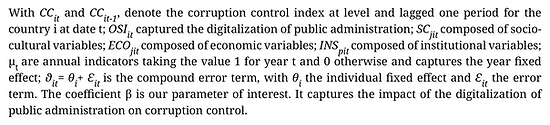
In order to empirically test the effects of the digitalization of public administration on corruption, we use a stepwise methodology. We assume that the digitalization of public administration increases corruption control or reduces corrupt practices. To reach this goal, we begin first by estimating the impact of the digitalization of public administration on corruption control by using Pooled Ordinary Least Square (Pooled-OLS) Driscoll-Kraay estimator, as shown in equation below:
(1)

We first perform OLS estimation because OLS is generally used as an initial analytical framework to give the general trend of the results. Because of the limitations of the Pooled-OLS, especially the sensibility of this method to endogeneity problem, and the persistence of corrupt practices in Africa region, we move to dynamic specification. By doing so, we apply the Systems Generalized Method of Moments (SGMM), proposed by Arellano and Bond (1991) and further developed by Arellano and Bover (1995) and Blundell & Bond (1998). There are several reasons motivating the choice of the GMM. This technique takes into account the heterogeneity of the countries and it also makes it possible to deal with the endogeneity problem of the endogenous variable when its lagged value is considered as an explanatory variable. The GMM system also allows to solve the endogeneity problem due to a possible bidirectional causality. By adopting the GMM approach, we free ourselves from estimation biases related to the omission of possible explanatory variables in our specification to produce robust results. Finally, this technique provides solutions to the problems of simultaneity bias that may arise from the choice of our variables.
The consistency of the GMM estimator depends on two things: the validity of the assumption that the error term does not exhibit serial correlation (AR (2)) and the validity of the instruments (Hansen test). Too many instruments can severely weaken and bias the Hansen over-identifying restrictions test, and therefore, the rule of thumb is that the number of instruments should be less than the number of countries (Roodman, 2009).
By doing so, we specify the following dynamic panel model:
(2)

Empirical Estimates
Baseline Results
The basic results are reported in table 1. In columns [1] and [2] we test de relationship between corruption control and the digitalization of public sector by using Driscoll-Kraay estimator to estimates for equation (1). We apply Driscoll-Kraay estimator, which estimates Pooled-OLS regression model with Driscoll and Kraay standard errors (Hoechle, 2007). The Driscoll & Kraay (1998) standard errors robust to general forms of heteroscedasticity and autocorrelation. The columns [1] and [2] report the estimate of (1). Column [1] first presents a bivariate regression between digitalization of public sector and corruption control, i.e. equation specifications without control variables. In columns [2] we add all control variable in the model. The findings of bivariate regression and the regression with control variables, show a positive effect of OSI on corruption control at the 1% threshold. Meaning that the digitalization of public sector increases corruption control in Africa.
As already mentioned above, estimating the equation using the Pooled-OLS method raises several problems, some of which are specific to dynamic models. The explanatory variables are not necessarily all exogenous even if this is assumed a priori, and causality between them and the explained variable could be twofold. Also, individual specific effects among others may be correlated with the explanatory variables. In order to circumvent these difficulties, we apply the Generalized Method of Moment (GMM) in estimating equation (2)
As it can be seen in In columns [3] and [4] table 1, the regressions satisfy the specification tests (AR1, AR2 and Hansen test). The number of instruments used is lower than the number of countries in the sample. Indeed, in order to limit the proliferation of instruments in the implementation of the GMM estimator, Roodman (2009) recommends specifying the model so that the number of instruments does not exceed the number of countries. Subsequently, Arellano and Bond’s (1991) autocorrelation test allows us to deduce the presence of autocorrelation of the residuals to order 1 and the absence of serial autocorrelation to order 2. Finally, the regressions pass the Hansen’s test and confirm the validity of the instruments.
The finding of the bivariate regression in column [3] confirms the positive effect of OSI on corruption control index at 1% level. This result is confirmed in columns [4] when all control variables are added in the model. That is, the increasing of online service in public administration decreases de corruption practices in Africa at 1% level. In terms of magnitude, 1% increasing in OSI is associated with 0.66% gain in corruption control. Thus, digitalization of the public services reduces the opportunities of rent-seeking by self-interested officials through the automation of task; it increases transparency and consequently reduces information asymmetries and uncertainty, discretionary behavior is reduced as well as in-person interactions and corrupt practices or opportunities of bribery are less likely to occur. This result confirms that obtain by Ouedraogo and Sy (2020) who demonstrated that, by bringing transparency and reducing the opportunities for bribes and influence, digitalization can improve trust in government officials in Africa, which is a key element in the citizens’ perceived level of corruption.
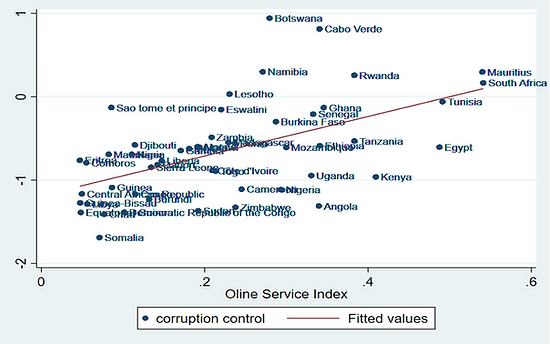
Fig. 1: Correlation between Corruption Control and the Digitalization of Public Administration
Source: Authors
Table 1: Baseline Estimation and Sensibility Analysis, Pooled-OLS and SGMM Estimates
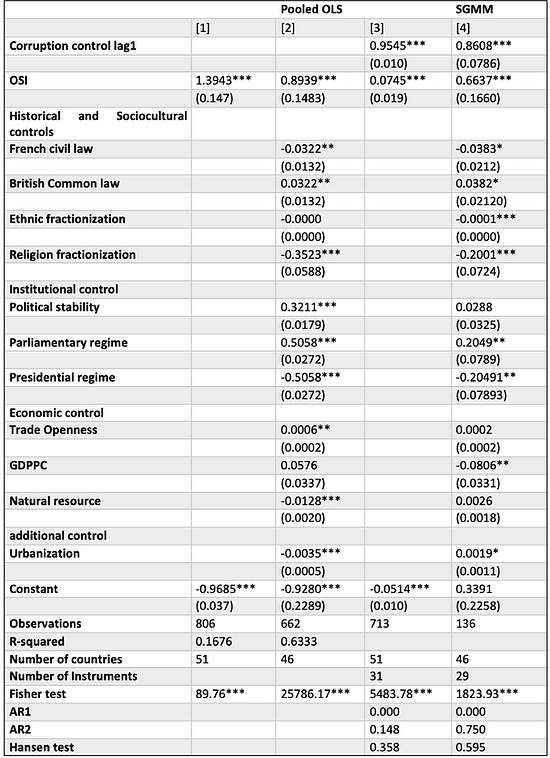
Note: *** p<0.01; **p<0.05; *p<0.1; The AR (1) and AR (2) confirm the use of the endogenous variable lagged by one period only. The Hansen test is a test of instrument validity in our system GMM analysis.
For de control variables, we find that, socio-cultural variables are all significant. French legal origin, ethnic fractionization and religion fractionization have a negative impact on corruption control. However English legal origin has a positive impact. According to institutional variables, political stability has a positive and significant effect at 1% on corruption control when we estimate the model by the pooled OLS method. Once we eliminate the endogeneity problems, the coefficient of political stability remains positive but not significant. African countries that have adopted a parliamentary system of government manage to keep corruption under control. Indeed, the coefficient associated with this variable is positive depending on whether the model is estimated by the Pooled OLS method or by the GMM method. However, countries with the presidential regime are more likely to have a high level of corruption. The sensitivity of the coefficient on presidential system is negative and significant at the 5 percent threshold, indicating that corruption control is low under presidential regime. Economic variables have mitigated impacts. GDP per capital affect negatively corruption control at 5 percent threshold, trade openness and natural resource are positive and negative respectively, but become no significant when we eliminated endogeneity problem (column [4] table 1). According to the urbanization, it has a positive and significant impact on corruption control.
Robustness Checks
This section carries out some robustness checks for the results.
Alternative Measures of Corruption
Our indicator of corruption has thus far been measured by the corruption index given by the Worldwide Government Indicator (WGI). The special feature of this index is that, it aggregates all the different types of corruption including grand and petty corruption. However, to be ensure that our results are not driven by the way corruption is measured, we consider the index of corruption given by the International Country Risk Guide (ICRG). This index is an assessment of corruption within the political system. It adapted to proxy the grand corruption in the level of government. It scaled from 0 to 1. Higher values indicate lower corrupt practices. We also use the corruption perception index (CPI) of Transparency International, it scaled from 100 (very clean) to 0 (highly corrupt) and, allow to proxy the petty corruption in the delivery of public sector service (Sadik-Zada et al., 2022).
It is immediately clear from the results reported in table 2 that the coefficient of Online Service Index is significant at the 1% and 10% depending on whether it is estimated by the Pooled OLS method or the SGMM, and carry the positive sign. Meaning that, digitalized public sector leads to decreasing corruption in the political system in Africa. Table 3 report the results when we proxy corruption using CPI. As show by the coefficient associated OSI, we still detected a positive and significant effect of digitalization on corruption control in delivery public sector services. Furthermore, the digitalization of public administration has a greatest impact on reduction of petty corruption expressed in CPI than corruption in political system expressed in ICRG corruption index.
Alternative Measures of the Digitalization of Public Administration
We now ponder over the alternative measures of digitalization of public administration. First, we consider the E-Government Development Index. It presents the state of E-Government Development of the United Nations Member States. Along with an assessment of the website development patterns in a country, the E-Government Development Index incorporates the access characteristics, such as the infrastructure and educational levels, to reflect how a country is using information technologies to promote access and inclusion of its people. The EDI is a composite of three different indices: (1) the Web Measure Index, (2) the Telecommunication Infrastructure Index and (3) the Human Capital Index. The Web Measure Index represents the generic aptitude of governments to employ e-government as a tool to inform, interact, transact and network. The Telecommunication Infrastructure Index defines a country’s ICT infrastructure capacity. Finally, the Human Capital Index relies on the United Nations Development Program (UNDP) education index, measuring the level of development of the human capital within a country.
We also consider the E-participation Index (EPI) from United Nation e-Government Survey. It focuses on the use of online services to facilitate the provision of information by governments to citizens (e-information Sharing), interaction with stakeholders (e-Consultation), and participation in decision-making processes (e-Decision-making).
At the end, we use government ICT usage from Global Information Technology Report (GITR) of World Economic Forum (WEF). It assesses the leadership and success of the government in developing and implementing strategies for ICT development, as well as in using ICTs, as measured by the availability and quality of online government services.
The result displayed in table 4 suggest that E-participation (columns [1] and [2]) and E-government (columns [3] and [4]) increases corruption control at 5% and 1% level respectively. It confirms our previous results. However, Government ICT usage negatively affect the corruption control index at 5% threshold (columns [5] and [6]). Although the magnitude of the tradeoff is slow, this result can be interesting. Suggesting that, in environment of higher risk of corruption such as African countries administrations, digitalization of public services can be also a high corruption risk area, especially for so-called petty bureaucratic corruption in key processes in which citizens and business interact with public officials.
Controlling for Other Effects
The digitalization of public administration could potentially improve corruption control through enhancing of citizen participation and education. Table 5 includes, citizen participation (column [1]) proxy by the ability of people to exercise their political rights and freedoms, indicates the integration of public opinion into public policy making. It is captured by the Freedom House database’s political right index. It also includes education (Column [2]) captured by school enrollment in secondary because we believe that being in secondary school implies being able to read and write. This indicator is given by the World Development Indicators. While the inclusion of citizen participation and education do not alter our baseline findings. It is interesting to observe that the coefficient of digitalization of public administration falls when citizen participation and education are included. Suggesting that the digitalization of the public administration may improve the fight against corrupt practices via enhancing citizen participation and education.
Table 2: The Digitalization of Public Administration and Corruption, Alternative Measures of Corruption Control, ICRG Corruption Index
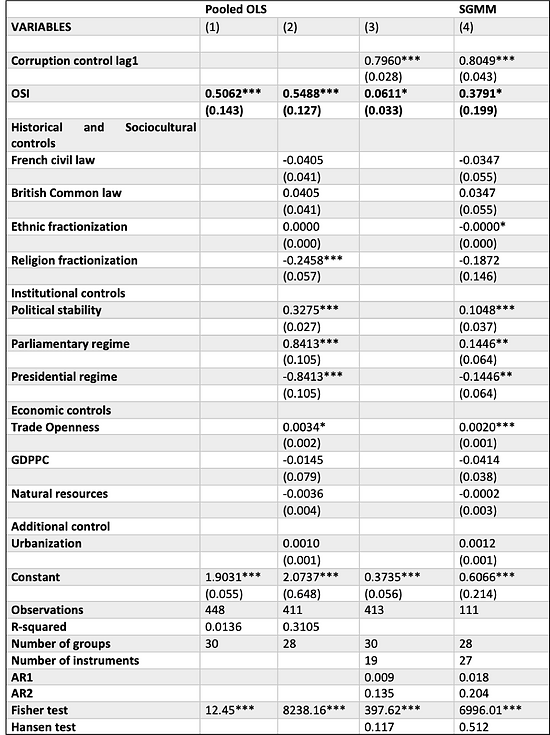
Note: *** p<0.01; **p<0.05; *p<0.1; The AR (1) and AR (2) confirm the use of the endogenous variable lagged by one period only. The Hansen test is a test of instrument validity in our system GMM analysis.
Table 3: The Digitalization of Public Administration and Corruption, Alternative Measures of Corruption Control, Corruption Perception Index of Transparency International
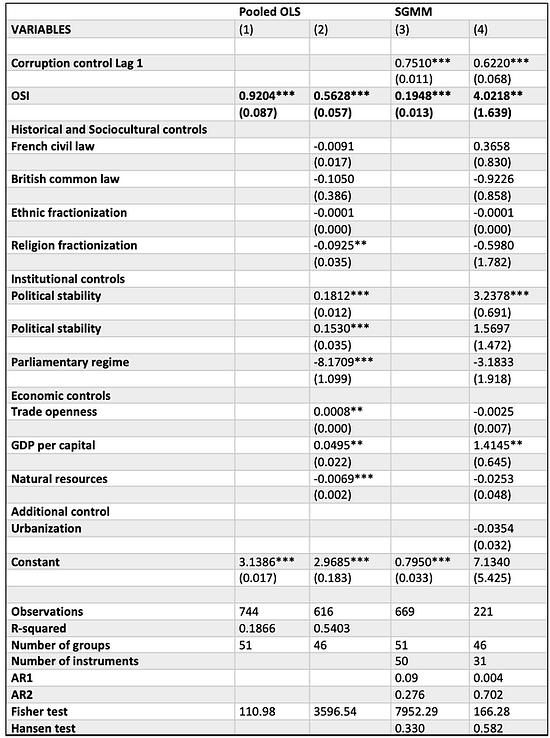
Note: *** p<0.01; **p<0.05; *p<0.1; The AR (1) and AR (2) confirm the use of the endogenous variable lagged by one period only. The Hansen test is a test of instrument validity in our system GMM analysis
Table 4: Alternative Measures of Digitalization of Public Administration, SGMM Estimates
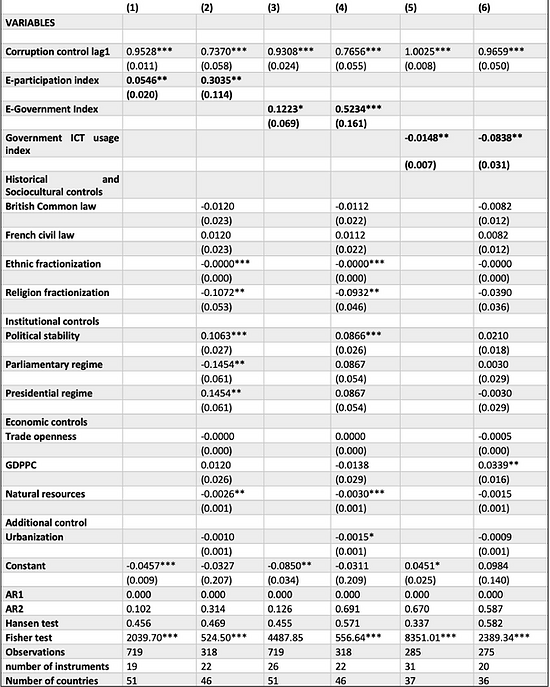
Note: *** p<0.01; **p<0.05; *p<0.1; The AR (1) and AR (2) confirm the use of the endogenous variable lagged by one period only. The Hansen test is a test of instrument validity in our system GMM analysis.
Table 5: Controlling of Citizen Participation and Education
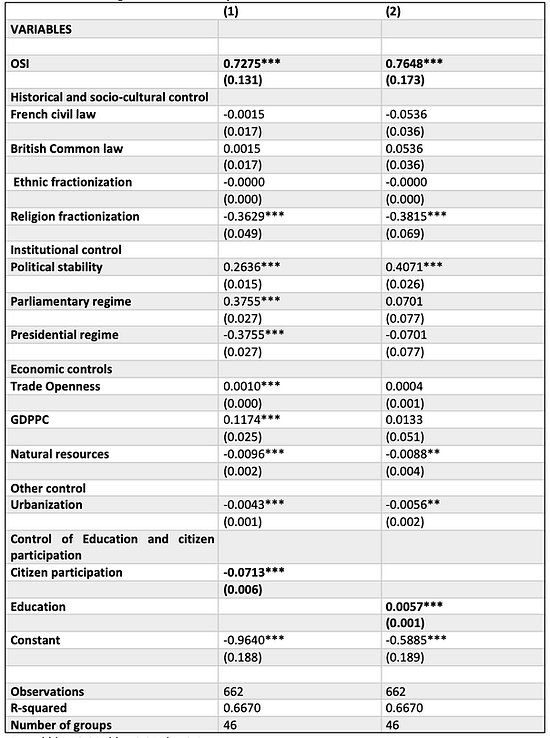
Note: *** p<0.01; **p<0.05; *p<0.1
Mediation Analysis of the Digitalization of Public Administration on Corruption
This subsection performs a more thorough investigation on the mediating effect of education and citizen participation on corruption control. The approach considered here involves estimation of two regression equations, as illustrated in Fig. 2 inspired from Ang (2013).
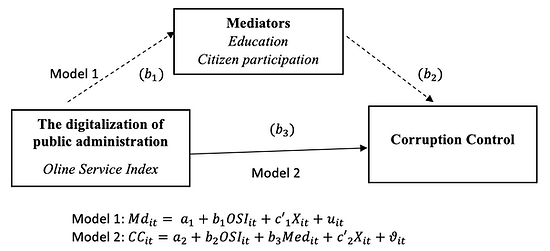
Fig. 2: Modeling the Mediation Effect
Where Mdit represents mediation variables (education and citizen participation).
First, the parameter (b1) describing the effects of digitalization of public administration (OSI) on the mediator (Md). Next, the direct effect is estimated by regressing corruption control (CC) on digitalization of public administration (OSI) while controlling for the mediator (Model 2). The coefficient of OSI provides the magnitude of this effect (b2). The indirect effect is given by the product of b1 and b3, where b3 measures the strength of the correlation between CC and Md in Model 2. This term also reflects the size of the mediation, which essentially depends upon the extent to which OSI influences the mediator (b1) and the extent to which the mediator affects CC (b3).
The estimation results for regressing these models are reported in Table 6. Globally, the results show that: i) OSI affects the two mediators, and the effects are statistically significant at the 1% level (columns [1a] and [2a]). ii) all three mediators have a significant separate effect on corruption control (columns [1b] and [2b]). iii) the OSI affects corruption control in absence of the mediators (column [3] in table 6). iv) the estimates coefficient of the digitalization of public administration on corruption control decreases once the mediator is included in the model (columns [1b] and [2b]) relative to column [3]). Taken together, the results suggest that mediation may have occurred where some influences of the digitalization of public administration on corruption control are carried through by education and citizen participation.
Table 6: The Mediation Effect of Education and Citizen Participation
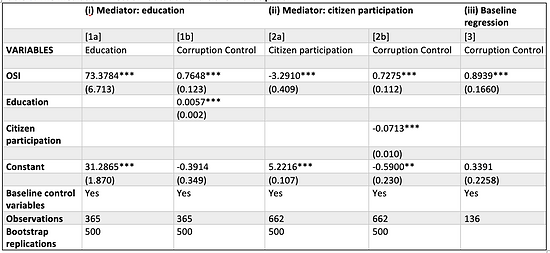
Note: robust standard errors are reported, ***, **, *; represent the statistical significance at the level of 1%, 5% and 10%, respectively
Table 7: Mediation Tests
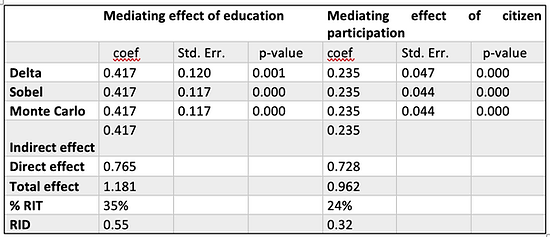
Note: RIT is the ratio of indirect effect/total effect; RID, the ratio of indirect effect/direct effect
In table 7, several mediation tests are considered to check whether the indirect effect of the digitalization of public administration on corruption through the influence of education and citizen participation are statistically different of zero. Considering the mediation effect education, the Sobel, Delta and Monte Carlo tests statistics are estimates to be of the same value, i.e., 0.417, and the p-value are less than 5%. Suggesting that the null hypothesis of no mediation is rejected. Concerning the citizen participation, the p-value of coefficient associated with Sobel, Delta and Monte Carlo statistics are all significant at 1% level, meaning that, the null hypothesis of no mediation is rejected.
It also pointed out that the usage of bootstrap confidence intervals does not alter the results. Indeed, the evidence presented implies that the mediation effect of education is material with about 35% of the total effect of online public services on corruption control. The table 7 also show evidences supporting the mediating effect of citizen participation (RIT equal to 24%). These results of transmission channel analysis confirm our previous analysis on the positive effect of E-participation and E-government to reduce opportunities of bribery. It also confirms the agency theory which stipulates that, the digital skills of citizens are the necessary conditions for transparent transactions.
Further Robustness Check
Since the previous results show a positive and significant effect of digitalization of public administration on corruption control, the irregular data distribution of our sample leads to adopting a novel and appropriate non-parametric estimation method, which could deal with the issue of abnormality in the data. In this sense, we use the Method of Moments Quantile Regression (MMQR) approach for analyses the heterogeneous relationship between digitalization of public administration and corruption. In the quantile, five quantiles of 0.10, 0.25, 0.50, 0.75 and 0.90 were chosen to estimate the coefficient of the dependent variables. The results are displayed in table 8. The OSI has a significant positive coefficient only for the two lowest quantiles and the median. Meaning that, for countries that start with a high level of corruption, digitalization of public administration is associated with a better control of corruption by reducing human interactions. The results also suggest that the effect of digital transformation of public sector is greatest in 10% of countries with the highest levels of corruption, such as Somalia, and tends to diminish in countries with low levels of corruption, such as Botswana.
Table 8: Results of Panel Quantile Regression with Fixed Effects (MMQR)
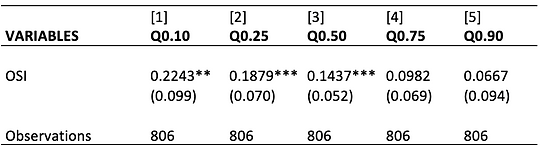
Note: ***, **, *; represent the statistical significance at the level of 1%, 5% and 10%, respectively
Conclusion
Using a panel of 51 African countries from 2003-2020, this work empirically examines the effect of digitization of public services on corruption. Through this study, we contribute to the economic literature of institutional change, highlighting digitization as a determinant of an effective institutional framework for public service in Africa. Preliminary linear results using the system GMM method showed that the digitization of public administration has a direct positive effect on the fight against corrupt practices in Africa. Finally, the analysis of transmission channels showed that, education and citizen participation are important channels through which the digitalization of public service impacts corruption control. By identifying these channels, our study allows for a specific treatment of corruption in Africa through digitalization. By accentuating relevant and recent findings, the results of this study can be used for a better conceptualization of national or regional development strategies based on the nexus between corruption and e-government advances in African countries. Investments in telecommunications to increase internet use and technological penetration, as well as in education, institutional practice of democracy, could enable African states to spur the fight against corruption.
Appendix
Table A1: Sample
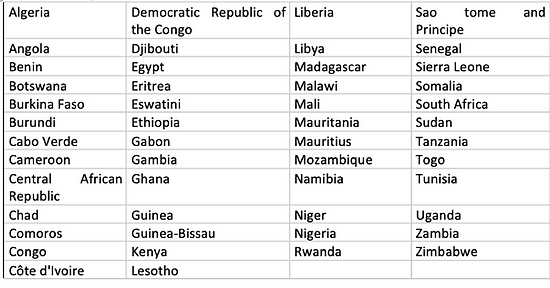
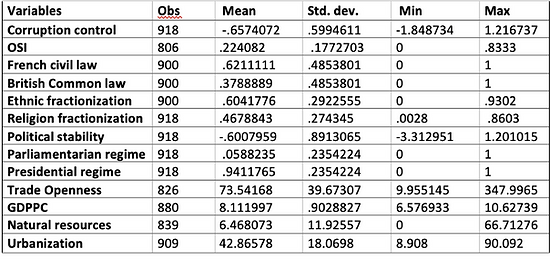
Table A2: Descriptive Statistic